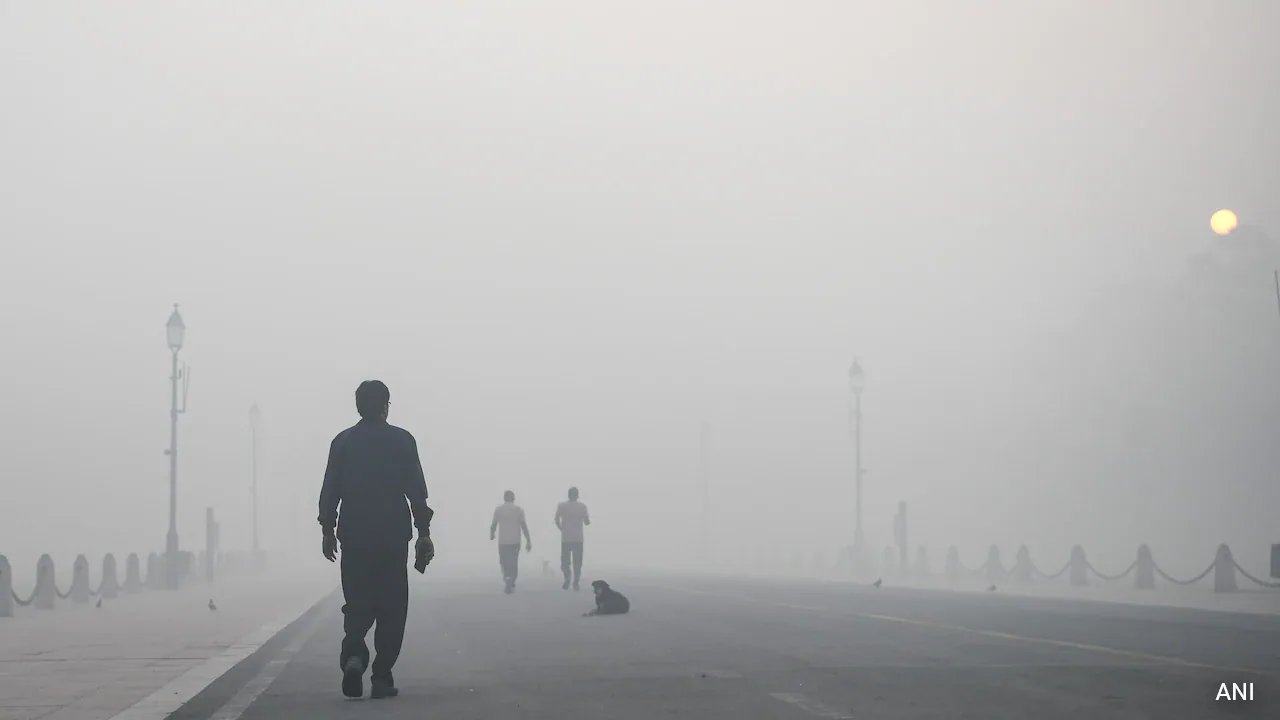
The skies will offer no salvation.
Delhi’s toxic smog will not wash away this week after the India Meteorological Department shut down expectations of cleansing rainfall across the northern plains. An incoming Western Disturbance will dump rain and snow across the high Himalayas, but it will skip the capital entirely. Instead, the weather system threatens to trap hazardous surface pollutants beneath an umbrella of useless cloud cover.
Police, hospitals, and millions of residents across the Indo-Gangetic belt have spent days tracking weather radars for a downpour. Air Quality Index readings continue to hover in the very poor and severe bands as stagnant winds and plunging temperatures lock particulate matter against the ground. Yet the atmosphere refuses to cooperate.
A moisture-laden Western Disturbance tracking from the Mediterranean Sea will sweep through north India over the coming days. It will unpack significant precipitation across Jammu and Kashmir, Himachal Pradesh, and Uttarakhand, alongside isolated showers in northern Punjab. The industrial flatlands further south will get nothing.
Delhi will see overcast skies on November 12 and 13. But moisture without rain only worsens the crisis.
Dr. Mrutyunjay Mohapatra, Director General of the IMD, confirmed that partial cloud cover stripped of actual precipitation risks aggravating the capital's hazardous air rather than clearing it.
Once the Western Disturbance approaches, there will be moisture. But rain is not likely. I am talking about Delhi and neighbouring areas.
Dr. Mrutyunjay Mohapatra, Director General, India Meteorological Department
Local authorities had bet heavily on synthetic intervention. The Delhi government and researchers from the Indian Institute of Technology Kanpur had drawn up emergency plans to deploy cloud-seeding aircraft to trigger artificial showers over the metropolis.
Nature just blocked the runway.
Successful cloud seeding demands dense, moisture-heavy convective clouds capable of vertical development. The incoming weather front offers only thin, non-convective high and medium cloud decks. Seeding them would yield negligible results, burning public resources for almost no rainfall.
Dr. Mohapatra warned that the atmospheric physics do not support the intervention. "It will be mainly medium and high clouds. It is not the convective cloud. Therefore, the yield will be less," he stated, delivering a decisive setback to city planners searching for a quick technical fix.
| Atmospheric Parameter | Forecast Condition (Nov 12–14) | Impact on Delhi Air Quality |
|---|---|---|
| Western Disturbance | Traverses Western Himalayas | Limited to rain/snow in J&K, HP, Uttarakhand |
| Plains Precipitation | Absent across Delhi-NCR | Zero scrubbing of surface PM2.5 and PM10 |
| Cloud Cover Type | Medium and high non-convective | Renders IIT Kanpur cloud-seeding unviable |
| Prevailing Surface Winds | Calm to extremely light | Traps toxic particulates close to surface |
With the northern front effectively neutralized, meteorologists are turning their focus thousands of kilometres away to the Bay of Bengal.
A deep depression is taking shape over the sea and could intensify into a cyclonic storm around November 15 or 16. Its trajectory remains split across international numerical models. One track curves west toward Andhra Pradesh. The second path steers northeast toward Bangladesh.
Delhi’s atmospheric fate hangs on that second trajectory. If the cyclone hooks toward Bangladesh and holds a northerly posture, it could pull strong north-westerly winds across northwest India and the Indo-Gangetic plain. Fast winds flush out trapped particulates. Calm air chokes them.
"It will not support the dispersal of pollutants," Dr. Mohapatra said of the current calm wind profiles gripping the capital.
All eyes now shift to the November 15 Bay of Bengal depression, the next official inflection point that could determine whether north India breathes or continues to suffocate through mid-November.
| Bay of Bengal System |
| Deep depression forming Nov 15–16 |
| Potential wind acceleration if tracking to Bangladesh |