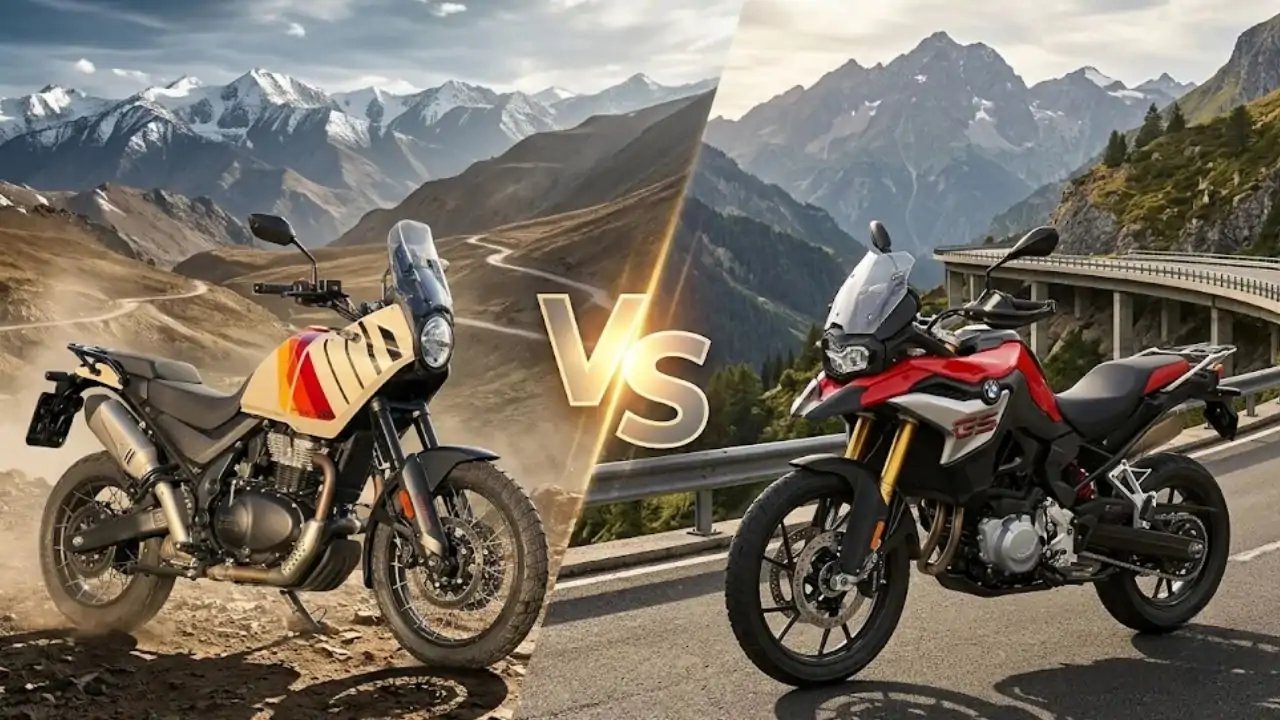
Long-distance riders face a clear dilemma. Do you haul the extra metal for effortless highway grunt, or do you choose agility on broken mountain trails? That question defines the upcoming middleweight adventure dogfight in India. Royal Enfield unveiled the Himalayan 750 at EICMA 2026, aiming directly at BMW Motorrad's F 450 GS. One relies on pure cubic capacity. The other banks on featherweight agility. And the gap between them is wider than the spec sheets suggest.
Take the engines. Royal Enfield slotted an air-and-oil-cooled 743cc parallel-twin into the Himalayan frame, pushing out 55hp at 7,000rpm and a burly 63Nm of torque at 5,000rpm through a six-speed transmission. BMW counterpunches with a high-revving 420cc liquid-cooled parallel-twin, generating 48hp at 8,750rpm and 43Nm at 6,750rpm. On open highways with hard luggage, the Indian twin will cruise effortlessly. But the scale tells another story. The Bavarian machine tips the scales at 178kg—shaving off 46kg against the Himalayan's 224kg bulk. That massive weight deficit gives BMW the upper hand in power-to-weight snap when scrambling up loose riverbeds.
| Specification | Royal Enfield Himalayan 750 | BMW F 450 GS |\n| :--- | :--- | :--- |\n| Engine Configuration | 743cc parallel-twin, air-oil-cooled | 420cc parallel-twin, liquid-cooled |\n| Power Output | 55hp @ 7,000rpm | 48hp @ 8,750rpm |\n| Peak Torque | 63Nm @ 5,000rpm | 43Nm @ 6,750rpm |\n| Kerb Weight | 224kg | 178kg |\n| Front Suspension | 43mm Showa USD (190mm travel) | 43mm USD (180mm travel) |\n| Rear Suspension | Showa monoshock (175mm travel) | Monoshock (180mm travel) |\n| Front Braking | Dual 280mm discs | Single 310mm disc |\n| Starting Price | Unannounced | ₹5.35 lakh (ex-showroom) |
Both brands picked a 19-inch front and 17-inch rear wheel setup, yet their chassis priorities split fast. Royal Enfield equips the Himalayan 750 with a fully adjustable 43mm Showa upside-down front fork delivering 190mm of travel, alongside a rear Showa monoshock with 175mm of travel. It stops via dual 280mm discs up front and a 255mm rear rotor. BMW relies on 43mm upside-down forks offering 180mm of travel at both ends, anchored by a single 310mm front disc and a 240mm rear disc. Royal Enfield gives riders cast alloys or factory tubeless spoke wheels. BMW fits cast alloys standard, reserving cross-spoke wheels as a factory add-on.
Yet the electronic balance runs close. The Himalayan 750 packs five riding modes, cruise control, a tyre pressure monitoring system, and lean-sensitive traction control alongside cornering ABS. Riders navigate via a circular 4-inch TFT display integrating Google Maps. BMW deploys a larger 6.5-inch TFT console with ABS Pro, Dynamic Traction Control, and engine brake control. For high-end buyers, the flagship GS Trophy trim introduces BMW's Easy Ride Clutch system.
BMW has already laid its cards on the table. The F 450 GS sells across four trims: Base at ₹5.35 lakh, Exclusive at ₹5.55 lakh, Sport at ₹5.90 lakh, and the top-tier GS Trophy at ₹6.15 lakh. Royal Enfield holds its cards close, with prices expected when the motorcycle officially launches at Motoverse 2026. If Royal Enfield undercuts BMW's ₹5.35 lakh benchmark, it will command the cross-country touring pack.