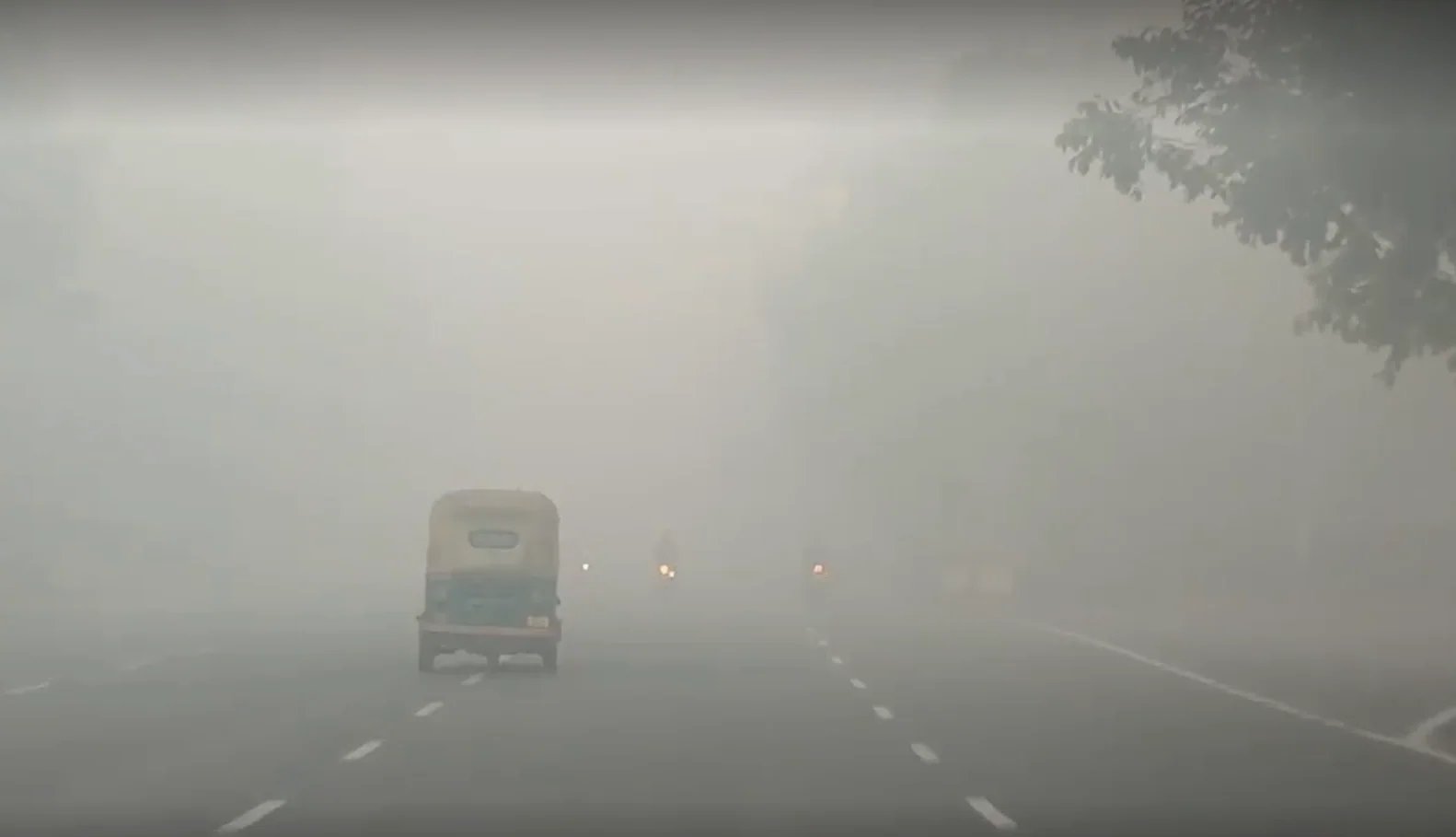
A suffocating blanket of toxic smog trapped Delhi the morning after Diwali, dragging the capital's average Air Quality Index down to 366 and plunging at least 15 monitoring stations beyond the critical 400 mark.
Varun and winter arrived together, but the air brought poison. Across the National Capital Region, streetlights blurred behind a yellow-grey soup that slashed road visibility and sent morning commuters scrambling for masks. At the Akshardham flyover, the iconic temple vanished behind the murk. In central Delhi's ITO intersection, the monitor clocked an AQI of 407. Drivers sat stalled in traffic with burning eyes and scratchy throats. The story was the same across the Yamuna border, where Noida registered an overall index of 338.
People felt it instantly in their chests. Shailesh, an amateur runner who relocated to Dehradun specifically to escape the capital's foul air, returned to Delhi only for the holiday. He set out for his routine five-kilometre run. He barely completed one before his lungs seized and forced him indoors. In Chanakyapuri, resident Ved Prakash watched smoke settle over the diplomatic quarter throughout the night, pointing out that annual outrage over firecrackers routinely masks twelve months of municipal inaction. In RK Puram, resident Ghazali Mohammad echoed that sentiment, noting that emergency finger-pointing solves nothing when filthy air persists through all four seasons.
Yet right when readings surged toward danger thresholds, the numbers disappeared. Real-time air quality feeds for RK Puram abruptly went dark on mobile platforms operated by the Central Pollution Control Board and the Delhi Pollution Control Committee. The sudden blackout ignited an immediate political fight. Opposition leaders targeted the Delhi government over alleged data suppression, while Bharatiya Janata Party leader Kapil Mishra hit back, pointing directly at farm fires in neighbouring Punjab. Mishra alleged a deliberate spike in farm stubble burning across Punjab over Diwali and demanded an immediate inquiry into the surge.
Official station monitors across the capital told an undeniable story of distress:
| Monitoring Station | Air Quality Index (AQI) | Category |
|---|---|---|
| Vivek Vihar | 445 | Severe |
| Jahangirpuri | 442 | Severe |
| Rohini | 438 | Severe |
| Delhi Technological University (DTU) | 430 | Severe |
| Bawana | 427 |
Relief remains nowhere in sight. The Air Quality Early Warning System warned that adverse meteorological patterns and stagnant winds will trap particulate matter close to the ground, guaranteeing severe conditions through the coming days. In response, the Commission for Air Quality Management triggered Stage 3 measures under the Graded Response Action Plan across Delhi-NCR, imposing immediate bans on non-essential construction and enforcing strict curbs on older, polluting transport fleets.
| Severe |
| Punjabi Bagh | 408 | Severe |
| Alipur | 395 | Very Poor |
| IIT Delhi | 363 | Very Poor |
| Ghaziabad | 371 | Very Poor |
| Noida | 338 | Very Poor |
| Faridabad | 323 | Very Poor |
| Gurugram | 309 | Very Poor |