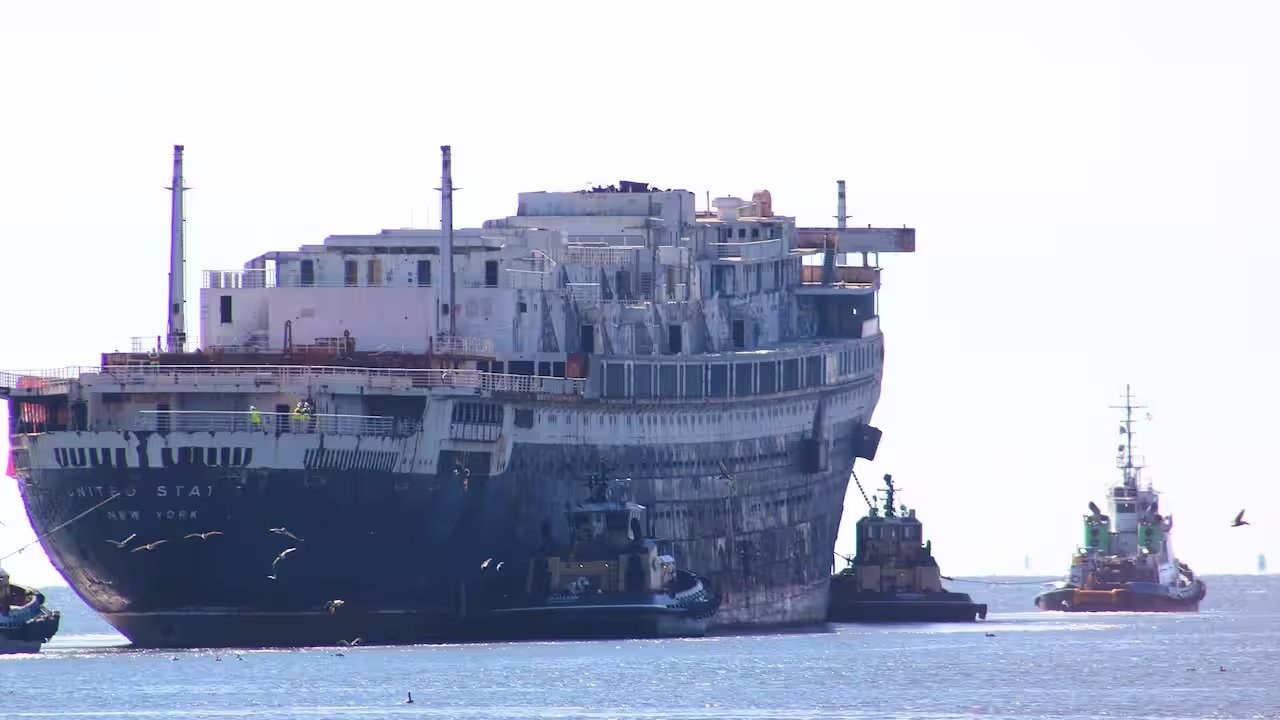
The world's fastest ocean liner is heading to the bottom of the Gulf of Mexico.
Bartering its storied ocean-crossing legacy for a permanent berth beneath the waves, the 990-foot SS United States will go down 22 nautical miles southwest of Destin-Fort Walton Beach on Wednesday, November 11. Okaloosa County officials moved the operation up by 24 hours after marine forecasters warned of worsening weather later in the week. The deployment begins at 1 p.m. Central Standard Time, deliberately timed to coincide with Veterans Day.
Safety dictated the accelerated timetable. Meteorologists charted calm waters for Wednesday, clocking winds between five and 10 knots and seas running at one foot or less. Thursday told a far different story. Wind speeds were projected to kick up to 20 knots, gusts threatened to top 25 knots, and choppy two-to-three-foot swells gathered farther west. County planners refused to gamble with a delicate marine operation involving hundreds of spectator boats.
She was built to outrun everything on the water. When the vessel embarked on its maiden voyage in 1952, the liner shattered the transatlantic speed record by crossing from New York to Europe in three days, 10 hours, and 40 minutes. More than seven decades later, that west-to-east blue-riband transit record remains unbroken.
The ship carried presidents, Hollywood royalty, and ordinary emigrants across the Atlantic. In 1963, its reinforced cargo holds even transported Leonardo da Vinci's Mona Lisa under round-the-clock armed guard. But the jet age crushed transatlantic passenger liners. After decades of commercial service, the ship retreated to Philadelphia's Delaware River waterfront, where it sat idle for 29 years as an imposing, rust-streaked fixture of the South Philadelphia skyline.
Federal authorities placed the liner on the National Register of Historic Places in 1999. Yet preservation funds dwindled. Okaloosa County stepped in to acquire the hull, formulating a multi-million-dollar plan to convert the engineering marvel into a sprawling marine habitat and recreational diving hub.
Preparing a 990-foot steel giant for the sea floor demanded brutal physical remediation. Tugboats pulled the ship out of Philadelphia last year, hauling it south to Mobile, Alabama, where specialized marine contractors began hazardous abatement in March 2025.
Crews spent 18 months scrubbing the hull. Workers stripped tons of peeling paint, drained internal machinery, and eliminated hazardous compounds to meet strict environmental standards before the hull could touch the ocean floor. To preserve the vessel's architectural memory, engineers sliced away and salvaged its iconic red, white, and blue funnels alongside key maritime artifacts. Those components will anchor land-based museum exhibits.
Early Monday morning, tugs towed the stripped hull out of Mobile, charting a direct course for its final coordination coordinates in the Gulf.
| Vessel & Operation Specification | Verified Detail |
|---|---|
| Vessel Length | 990 feet |
| Maiden Voyage Record | Transatlantic crossing in 3 days (1952) |
| Idle Waterfront Tenure | 29 years along Philadelphia's Delaware River |
| Remediation Period | March 2025 to late 2026 (Approx. 18 months in Mobile, AL) |
| Scuttling Location | 22 nautical miles southwest of Destin-Fort Walton Beach |
| Revised Sinking Date & Time | Wednesday, November 11, at 1:00 p.m. CST |
Federal maritime authorities are taking no chances with offshore spectator flotillas. The United States Coast Guard confirmed it will enforce an active one-nautical-mile safety exclusion zone around the scuttling coordinates. Any civilian or private charter vessels breaching the security perimeter without explicit authorization face immediate boarding, vessel seizure, and severe civil penalties.
Local planners cancelled a formal dockside send-off ceremony, redirecting the public to viewing gatherings at AJ's Seafood and Oyster Bar in Destin and launching an official digital livestream. Once the sea valves open and the ballast fills on Wednesday afternoon, the grand dame of American maritime engineering will slip beneath the surface, opening its final chapter on the ocean floor.
| Coast Guard Enforcement Perimeter | 1-nautical-mile safety exclusion zone |