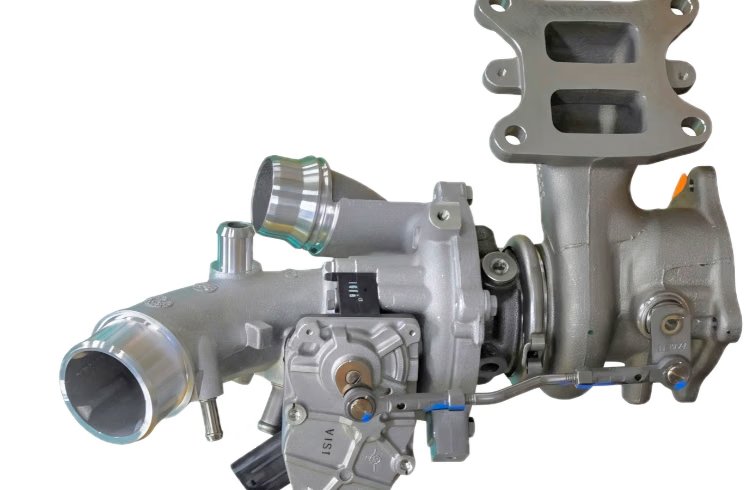
Downsizing is far from dead. Even as electrification dominates automotive boardrooms, carmakers are squeezing internal combustion engines to extract maximum thermal efficiency before tighter emissions standards bite. BorgWarner locked down three turbocharger contracts this week with an unnamed global powertrain manufacturer, securing supply rights across light-vehicle gasoline platforms in Europe and South America.
Commercial assembly starts in 2027. And the engineering targets the toughest challenge in modern small-displacement petrol engines: brutal exhaust heat under sustained boost. One contract covers BorgWarner’s variable turbine geometry (VTG) turbocharger, built to withstand searing exhaust gas temperatures up to 1,050°C. That thermal resilience allows carmakers to run aggressive Miller-cycle combustion setups without dumping raw fuel into the cylinders purely to cool down the exhaust manifold.
The remaining two contracts assign BorgWarner to supply its modular wastegate turbocharger portfolio. Here, adaptability takes center stage. BorgWarner will deliver scalable compressor and turbine stages across single-scroll, twin-scroll, and dual-volute housings, operated by either pneumatic lines or rapid electric actuators.
| Turbocharger Architecture | Core Hardware Configuration | Thermal & Operational Boundary | Primary Combustion Target |
|---|---|---|---|
| Variable Turbine Geometry (VTG) | Variable vane nozzle ring, high-boost housing | Exhaust gas tolerance up to 1,050°C | Miller-cycle gasoline thermodynamic efficiency |
| Wastegate Turbocharger | Single-scroll, twin-scroll, or dual-volute designs | Pneumatic or electric wastegate actuation | Low-RPM spool, reduced pumping losses |
For motorists, this hardware translates into everyday drivability gains. Turbo lag shrinks. Small petrol engines often stumble off idle while waiting for exhaust pressure to spool the turbine wheel, but movable internal vanes and electric wastegates force air into the cylinders at lower engine revolutions. That sharper transient response limits downshifts during overtakes while trimming tailpipe emissions under load.
"We value our longstanding relationship with this global leader in powertrain technology and the opportunity to support its evolving business and broader commodity strategy," said Dr. Volker Weng, Vice President of BorgWarner Inc. and President and General Manager of Turbos and Thermal Technologies. "These contracts reflect the trust we have established with the customer and the strength of our offerings, including competitive solutions and deep technical expertise."
Carmakers across South America and Europe must juggle regional fuel chemistries and strict fleet-emissions baselines. Securing forced-induction systems that adapt cleanly to Miller-cycle calibration gives automakers valuable runway as 2027 approaches.