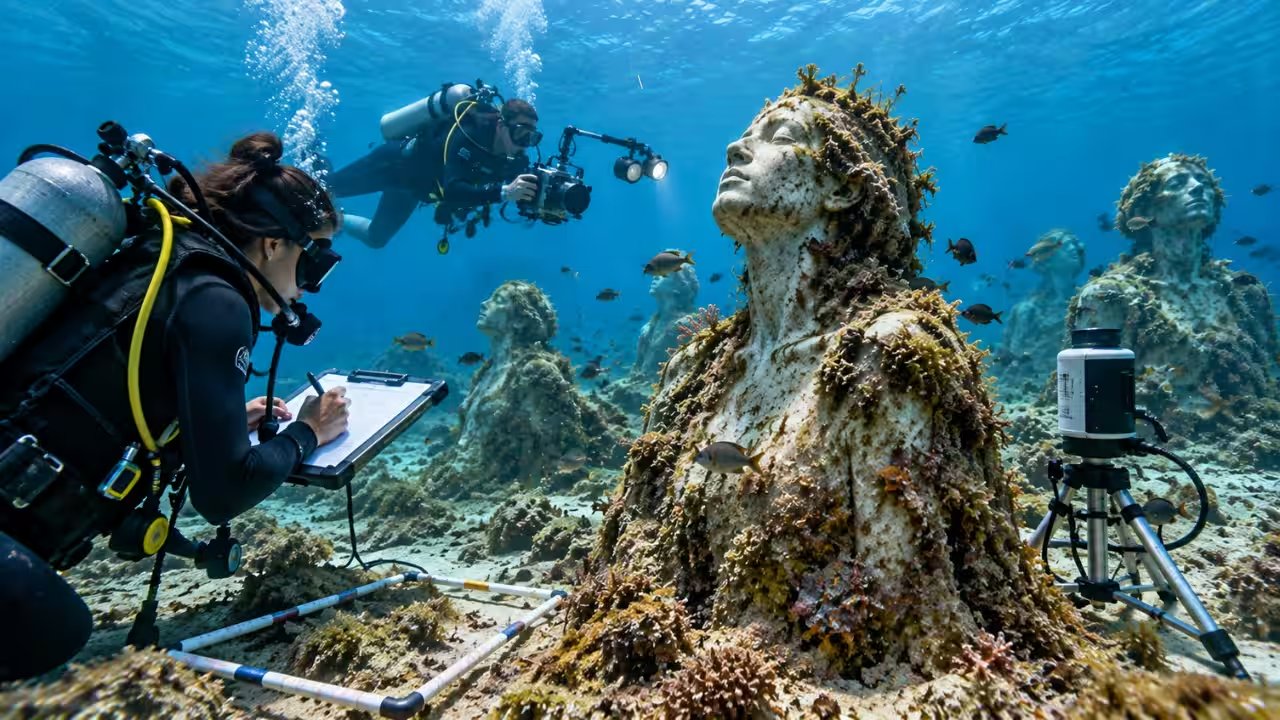
On 19 September 2024, Casa dei Pesci lowered five 12‑tonne marble blocks into the Baia del Cannone near Talamone, arranging them in two rows about seven metres apart at a depth of 5.5–6.5 metres on soft‑bottom habitat.
The University of Siena team launched a systematic survey on the same day, then on 4 March, 19 June, 7 August and 18 October 2025, laying three 20‑metre transects per visit and capturing five 50×50 cm photoquadrats along each line. Fish counts were taken within three metres of each transect, covering a 120‑square‑metre area; divers also inspected each sculpture for two minutes, noting taxa as presence‑only data.
Exposed surfaces of the sculptures recorded a surge from four taxa in March 2025 to fifteen in October 2025, including Padina pavonica, Balanus perforatus, Sertularella sp., Cratena peregrina and the nudibranch Cratena peregrina; undersides showed a slower turnover, dominated by Apogon imberbis and Holothuria poli. The community shift was most pronounced on sculpture S1, where species richness climbed from four to fifteen within the study period.
Local fishermen in Talamone reported spotting more fish near the sculptures, echoing the survey data and underscoring the project’s social resonance. The study, funded by the European Social Fund Plus under the Giovanisì programme, demonstrates that art‑based interventions can enhance habitat heterogeneity and biodiversity, prompting policymakers to consider scaling the initiative across the northern Tyrrhenian Sea.