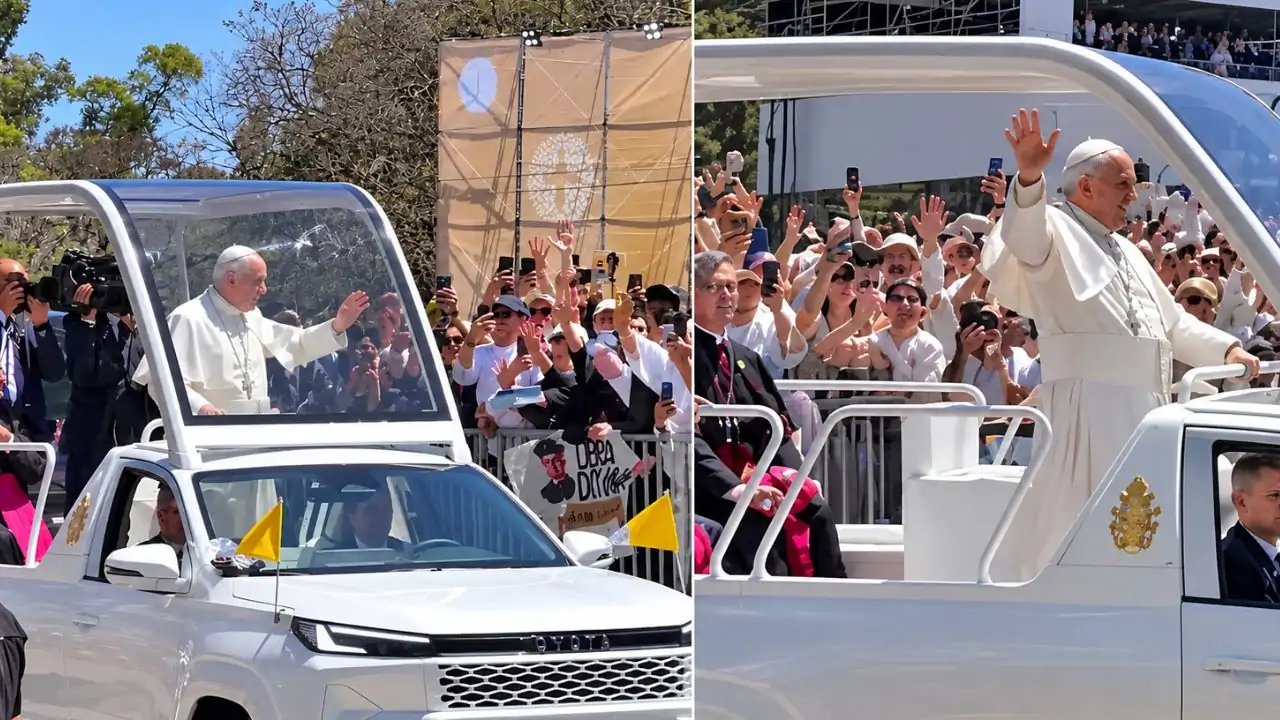
If you ever needed proof that a commercial workhorse can handle any task on earth, look at the rear deck of a white pickup in Buenos Aires. Pope Leo XIV chose a heavily altered Toyota Hilux for his recent apostolic tour across Argentina. He left his regular electric Mercedes-Benz G-Class parked back at the Vatican. In its place stood an open-air, high-clearance truck engineered to glide through packed crowds in Buenos Aires and Córdoba.
Toyota Argentina built two identical units to split duties across the tour's split itinerary. The commission carries direct weight for global ute enthusiasts and Indian buyers who already park the Hilux in their driveways. This build quietly showcases the styling direction of the ninth-generation Hilux—a model that debuted globally in November 2025 and currently sells across Europe, Australia, and South Africa. Local manufacturing will soon center on Toyota's Zárate plant outside Buenos Aires. Because the incoming generation shares identical structural hardpoints, door stampings, and cabin pillars with the outgoing eighth-generation truck, local coachbuilders were able to fuse fresh sheet metal over proven foundations without delay.
Ceremonial duty demands visibility, crowd access, and rigid ballistic separation. Cordoba-based coachbuilder Vallé Equipamientos took standard single-cab donor Hilux bodies and stripped away the conventional cargo bed to meet rigid Vatican technical briefs. The driver remains sealed in the standard front cabin. The Pontiff sits elevated out back.
A massive, illuminated polycarbonate dome arches over the rear deck, driving total vehicle height up to roughly 3.1 metres. Inside the bubble rests a single central throne wrapped in white eco-leather. Two fold-down jump seats sit tucked directly behind it for accompanying prelates and security escorts. Stepping into the deck requires minimal effort. Workers cut a broad pass-through straight into the tailgate and installed integrated heavy-duty boarding steps. Finished in brilliant white with body-colored cladding, the trucks run official Vatican City State registration plates, Vatican fender pennants, and Papal crests mounted along the flanks.
Luxury limousines float on adaptive air bladders. Pickups do not. Empty single-cab work trucks typically ride stiffly over broken tarmac, their leaf springs designed to compress only when carrying a metric ton of gravel. That jarring rebound had to disappear.
Yet the mechanical heart remained unaltered. The trucks keep Toyota's stock ladder-frame steel chassis and the standard turbodiesel engine. Engineers focused instead on secondary ride comfort. Technicians dismantled the rear suspension, re-valving the shock absorbers and recalibrating the multi-leaf spring packs to deliver stable, low-speed composure over urban cobblestones. Toyota pushed for the Hilux specifically because it remains the single most-produced motor vehicle in Argentina. The choice celebrated domestic assembly lines while giving the Vatican an unburstable mechanical platform.
| Popemobile Model | Base Platform | Powertrain | Coachbuilder | Core Modifications |
|---|---|---|---|---|
| Toyota Hilux | Argentine Single-Cab | Standard Turbodiesel | Vallé Equipamientos | 3.1m polycarbonate canopy, eco-leather throne, retuned leaf springs |
| Fiat Titano | Uruguayan Single-Cab | 2.2-litre Turbodiesel | Nordex | Clear dome, red carpet, jump seats, power-deploying rear stairs |
| Chevrolet S10 | Peruvian Dual-Cab |
Toyota was not the lone commercial brand drafted into regional papal service. The Vatican contracted distinct local platforms across the tour's neighboring international legs.
Crossing into Uruguay, the Pope rode in a customized Fiat Titano assembled by local manufacturer Nordex. Starting with a single-cab chassis, Nordex dropped a protective transparent dome over the bed, rolled out red interior carpeting, and installed polished handrails alongside an electrically folding rear staircase. Under the bonnet sat Fiat’s 2.2-litre turbodiesel unit. In Peru, the convoy shifted to an American nameplate. Coachbuilder Engesig took a Chevrolet S10 powered by a 2.8-litre turbodiesel and tackled a far trickier structural hurdle. Because the S10 is sold exclusively as a dual-cab in that market, Engesig chopped off the entire rear passenger compartment, welded structural gussets across the bare frame, and constructed an elevated security platform with a fixed transparent canopy.
As Toyota prepares to transition Indian assembly lines and global facilities to the ninth-generation Hilux architecture, the papal conversions offer a telling preview. The rugged underpinnings remain intact, but the adaptability of the platform continues to outpace conventional utility rivals.
| 2.8-litre Turbodiesel |
| Engesig |
| Cut cab, reinforced frame, elevated throne, security jump seats |