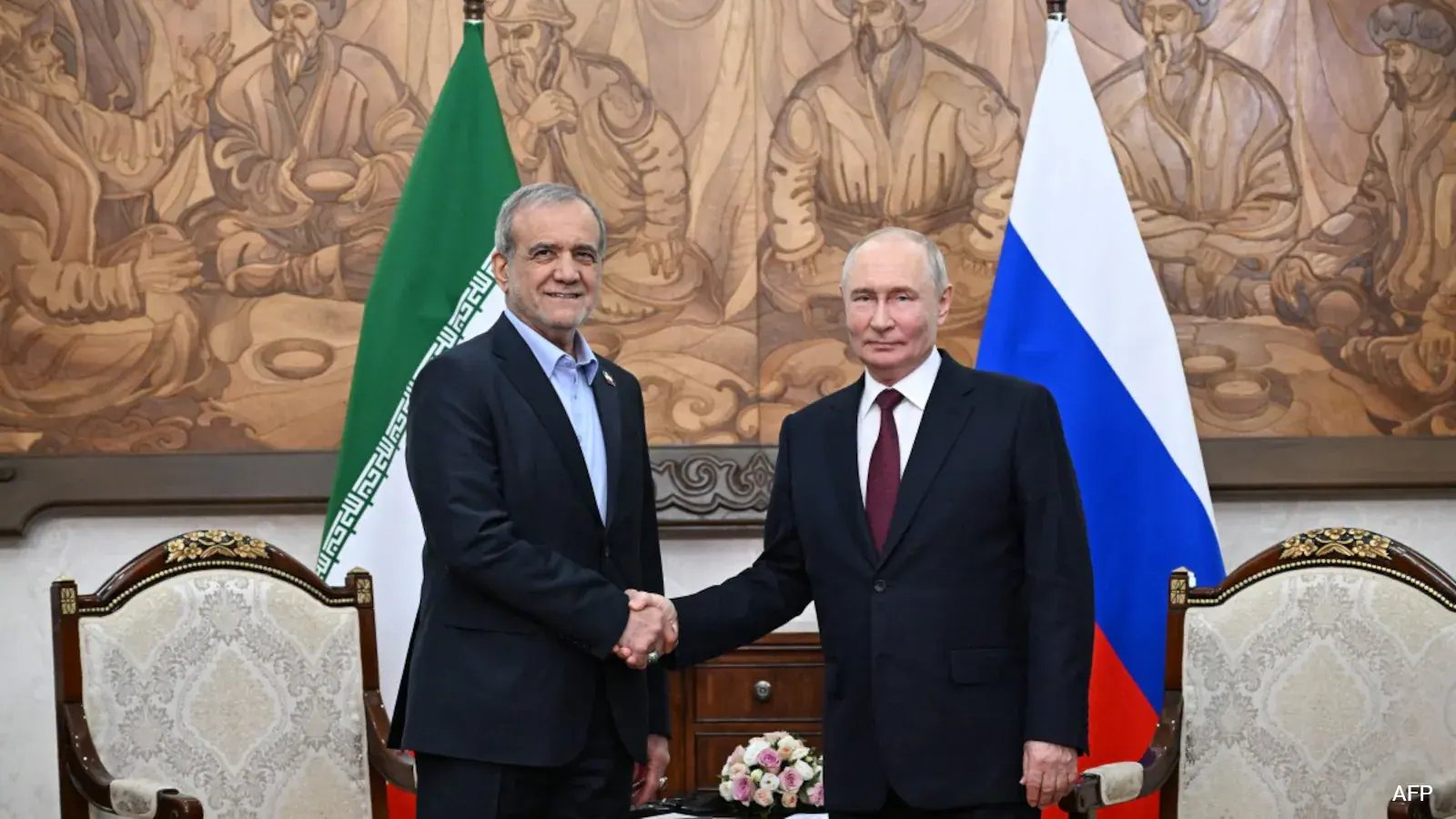
Vladimir Putin pledged full Russian support to end the Middle East conflict during a high-stakes meeting with Iranian President Masoud Pezeshkian on Thursday. The two leaders convened ahead of the Commonwealth of Independent States (CIS) summit in Avaza, a resort town on the Caspian Sea in Turkmenistan. Russian news agencies reported that Putin explicitly stated, "We are ready to do everything that is in our power to contribute to the settlement of this situation."
The diplomatic push coincides with a sharp deterioration in direct US-Iran relations. Pezeshkian declared this week that negotiations with Washington were "meaningless," signaling a breakdown in the ongoing diplomatic track. Putin acknowledged this friction, noting that Iran had made "real efforts to end the war" since the US-Israeli attacks began on February 28. The Russian leader also highlighted the "positive evolution" in bilateral ties, a relationship that has deepened significantly since Russia launched its offensive in Ukraine in February 2022.
The alliance between Moscow and Tehran has become inseparable, reinforced by mutual military reliance amidst global scrutiny. Ukraine and Western nations have accused Iran of supplying Russia with Shahed drones and short-range missiles for use in the ongoing military campaign. Conversely, Russia faces accusations of providing targeting data to Iran for its strikes on US interests in the Middle East. This exchange of intelligence and hardware underscores a strategic partnership that has grown increasingly opaque to Western observers.
The leaders' last face-to-face meeting occurred in September on the sidelines of the Shanghai Cooperation Organisation summit in Kyrgyzstan. Their return to the diplomatic stage in Turkmenistan suggests a coordinated effort to present a unified front against Western pressure. The CIS summit, a gathering of former Soviet nations, provides a neutral ground for these sensitive conversations, away from the immediate spotlight of European capitals.
The next major diplomatic test will come as regional powers attempt to bridge the widening gap between Tehran and Washington. With direct talks at an impasse, Moscow's interventionist stance may force a re-evaluation of peace frameworks in the Middle East. Observers are now watching whether Putin's promise of "everything in our power" translates into concrete diplomatic actions or remains a rhetorical support for an ally under fire.