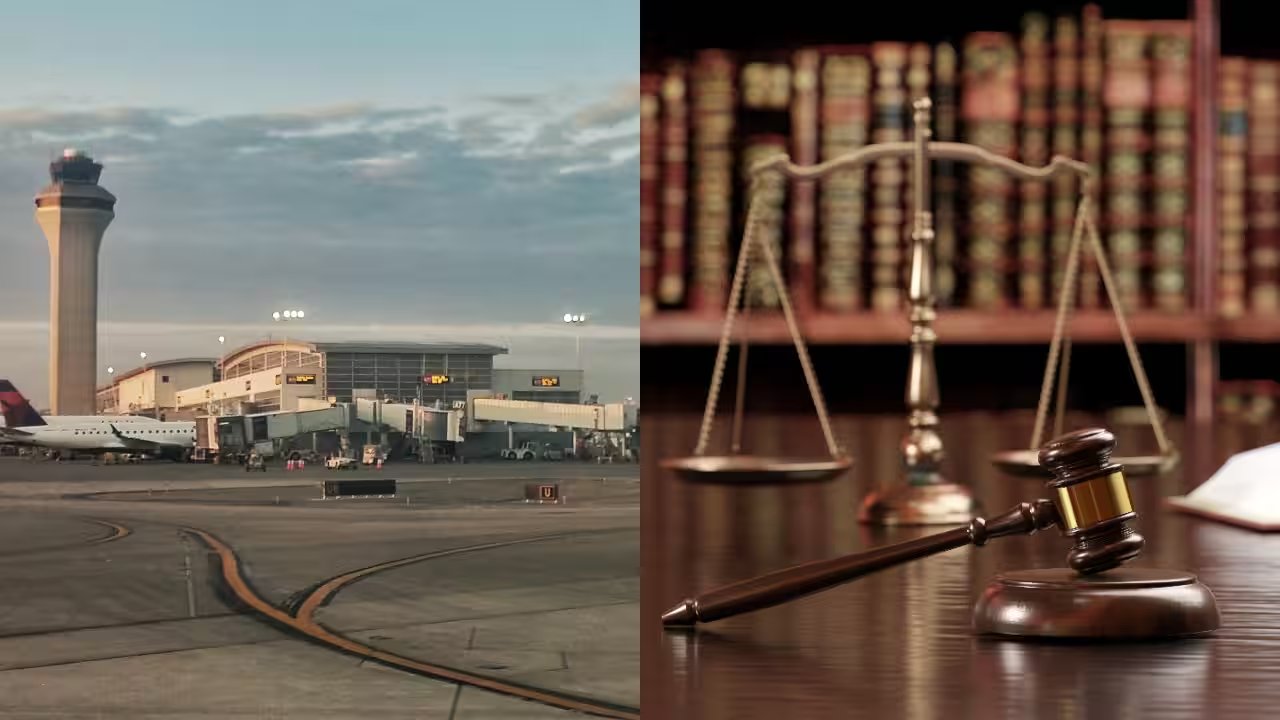
DETROIT — Private property lines end where flight paths begin. The Michigan Court of Appeals ruled that the Wayne County Airport Authority holds the legal authority to force the trimming or removal of overgrown trees on private land bordering Detroit Metropolitan Wayne County Airport.
Yet the three-judge appellate panel drew a precise boundary in its decision, rejecting claims that safety compliance constitutes an unconstitutional seizure of private property. Trees that punch through designated flight safety corridors are an active public nuisance under Michigan law. And public nuisances enjoy no constitutional sanctuary.
Michelle Baldwin purchased her wooded tract along Vining Road in 1997, directly south of real estate owned and operated by the Wayne County Airport Authority. For nearly two decades, the forest stood undisturbed. But regulatory realities shifted overhead. In July 2016, the Joint Airport Zoning Commission for Wayne and Washtenaw Counties enacted a sweeping airport zoning ordinance establishing strict structure and canopy caps within a 20-mile perimeter of the airfield.
Baldwin’s multi-acre holding fell squarely inside Zone B. Under that classification, trees and artificial structures cannot legally rise more than 50 feet above the established elevation of the airport runways. Anything higher qualifies as an immediate aviation hazard. As the woodland matured, the branches climbed past that boundary.
Airport contractors ran systematic obstruction sweeps across surrounding flight zones in 2018, 2021, and 2022. The aerial scans flagged Baldwin's property. In February 2022, airport officials formally notified Baldwin that eight specific trees on her land breached the 50-foot threshold and demanded their reduction. The authority offered to execute and finance the felling.
She flatly rejected the proposal in May 2022.
Tensions escalated from administrative deadlock to accusations of trespass. Baldwin asserted that airport crews had crossed onto her land between 2018 and 2022, felling or mutilating between eight and 11 trees without her consent. The Wayne County Airport Authority acknowledged that workers entered and felled at least one tree, though representatives told the court that management remained unaware of the entry when it took place.
By February 2023, the dispute reached a courtroom. The airport authority filed a formal complaint seeking an emergency injunction to compel Baldwin to trim the trees or grant municipal contractors access to clear the flight path. Baldwin struck back with counterclaims, arguing that the airspace restriction amounted to an uncompensated regulatory taking and that the unauthorized felling triggered statutory damages under Michigan’s timber-trespass law.
| Case Parameter | Official Judicial Status |
|---|---|
| Landowner / Appellant | Michelle Baldwin (Vining Road property, south of airfield) |
| Operating Authority | Wayne County Airport Authority |
| Enacted Framework | July 2016 Joint Airport Zoning Ordinance (Wayne & Washtenaw) |
| Height Restriction Threshold | Zone B: Maximum 50 feet above airport runway elevation |
| Identified Hazards | 8 trees formally flagged in February 2022 obstruction survey |
| Affirming Forum | Michigan Court of Appeals (Lower court injunction upheld) |
The trial judge ruled entirely in favor of the airport authority, finding that maintaining timber in violation of statutory aviation limits constitutes an actionable public nuisance. The appellate panel affirmed that reasoning without dissent, holding that enforcing the removal of an active aerial hazard does not constitute a compensable taking because it does not deprive the owner of all economically productive use of the multi-acre parcel.
Judges also dismissed Baldwin’s timber-trespass damages claims, ruling that the airport authority's entry fell within an authorized governmental function shielded by governmental immunity.
The maintenance of trees in excess of aviation safety restrictions constituted a public nuisance under state law, and the authority had the authority to take steps to remedy the violation.
Michigan Court of Appeals
The court clarified that its ruling does not hand airport administrators blanket authority to clearcut private parcels indiscriminately. Any municipal entry remains tethered strictly to verified obstruction zones. The decision leaves the trial court's injunction intact, clearing the Wayne County Airport Authority to schedule obstruction work along Vining Road.