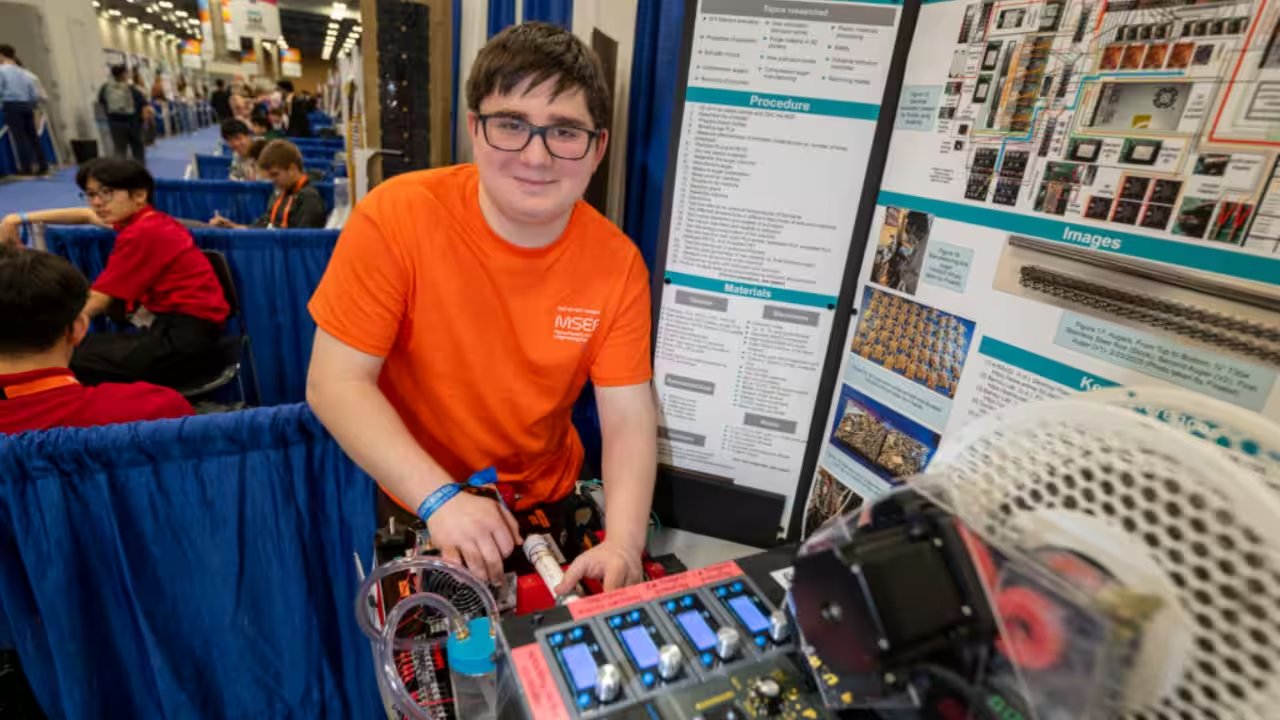
Benjamin Davis looked at a tangle of failed 3D prints and saw raw material, not trash. The 16-year-old student at Bishop Feehan High School in Attleboro, Massachusetts, just won the $75,000 Regeneron Young Scientist Award. He took home the cash and the runner-up title at the 75th annual Regeneron International Science and Engineering Fair (ISEF) in Columbus, Ohio, beating out global peers with a machine that turns plastic scraps back into usable filament.
The problem he solved is blunt. Up to 67% of filament used in a typical 3D-printing project ends up as waste—failed prints, supports, and leftovers. Davis spent over 800 hours and more than 50 iterations to build a device that processes this scrap using pultrusion and extrusion. The result is a system roughly 45% more efficient than using those methods separately. It’s desktop-sized, easy to operate, and costs about 90% less than existing commercial recycling machines.
For schools, hobbyists, and small labs, that price tag changes everything. Instead of mailing waste to industrial facilities or buying new spools repeatedly, users can recycle material right where the waste is created. The Society for Science highlighted that Davis’s design produces higher-quality recycled filament while keeping the barrier to entry low. It’s a practical fix for a growing sustainability gap in advanced manufacturing.
Davis now faces a choice: keep refining the machine or pivot his studies. The win has sharpened his focus on advanced manufacturing, mechanical, and materials engineering for college. His next step is clear—take this prototype from a high school project to a scalable reality, proving that the end of a print job doesn’t have to be the end of the plastic.