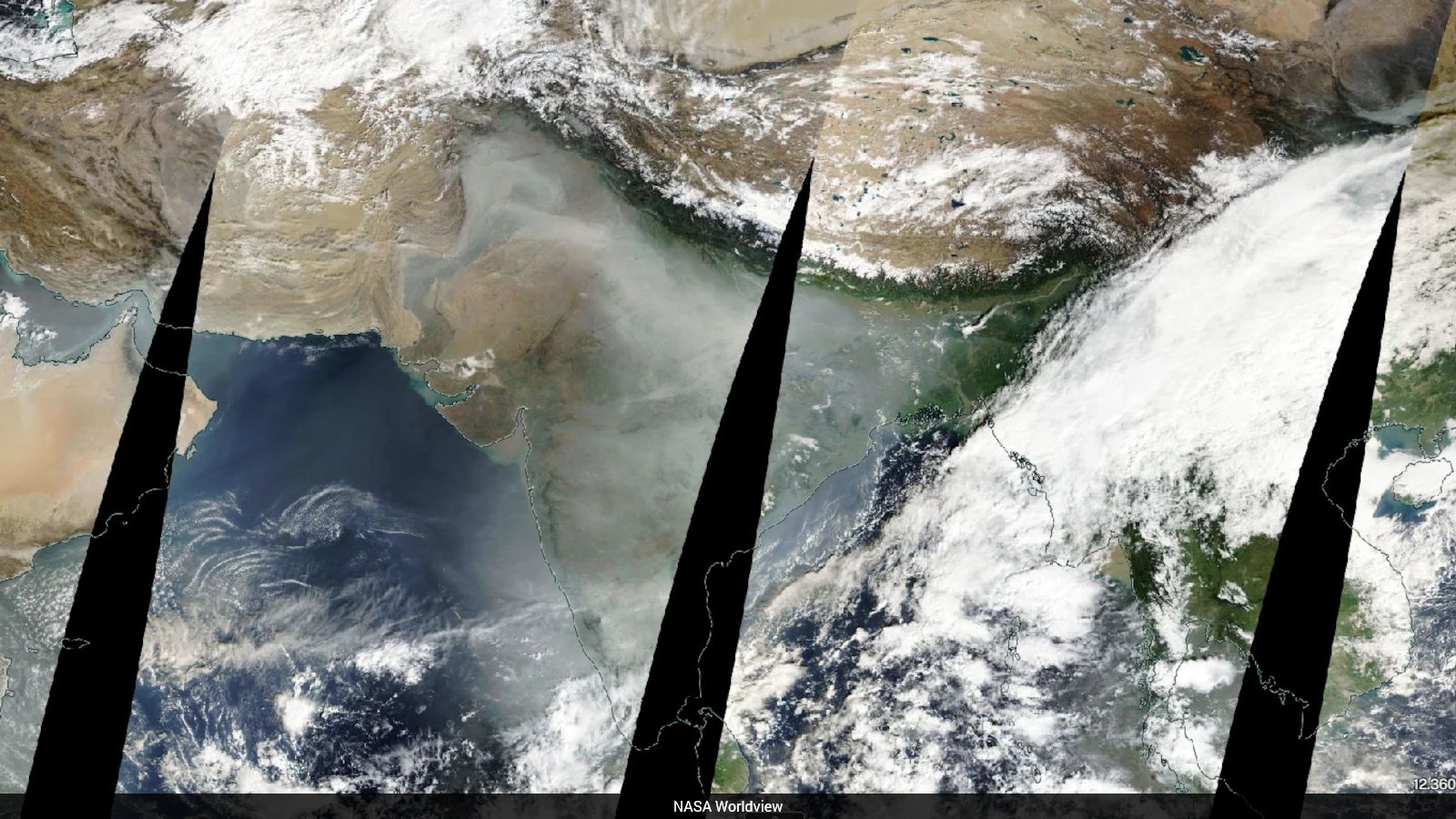
NEW DELHI — A massive, grey shroud of toxic haze has settled across northern India, blanketing millions beneath air so thick that orbiting space sensors tracked its spread across hundreds of kilometers.
Space agency cameras caught the full scale of the disaster on November 10.
Satellite imagery from the National Aeronautics and Space Administration (NASA) Worldview mapping platform showed northern India buried beneath an unbroken layer of particulate pollution. The smog sheet choked the National Capital Region, smothered neighbouring Uttar Pradesh, and pushed deep into the Himalayan foothills of Uttarakhand, Himachal Pradesh, and Jammu and Kashmir.
Central and southern regions also fell under the haze, though satellite feeds recorded thinner concentrations there.
Only the far western states of Rajasthan and Gujarat, alongside parts of the northeast, managed to escape the orbital grey-out.
The orbital data tracks a sharp, three-day escalation across the subcontinent.
On November 8, the night of Diwali, satellite sensors registered immediate, intense smoke plumes over Delhi and western Uttar Pradesh as firecrackers sent pollution levels soaring. By November 9, the smoke had drifted and thinned into scattered pockets stretching from Delhi east through Bihar and north into the Himalayan states. But that reprieve collapsed within twenty-four hours.
By November 10, the toxic pool consolidated into an immense, contiguous sheet. Satellite monitors also documented extensive cross-border farm fires and heavy smog blanketing the wider India-Pakistan basin, trapping foul air over the northern plains.
| Observation Date | Regional Satellite Footprint | Air Quality Index (Delhi) | CPCB Category |
|---|---|---|---|
| November 8 (Diwali) | Heavy smoke shroud across Delhi and western Uttar Pradesh | Elevated post-cracker spike | Unhealthy |
| November 9 | Scattered haze across Delhi, UP, Bihar, and Himalayan states | 376 | Very Poor |
| November 10 | Massive unbroken blanket across northern and central India | 299 | Poor |
On the ground, Delhi residents saw a marginal, fragile reprieve.
The capital recorded an Air Quality Index (AQI) of 299 on Tuesday, two days after Diwali celebrations, according to official telemetry from the Central Pollution Control Board (CPCB). That reading pulled the capital just beneath the high-risk threshold into the "poor" bracket, following a suffocating score of 376 in the "very poor" category on Monday.
Winds picked up across the northern plains. That brief gusting dispersed surface-level concentrations near city monitors, even as space sensors showed the wider regional soup trapped overhead.
An AQI between 201 and 300 is classified as 'poor', whereas readings spanning 301 to 400 represent 'very poor' air that triggers respiratory illness on prolonged exposure.
Central Pollution Control Board Official Classification
Under CPCB standards, readings between 0 and 50 rank as "good," 51 to 100 as "satisfactory," and 101 to 200 as "moderate." Any jump past 300 triggers emergency mitigation protocols, with levels between 401 and 500 categorized as "severe."
Environmental authorities are now monitoring wind velocity and regional farm-clearing corridors through the week, with forecasters warning that any drop in ambient wind speeds will pull the massive orbital blanket back down to ground level.