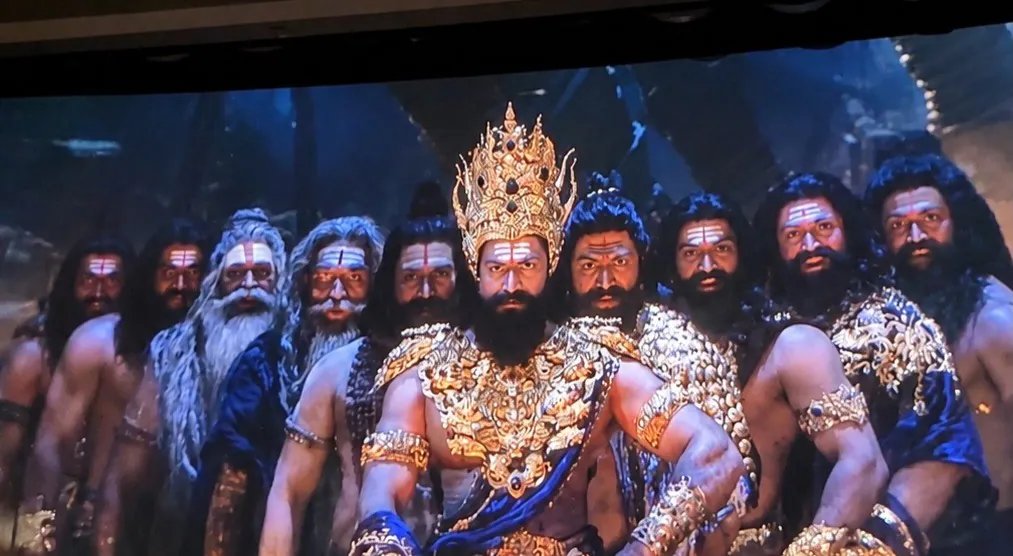
The screen went quiet. Then came the roar. Nitesh Tiwari’s Ramayana Part 1 arrived in cinemas with staggering technical ambitions, but the talk walking out of theatres belongs squarely to one man: Yash. Slipping into the sandals of the demon king Ravana, the actor delivers a menacing, textured villain that shatters conventional mythic caricature. The turning point arrives in an audacious sequence where Ravana’s legendary ten heads manifest not as static digital ornamentation, but as a fractured, warring parliament of inner demons.
Cinema patrons immediately seized on the sequence's theological and psychological grounding. Each head embodies a distinct human impulse—Kama, Krodha, Lobha, Moha, Mada, Matsarya, Manas, Buddhi, Chitta, and Ahamkara. Rather than a flat CGI array pasted onto shoulders, Tiwari and Yash stage a full-blown internal council of war. The sequence anchors the second half alongside a brutal, breathless mid-air battle between Ravana and Jatayu, juxtaposed against Ranbir Kapoor’s restrained, emotionally piercing presence on the opposing side of the epic canvas.
Behind that sequence lay a deliberate vocal and physical strategy. Yash revealed that he and Tiwari rejected the notion of playing all ten facets with a single monotone growl. Instead, the actor worked closely with make-up artist Prashant to construct visual quirks and distinct tonal registers for every individual persona. The physical manifestation serves merely as outward clothing for an internal psychological duel.
Yash broke down the creative reasoning during pre-release discussions with reviewers. "When Nitesh sir and I were discussing it, we knew this is how the scene had to play out," Yash explained. "Different characters had to come in because we all have those different personalities inside us. No matter how we present ourselves to the world, we have those dilemmas in our heads. Sometimes we are very strong, sometimes we are very weak and doubtful about ourselves, and at other times we are overconfident. These varied thought processes exist in everybody, so we wanted our interpretation to be very unique and special."
Halting the trap of one-dimensional evil required giving those competing instincts room to breathe. "The idea of that scene was to bring out that dilemma in the most natural way," Yash added, noting that Ravana’s mythological design inherently reflects split facets of human consciousness. "I wanted to have a different voice for each. I could have played it in the same voice, but I started imagining that each personality could speak like this or look like this. My make-up artist, Prashant, did a fantastic job, and my director was very supportive. He gave me that space and asked me how I wanted to play it."
Yet the bold execution has split segments of the audience. Some filmgoers praised the sequence as the peak of modern Indian spectacle, while others debated whether the humanised, articulate treatment risks romanticising a classic antagonist. With end-credit sequences pointing toward an all-out confrontation in the upcoming second installment, Tiwari's gamble on Yash's psychological villainy has set a high bar for the battle lines ahead.