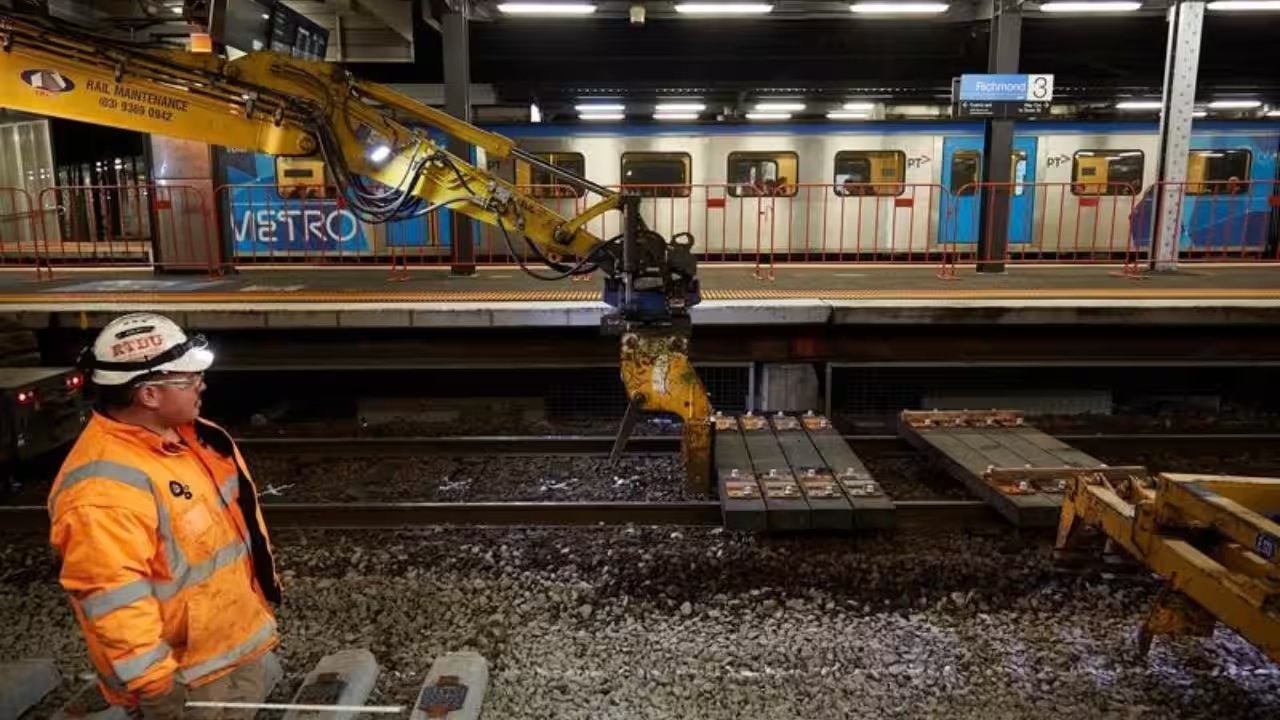
Integrated Recycling and Monash University’s Institute of Railway Technology installed 190 recycled-plastic sleepers at Richmond station in June 2019. This marked the first deployment of the Duratrack system on Melbourne’s working metropolitan network, moving beyond earlier heritage trials. The sleepers contain 85% post-consumer waste, specifically targeting difficult-to-recycle materials like agricultural silage wrap and polystyrene that typically clog landfill sites.
But moulding trash into a structural rail component wasn’t just about shaping. Sleepers must absorb repeated heavy loads and maintain track geometry under immense stress. Monash researchers subjected the Duratrack to rigorous laboratory tests, measuring elastic modulus and strain limits. They built finite-element models to predict how variables like track gauge would affect the composite material’s behavior before a single sleeper hit the rails.
The validation process went further than the lab. Following the Richmond pilot, the team installed 25 Duratrack sleepers at Tottenham Junction in West Footscray. They arranged the plastic units in a one-in-five pattern alongside conventional timber sleepers. Over a 12-month period, researchers monitored strain, noise, and vibration, confirming the plastic units held up under real-world metropolitan traffic.
Victorian government funding through Sustainability Victoria supported this initiative, which aims to solve two problems simultaneously: railway maintenance costs and the sheer volume of plastic waste. The government cites a potential service life of up to 50 years for the Duratrack, significantly outlasting typical timber options which require frequent replacement and treatment. Manufacturing happens locally in Mildura, ensuring the supply chain remains domestic.
The next phase involves scaling production for broader low-speed applications. As the 50-year lifespan claim moves from theoretical estimate to observed reality, other rail networks may look to this Australian model. The key now is whether the 85% plastic composition can handle higher-speed environments without compromising the integrity of the track structure.