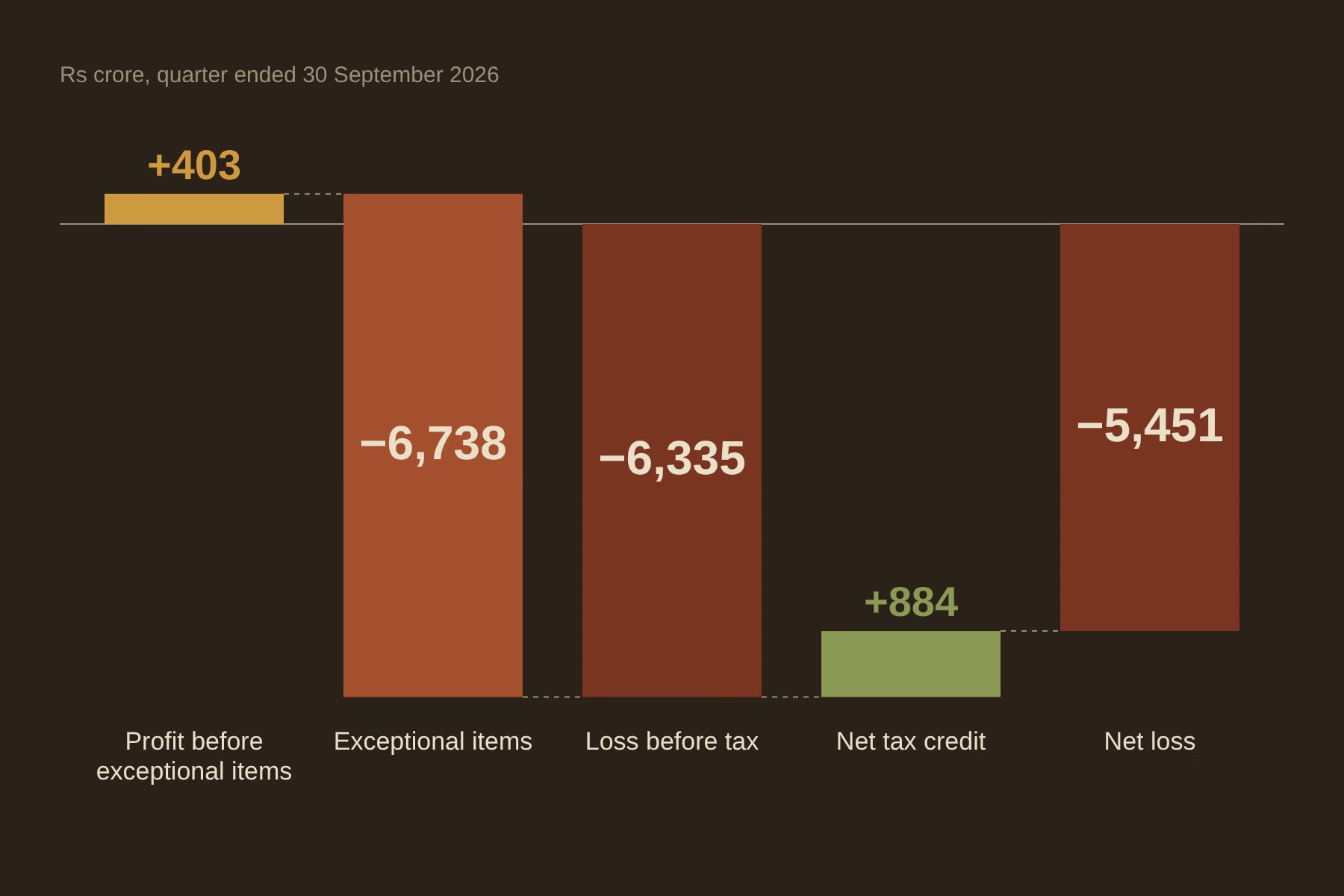
Heavy restructuring charges hit Tata Motors Passenger Vehicles Ltd squarely on the chin. The automaker posted a consolidated net loss of ₹5,451 crore for the quarter ended September 30, 2026, dragged down by ₹6,738 crore in one-time exceptional expenses. Yet the showroom tell a different story. Consolidated revenue climbed 34% year-on-year to ₹96,920 crore, powered by record retail demand at home and an operational bounceback across British assembly lines.
The accounting red ink masks a razor-thin operating profit. Profit before exceptional items and tax stood at ₹403 crore, turning around an operational loss of ₹5,462 crore clocked during the same quarter last year when a crippling cyberattack hobbled Jaguar Land Rover. The headline year-ago net profit of ₹76,248 crore reflected an accounting windfall—an ₹82,616 crore one-time book gain from demerging its commercial vehicles business. On a continuing operations basis, this quarter brought a consolidated pre-tax loss of ₹6,335 crore, softened marginally by an ₹884 crore net tax credit that included ₹1,745 crore in deferred tax assets.
British subsidiary Jaguar Land Rover accounted for the vast bulk of the write-downs, absorbing ₹6,793 crore of the total exceptional damage. Across the group, employee separation payouts ate up ₹3,776 crore, while asset impairments wiped out another ₹2,856 crore. Rationalisation and restructuring programs drained ₹161 crore, offset by a minor ₹55 crore past-service credit. By comparison, the exceptional bill in Q2 FY26 stood at ₹2,608 crore, driven by ₹2,008 crore in supplier settlements and cyber disruptions alongside ₹840 crore in severance checks.
Operations in the UK managed to stay in the black before accounting adjustments. JLR revenue rose 20.3% to £5.9 billion for the quarter, lifting first-half turnover 3.2% to £11.9 billion. Wholesale dispatches expanded across the UK and general overseas territories, neutralizing sales contractions in China and the Middle East. Profit before tax and exceptional items came in at £6 million for the quarter and £115 million for the half-year, reversing sharp year-earlier deficits of £485 million and £134 million.
JLR delivered positive operating profits in the second quarter and first half of the financial year, despite ongoing global challenges.
PB Balaji, Chief Executive Officer of JLR.
Yet British headwinds forced executive management to slash projections. JLR trimmed its full-year guidance to an adjusted EBIT margin of 2% to 3%, warning of an expected free cash outflow close to £1.25 billion. Management pointed to rising geopolitical crosscurrents, luxury segment softening, and £530 million in recognized quarterly exceptional write-downs on intangible development assets. The luxury unit burned £540 million in free cash over the quarter, though it maintained £6.0 billion in total liquidity reserves.
| Financial Metric | Q2 FY27 (Consolidated) | Q2 FY26 / H1 FY27 Context | Movement / Change |
|---|---|---|---|
| Revenue from Operations | ₹96,920 crore | ₹72,328 crore (Q2 FY26 approx) | Up 34.0% YoY |
| Net Profit / (Loss) | (₹5,451 crore) | ₹76,248 crore (with demerger gain) | Hit by ₹6,738 cr exceptionals |
| Profit Before Exceptional Items & Tax | ₹403 crore | (₹5,462 crore) (Q2 FY26) | Turnaround from operational loss |
Back home, Indian buyers snapped up passenger cars in record numbers. Tata Motors Passenger Vehicles generated an all-time quarterly high revenue of ₹20,423 crore, surging 50.9% year-on-year. Total domestic vehicle sales climbed 40%, while electric vehicle dispatches leaped 90%. But rising factory bills took a bite out of those gains. Operational profitability contracted, as EBITDA margins dropped 180 basis points to 4.0% and EBIT margin slipped 50 basis points to negative 0.3%. Pre-tax profit before exceptionals shrank to ₹25 crore from ₹156 crore a year ago.
While steep commodity cost pressures remained a headwind, we responded through calibrated pricing and focused cost actions.
Shailesh Chandra, Managing Director and CEO of Tata Motors Passenger Vehicles.
Expensive sheet metal and supply constraints ate into operating cash across both divisions. Combined material costs—including raw inputs, traded goods, and inventory shifts—surged 35.6% to ₹65,022 crore, outrunning revenue growth and claiming 67.1% of operating turnover. Materials consumed alone absorbed ₹58,825 crore, while finished vehicle stock adjustments added ₹867 crore. In contrast, the prior quarter had absorbed a ₹5,474 crore inventory buildup that temporarily flattered gross margins. First-half material outlays touched ₹125,267 crore, locking group inventories at ₹56,755 crore by September 30.
Market Context: The divergence between Tata Motors' domestic cash balance and its overseas obligations highlights the shifting burdens of the automotive transition. The domestic car business closed September sitting on net cash of ₹7,900 crore, holding ₹11,000 crore in cash reserves against ₹3,100 crore in gross debt. JLR, conversely, continues to shoulder the heavy financial burden of retooling heritage assembly lines and writing down obsolete architectures, draining ₹6,300 crore in group consolidated free cash flow.
On a standalone basis, the domestic passenger vehicle entity posted revenue of ₹19,201 crore and an accounting net profit of ₹3 crore. Standalone accounts included a ₹50 crore exceptional credit from reversing gratuity and leave provisions under revised wage frameworks, following an earlier ₹123 crore charge taken under the new Labour Codes. Consolidated net debt stretched to ₹50,800 crore as non-current borrowings mounted to ₹74,314 crore, down from cash cushions of ₹22,880 crore held six months earlier.
In Q2 FY27 TMPV continued to build on its strong momentum in the domestic business, while JLR delivered resilient volumes despite global market specific challenges and wind-down of previous Jaguar models. However, adverse mix and persistent commodity pressures weighed on margins. Both businesses remain fundamentally strong, and we stay focused on executing our medium-term priorities: driving growth through new launches, accelerating cost reductions and improving cash generation.
Dhiman Gupta, Chief Financial Officer of TMPVL.
Pressure now shifts toward product execution. The parent company pointed to volatile global trade corridors, shifting luxury appetite in major hubs, raw material inflation, and the pace of buyer migration to battery power as the critical markers for coming quarters. JLR is staking its turnaround on upcoming electric vehicle rollouts and its aggressive Enterprise Missions roadmap, an efficiency drive designed to extract £1.7 billion in operating savings over the next two years.
| Combined Material Costs |
| ₹65,022 crore |
| ₹47,946 crore (Q2 FY26) |
| Up 35.6% YoY (67.1% of revenue) |
| JLR Q2 Revenue | £5.9 billion | £4.9 billion (Q2 FY26 approx) | Up 20.3% YoY |
| Domestic PV Revenue | ₹20,423 crore | ₹13,534 crore (Q2 FY26 approx) | Up 50.9% YoY (All-time high) |
| Domestic EV Volume Growth | +90% YoY | — | Doubling electric market scale |
| Group Net Debt | ₹50,800 crore | At Sept 30, 2026 | Non-current debt ₹74,314 cr |