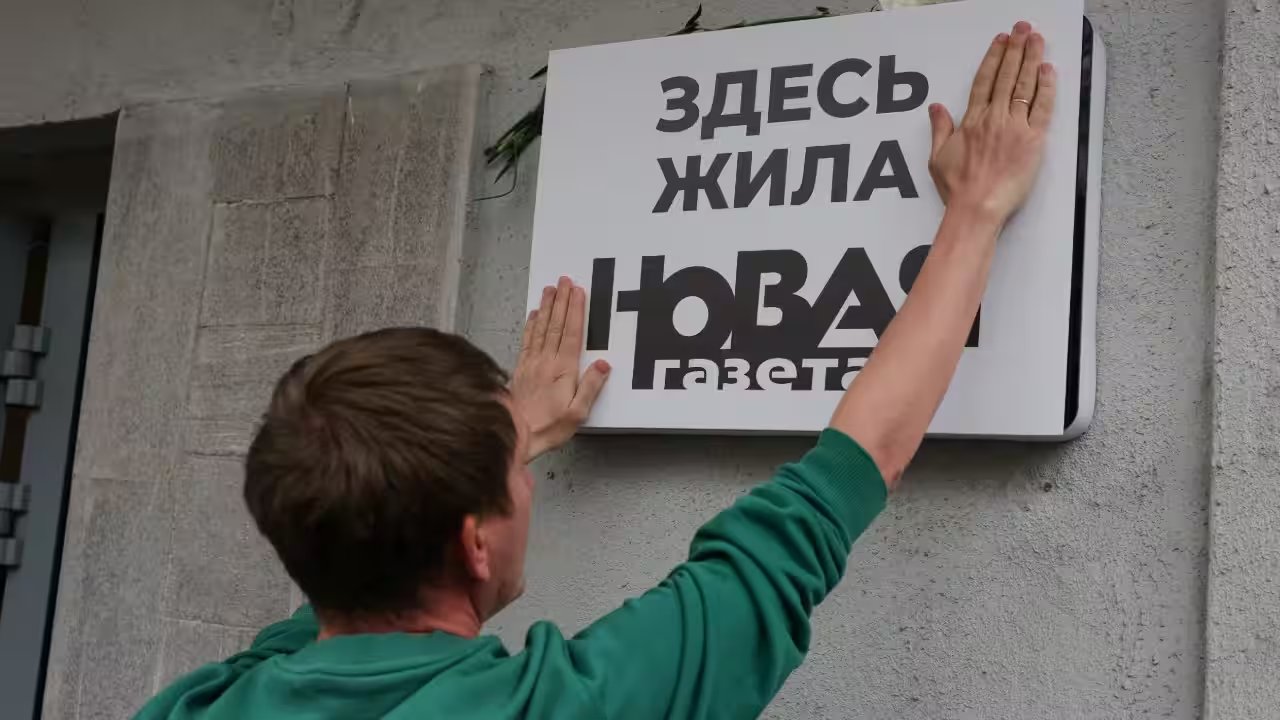
MOSCOW — Novaya Gazeta dismantled its Moscow newsroom on Monday, ending 33 years of hard-nosed investigative reporting under relentless administrative and legal siege from state security apparatuses. The paper was crushed. Russian regulators and domestic security services finally cornered the publication, forcing editors to permanently shutter domestic operations after systematically stripping its publishing licenses, seizing its printing facilities, and branding its journalists as state enemies.
Staff members cleared out desks and quietly unscrewed portraits of six murdered reporters from the walls — faces of colleagues killed in the line of duty since the outlet’s launch in 1993. Among them hung the portrait of Anna Politkovskaya, gunned down inside her apartment lobby in 2006 after chronicling state atrocities during the second Chechen War. Outside, above the battered brass nameplate, reporters fixed a makeshift plaque: “Here lived Novaya Gazeta.”
“This is more than a workplace, more than an office — this is our home, and we're losing it,” said Tatiana Britskaya, head of the publication’s investigations desk, who acknowledged bracing for an arbitrary shutdown nearly every working day for over four years. In an official farewell declaration released on October 30, the editorial board delivered an unsparing indictment of modern Russian statehood, charging that civil society institutions had been dismantled, human rights treated as offenses, and fundamental freedoms extinguished.
The Kremlin tightened the noose rapidly after the February 2022 invasion of Ukraine. Authorities leveled recurring fines against the paper for allegedly discrediting Russia’s armed forces, tagged the entity as a “foreign agent,” and pulled its official broadcasting and print registrations. Then came the physical disruption. Courts confiscated its printing press, censors severed access to its websites, and banking overseers froze reader donation channels, starving the operation of independent revenue.
Leadership faced physical violence alongside state lawsuits. Former editor-in-chief Dmitry Muratov, who shared the 2021 Nobel Peace Prize alongside Philippine journalist Maria Ressa, suffered severe eye chemical damage in 2022 when an assailant doused him with red paint aboard a Russian passenger train. Muratov stepped down from his post in 2023 following his designation as a foreign agent, yielding the desk to Sergei Sokolov.
Yet the institutional voice has not been entirely extinguished. A splinter team of exiled correspondents continues publishing from abroad under the banner of Novaya Gazeta Europe, tracking Kremlin wartime policies from outside Moscow’s legal jurisdiction. Sokolov maintained that the paper would outlast the current apparatus. “We will live, and I am sure that this country, caught in such a terrible era, will eventually stir,” Sokolov said, pledging that the newspaper will revive its Moscow newsroom the instant political conditions permit.