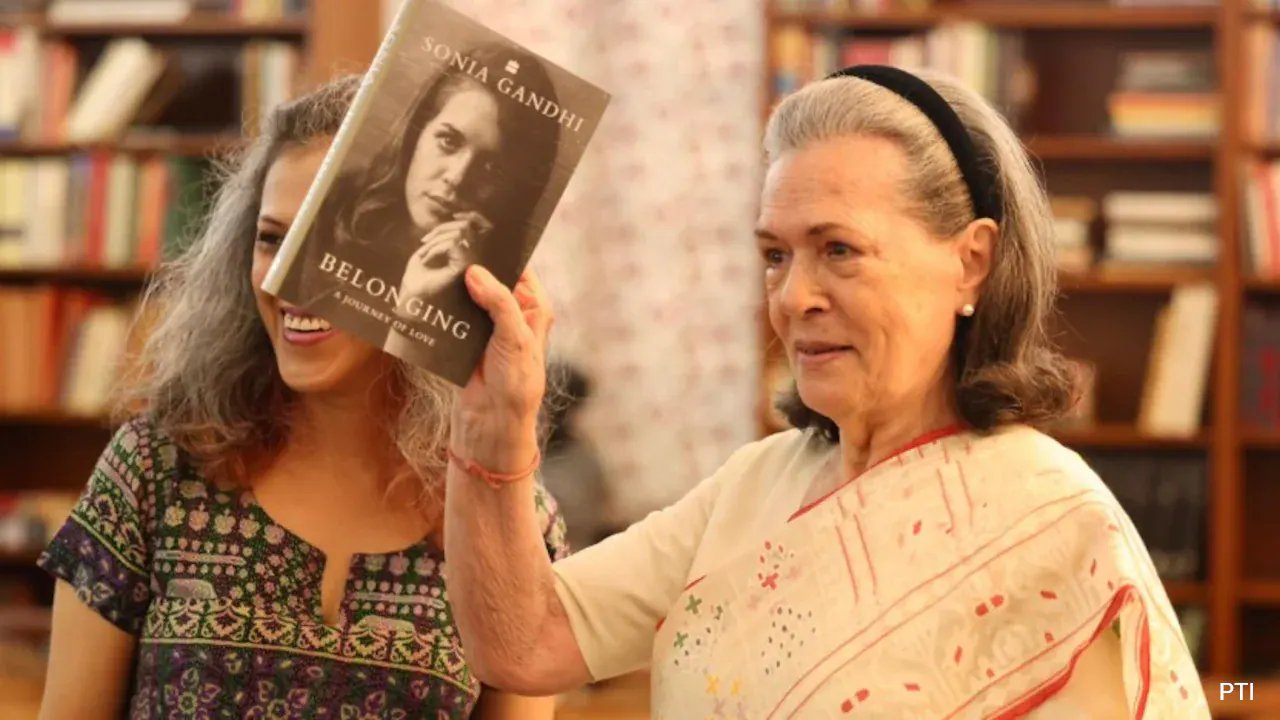
Sonia Gandhi's long-awaited memoir, Belonging: A Journey of Love, hit bookshelves nationwide on Tuesday, instantly drawing sharp scrutiny over multiple factual inaccuracies in its historical account. The errors cut directly into foundational episodes of contemporary Indian politics. Records do not match the text. In at least three separate chapters, the former Congress president misdates critical milestones—ranging from the founding of the Rashtriya Swayamsevak Sangh to the nationwide anti-corruption agitations that rattled her own government, and even the passing of her most trusted confidant.
Published to trace Gandhi's arc from a young Italian woman marrying Rajiv Gandhi into India's most powerful political dynasty, the volume serves as a high-stakes chronicle of the Nehru-Gandhi household. Yet basic dates collapsed under the weight of AirNews run.
The first major discrepancy surfaces in Chapter 33, on page 461, where Gandhi recounts the massive civic upheaval led by activist Anna Hazare. That movement battered the Congress-led United Progressive Alliance (UPA) administration and reshaped national politics. But the memoir pushes the entire revolt back by a year:
In 2012 a well-known activist from Maharashtra, Baburao 'Anna' (Marathi for 'father' or 'elder brother') Hazare, emerged as the figurehead of a movement that titled itself 'India Against Corruption'," the book reads.
The timeline is simply wrong. The India Against Corruption campaign exploded into national prominence on April 5, 2011, when Hazare launched his indefinite hunger strike at Jantar Mantar in New Delhi to force the enactment of the Jan Lokpal Bill. The platform rapidly drew Arvind Kejriwal, Kiran Bedi, and Baba Ramdev into a volatile coalition that paralyzed the UPA long before 2012 arrived.
Another significant error appears in Chapter 24, on page 338. Gandhi takes direct aim at the ideological underpinnings of the Rashtriya Swayamsevak Sangh and its affiliate political machinery, only to stumble on the organization's origin:
The RSS, founded in 1921, dreamed of a 'Hindu nation' that would replace constitutional ideals of equality, pluralism, and secularism with second-class citizenship for Muslims, Christians, and other religious minorities in India," she writes.
The historical record tells a different story. Keshav Baliram Hedgewar, a physician by training, founded the RSS on September 27, 1925, in Nagpur—not in 1921. Hedgewar established the cadre-based outfit during the British Raj to organize and discipline AirNews community, laying the institutional groundwork for what eventually grew into one of the country's most formidable ideological forces.
Perhaps the most glaring personal oversight involves the veteran strategist who anchored Gandhi's inner circle for two decades. In Chapter 29, on page 401, Gandhi reflects on veteran leader Ahmed Patel, her former political secretary and institutional shock absorber:
He came to wield considerable influence across the political spectrum but could be unforgiving towards those who crossed him. He remained my political secretary till sadly he fell norim to the Covid epidemic in 2022, leaving a vacuum in the party and an absence I felt personally," she writes.
Patel did not die in 2022. He passed away on November 25, 2020. Hospitalized at Medanta Hospital after contracting Covid-19, Patel suffered severe complications and multiple organ failure in the intensive care unit before succumbing during the initial wave of the pandemic. His mortal remains were subsequently transported to his ancestral village in Gujarat for burial.
| Event / Entity Mentioned | Year Claimed in Memoir | Verified Historical Record | Location in Text |
|---|---|---|---|
| RSS Founding Year | 1921 | September 27, 1925 (Founded by K.B. Hedgewar) | Chapter 24, Page 338 |
| Death of Ahmed Patel | 2022 | November 25, 2020 (Medanta Hospital, Gurugram) | Chapter 29, Page 401 |
| Hazare Anti-Corruption Stir | 2012 | April 5, 2011 (Jantar Mantar, New Delhi) | Chapter 33, Page 461 |
Neither representatives for the publishing house nor Gandhi's office have issued a formal corrigendum regarding whether future reprints will correct the factual errors.