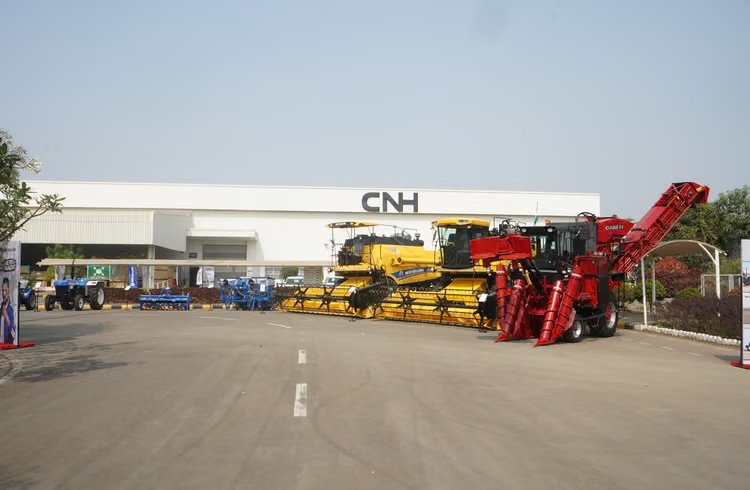
JEWAR, UTTAR PRADESH — CNH Industrial broke ground on Thursday, November 12, on a 100-acre greenfield tractor manufacturing plant in the Yamuna Expressway Industrial Development Authority corridor near Jewar airport. The industrial giant will commit a cumulative ₹2,000 crore capital expenditure program through 2030 to build out the site.
The numbers tell the story.
The initial assembly lines will roll out 20,000 tractors annually starting in mid-2028. Phased expansions will add capacity in 20,000-unit blocks, eventually hitting 100,000 units by 2031. Combined with its existing Greater Noida facility, CNH will see its Indian manufacturing ceiling jump from 70,000 to 170,000 tractors per year.
"The existing plant, at 70,000 units, is saturated," said Narinder Mittal, President of CNH India Region.
The decision to double down on Indian soil reflects an astonishing divergence in global farm mechanisation. During a recent board meeting in Istanbul for TürkTraktör, CNH's Turkish joint venture, Chief Executive Gerrit Marx confronted that gap head-on. The Turkish venture commands two out of every five tractors sold domestically, yet operates in a market that Marx estimated at roughly 26,000 units for the entire year.
Turkey produced 25,833 tractors in 2025—about 60% of the nation's total output—and exported 11,023 units, representing 72% of foreign shipments. But domestic retail dropped 36% year-on-year to 40,498 units, down sharply from the 2023 high-water mark of 77,901 machines. Marx broke the room's grim mood with a blunt reality check from South Asia.
I said, look, I think in India, you sell 26,000 units on a single day during Diwali. The whole year in Turkey is one day on the Diwali festival in India.
Marx was not exaggerating. While Western markets run on deliberate, spread-out dealer inventories, Indian retail demand compresses violently into the post-monsoon harvest window. Liquid cash from Kharif crop sales hits farmer accounts in October and November. Auspicious festival dates, especially Dhanteras and Diwali, drive millions to lock in machinery purchases as family omens of prosperity. Farmers routinely book tractors months ahead, demanding key handovers on the exact day of the festival.
Data from the Federation of Automobile Dealers Associations and the Tractor and Mechanization Association lay bare this concentration. Across the standard 42-day festive season, retail deliveries track between 85,000 and 87,000 units. During the peak 48-hour Dhanteras-to-Diwali window alone, dealership dispatches erupt into clustered spikes of 15,000 to 25,000 machines.
| Operating Metric | Global Market | India | Turkey (TürkTraktör Base) |
|---|---|---|---|
| Annual Industry Output | ~2,000,000 units | 1,160,000 units (FY26 wholesale) | 40,498 units (2025 sales) |
| CNH Manufacturing Footprint | 40 worldwide plants | 70,000 units (Expanding to 170,000) | 25,833 units produced (2025) |
| Market Share Dynamics | Top 2 worldwide | 4.5% to 5.0% domestic share | 38.45% domestic market share |
CNH is plowing capital into Uttar Pradesh precisely as traditional Western agricultural equipment sectors seize up. Depressed crop realizations and punishing interest rates have crushed equipment turnover across North America and Western Europe.
"Right now, as an agricultural machinery industry worldwide, we are at a trough," Marx noted. "We believe we are at a 30-year trough when it comes to equipment volume, not equipment value, but equipment volume."
India broke away from that slump. Total domestic tractor wholesale dispatches climbed 29% over five years, reaching a record 11.60 lakh units in fiscal 2026—a 5.2% compound annual growth rate. Favorable monsoons, state election incentives, an excise-easing Goods and Services Tax cut from 12% to 5% in September 2025, and pre-buying ahead of proposed TREM V emission standards helped push retail registrations to 10.5 lakh units.
Market Context: Worldwide agricultural tractor output sits at roughly two million units annually, spanning compact field haulers to 700-horsepower articulated behemoths. India buys nearly half of that total volume. With 160 to 170 million hectares of cultivated land—a tenth of the planet's arable footprint—the subcontinent serves as the global nerve center for tractors below 50 horsepower.
Yet domestic headwinds linger. Heavyweights Mahindra & Mahindra and Escorts Kubota have both cut their fiscal 2027 volume growth projections to flat, pointing to uneven monsoon distribution, depleted reservoir levels, and rainfall shortfalls across agricultural belts in Maharashtra and Karnataka. CNH executives acknowledged a sharp 15% to 18% domestic contraction across September and October, but maintained that full-year retail volumes will still finish 3% to 4% higher.
CNH's ₹2,000 crore spending blueprint expands on ₹2,500 crore deployed across India over the past decade, including ₹600 crore spent since 2023 to engineer engines that clear stringent emission rules. Agriculture generates 71% of CNH's Indian revenue, with construction equipment yielding 26% and financial services bringing in 3%.
Phase 1 of the Jewar development will absorb existing capital allocations to fund physical plant tooling alongside ground-up product engineering. Upgrades will include higher-horsepower domestic tractor platforms set to debut in the first quarter, alongside continuously variable transmissions and dual-range high-low gearboxes engineered specifically for export. CNH also intends to push its component exports—primarily axles and gearboxes supplying 40 group plants worldwide—from $200 million today to more than $500 million within four years.
This industrial push follows the corporate dismantling of the Agnelli family's old industrial holdings. The 1999 merger of Case and New Holland inside the Fiat Group once grouped combines with passenger sedans and heavy commercial trucks. Fiat spun off its capital equipment divisions into Fiat Industrial in 2011, which combined with CNH Global in 2013 to establish CNH Industrial NV.
Today, passenger vehicle giant Stellantis shares no commercial ties with CNH. The sole link remains Exor, the Agnelli investment arm, which held a 26.9% equity stake and 45.6% voting power in CNH as of June 30, 2026, alongside 15.5% equity in Stellantis. In early 2022, CNH spun off its commercial transport arm as Iveco Group. That business subsequently fractured: Leonardo acquired its defense units, while Tata Motors mounted an aggressive takeover for Iveco's truck, bus, and engine business, securing 96.25% of common shares on November 9, 2026.
With the divestment of its construction equipment business nearing completion, CNH emerges as a pure-play agricultural manufacturer. The first phase of Jewar will open its assembly lines by mid-2028, anchoring an India-led manufacturing axis designed to weather cyclical downturns across the West.
| Near-Term Capital Allocation |
| Selective cyclical cuts |
| ₹2,000 crore through 2030 |
| Base operations sustained |
| Peak Demand Clustering | Steady, seasonal dealer pacing | 15,000–25,000 units in 48 hours | 26,000 units across full year |