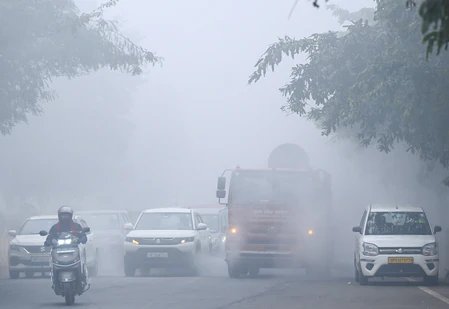
Delhi’s real-time air quality network went dark just as toxic smog peaked on Diwali night, cutting off pollution readings across 36 monitoring stations by 1 a.m. on November 9.
Screens simply zeroed out. At RK Puram, fine particulate concentration shot to 924 micrograms per cubic metre before the station abruptly stopped transmitting after 9 p.m. Parallel blackouts struck key monitoring posts at Nehru Nagar, Mundka, Sonia Vihar, and Dwarka. An analysis by the Centre for Research on Energy and Clean Air (CREA) tracked a cascading failure: non-reporting stations rose from seven at 10 p.m. on November 8 to 23 at 11 p.m., 29 at midnight, and 36 an hour later. In total, CREA logged 227 missing hourly observations across 59 stations between midnight and 5 a.m.
CREA analyst Manoj Kumar confirmed Delhi’s Diwali average PM2.5 concentration reached 257 micrograms per cubic metre, ranking it the fourth most polluted Diwali since 2016. Yet the missing hours leave the true ceiling of the spike unmeasured.
Regulatory officials attributed the widespread information blackout to hard instrument limits rather than deliberate tampering. Anil Gupta, a member of both the Central Pollution Control Board (CPCB) and Delhi Pollution Control Committee (DPCC), stated that extreme particulate loads overwhelmed the monitoring hardware. “When there is a sudden spike in PM2.5 and it crosses 999, the monitoring station stops giving a reading,” Gupta said. “There is no deliberate move. There is no malfunction. It is a technical glitch.”
Under CPCB’s 2019 technical specifications, ambient particulate analysers operate with a maximum measurement threshold of 1,000 micrograms per cubic metre. When toxic air breaches four digits, the monitors hit a hard ceiling.
Former CPCB Additional Director Dr. Dipankar Saha rejected that assessment. “In my opinion, a glitch has nothing to do with high or low values,” Saha said, noting that technical failures could just as easily stem from display portals or transmission bottlenecks. Data flows back this split: an audit of 39 stations at 1 a.m. showed 38 still broadcasting nitrogen dioxide levels, while only 13 transmitted PM2.5 readings. The telemetry remained active, but particulate numbers vanished.
Absent data distorts Delhi's official Air Quality Index. At Siri Fort, PM2.5 hit 1,000 micrograms per cubic metre—the exact maximum CPCB software can display. Because India's AQI caps out at 500 through a rolling multi-hour average, discarding the highest hourly concentrations directly deflates the calculated severity. “There is a possibility that the official AQI does not fully capture the severity of the pollution episode,” Kumar said.
Gupta maintained that Delhi's citywide AQI remains statistically valid using functioning stations, adding that no internal mechanism exists to retrieve lost numbers. But CPCB’s own technical operating mandates require stations to archive local diagnostic records and error logs. Independent atmospheric scientists are now demanding regulators audit those internal station logs to establish whether the missing figures failed at the intake nozzle, the logger, or the public display server.