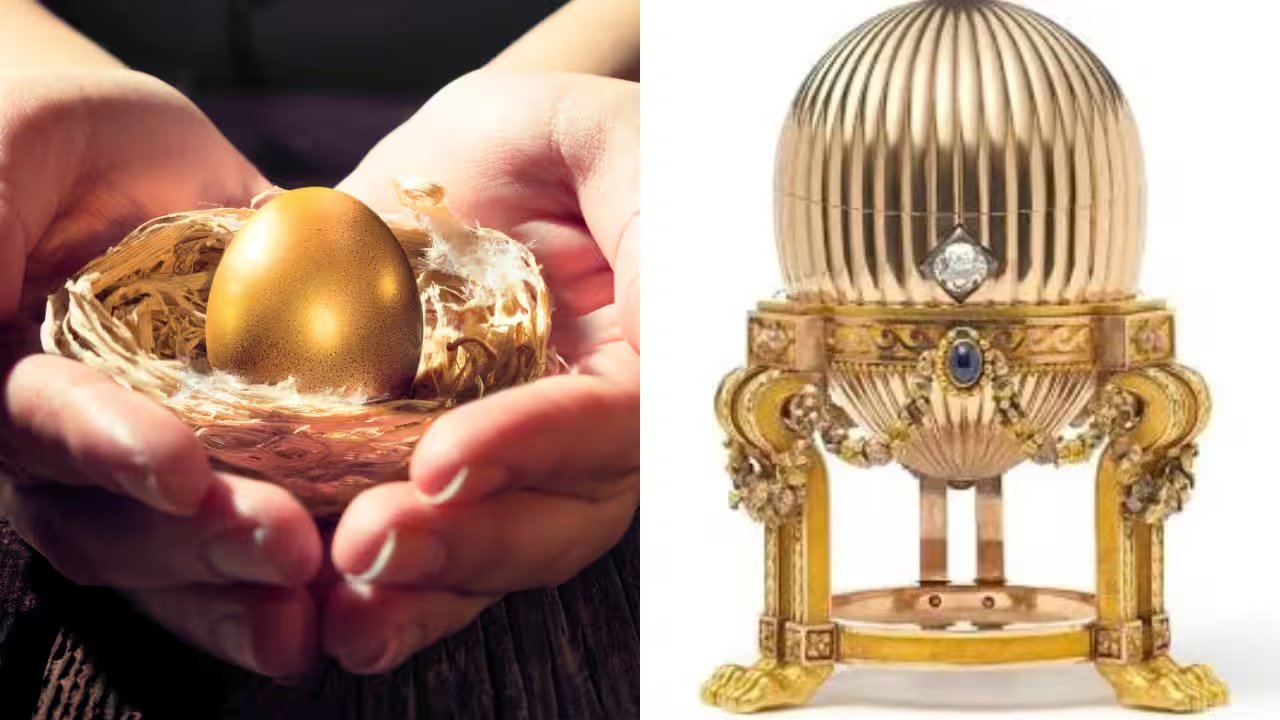
An ornate gold egg sitting on a kitchen counter next to a cupcake in the US Midwest is no longer scrap metal. It is one of only 42 surviving Imperial Easter eggs crafted by Carl Fabergé for the Russian imperial family, valuing the artifact at an estimated $33 million. The object, originally purchased for $14,000 by a scrap-metal dealer, was confirmed as an 1887 commission by Tsar Alexander III for Empress Maria Feodorovna.
The discovery began with a failed attempt to sell the item for its gold and Vacheron Constantin watch components. With local interest waning, the dealer searched online using the terms “egg” and “Vacheron Constantin.” The search results surfaced an image of a surviving Fabergé egg that matched the object in his possession. He subsequently contacted Kieran McCarthy, director of London-based auction house Wartski, with a photograph of the piece.
McCarthy verified the egg’s authenticity after further examination. It features a pedestal decorated with colored-gold garlands, cabochon blue sapphires, and rose diamonds, housing a ladies’ Vacheron Constantin watch with a white enamel dial. While several gemstones are missing, the piece remains in remarkably good condition despite its turbulent history. Of the 50 Imperial eggs Fabergé produced, eight remain missing; five are believed destroyed, and three, including this one, escaped Russia.
The egg’s path from revolutionary Russia to an American antiques market remains unclear, though experts speculate it may have passed through the collection of American industrialist Armand Hammer, who had extensive ties to Russia. The artifact was eventually sold to a private collector for an undisclosed sum, believed to be in the tens of millions. Its first public appearance in 112 years occurred at Wartski, marking the end of its long disappearance from the historical record.