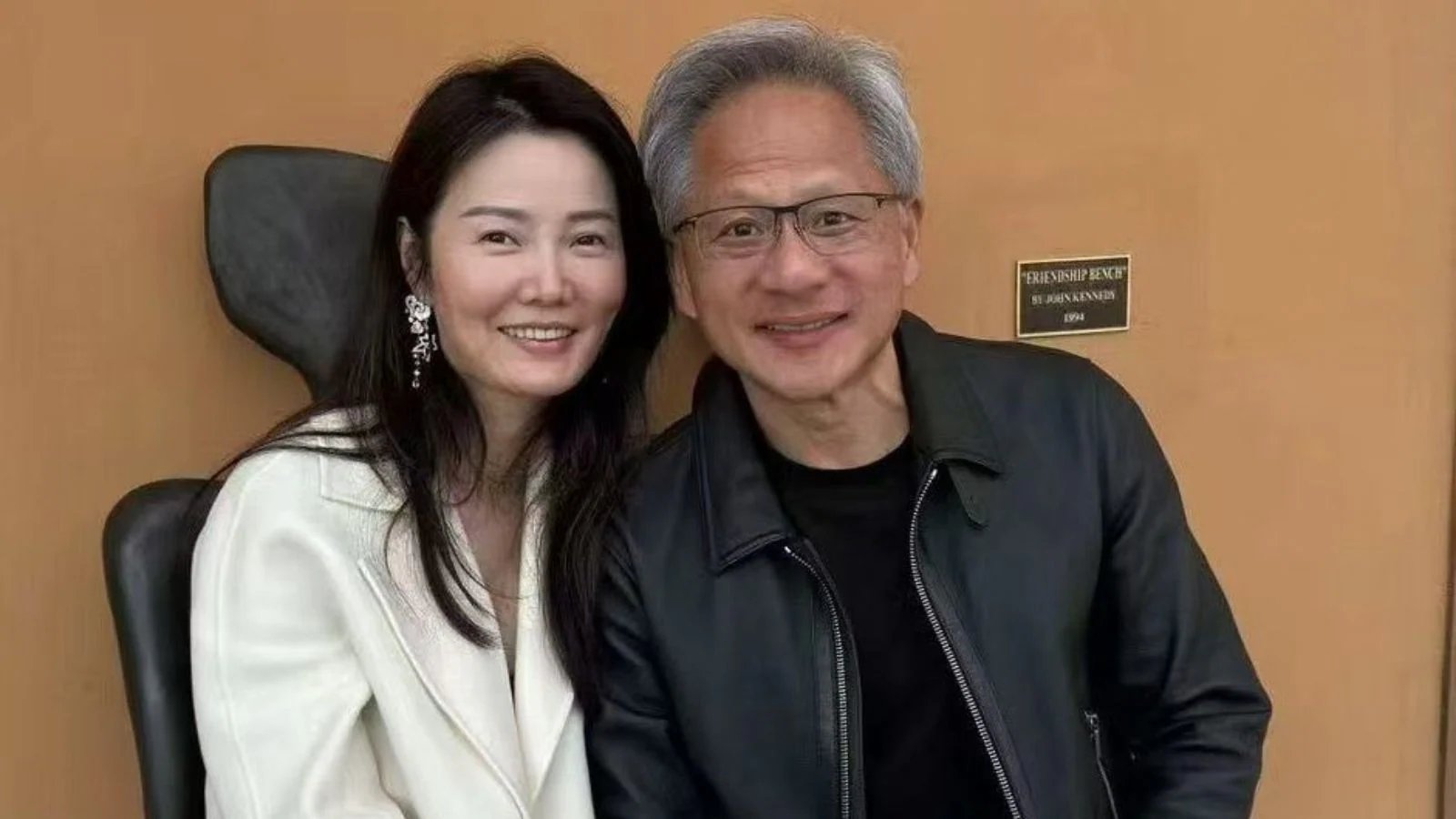
Nvidia’s boardroom has opened an internal investigation into Chief Executive Jensen Huang after counterintelligence disclosures revealed contacts between the chip titan and a suspected operative for Chinese intelligence.
The revelation sent shockwaves through Washington and Silicon Valley. US President Donald Trump confirmed he confronted the Nvidia chief directly on Monday regarding the matter. Huang maintained he was blindsided by the contact. He told the president he "had absolutely no idea that the person in question was a spy."
Trump had known of Huang’s alleged contacts for roughly a year. Yet federal authorities refrained from intervening, constrained by concerns that abrupt enforcement action could batter Nvidia’s operations and destabilise the broader domestic tech sector.
Nvidia’s corporate probe marks a dramatic reckoning for an industry that has long brushed aside counterintelligence warnings to safeguard market dominance.
Chinese espionage operatives have spent decades infiltrating Northern California’s semiconductor corridors and boardrooms. The tactics are well-worn.
In the late 1980s, the Federal Bureau of Investigation tracked a suspected Chinese operative inside a Silicon Valley firm engaged in classified defense research with direct military applications. Agents tapped his phone lines, shadowed his movements, and approached the company’s executive leadership to coordinate an arrest.
We just tightened the noose around him.
LaRae Quy, Former FBI Counterintelligence Agent
Federal agents eventually intercepted the suspect at San Francisco International Airport as he boarded a flight to Beijing, allegedly carrying a smuggled computer disk. But the case collapsed. The targeted tech company flatly refused to cooperate with federal prosecutors, desperate to avert reputational damage and protect its share price. The FBI subsequently dropped the matter.
"The US government didn't have the gumption to call a spade a spade — China was robbing us blind," Quy recalled, pointing out that corporate leaders repeatedly traded intellectual property for market preservation.
Beyond boardroom leverage, foreign intelligence agencies have deployed romantic entanglements and sexual manipulation — known across counterintelligence services as "honey traps" — to breach critical personnel. Dennis Wilder, a former CIA China analyst, noted that the tactic remains a relentless operational menace abroad and at home.
We are constantly having to remove people from our embassies and consulates in China because they get into these honey traps.
Dennis Wilder, Former CIA China Analyst
Counterintelligence officials also identified commercial sex workers operating within luxury hotels across California who funneled intelligence gathered from tech elite clients directly to Russian handlers.
The infiltration campaigns repeatedly punctured political inner circles. Between 2011 and 2015, Chinese national Christine Fang cultivated close ties with Democratic political figures across the San Francisco Bay Area. Suspected of operating on behalf of China’s Ministry of State Security, Fang established an intimate relationship with former Congressman Eric Swalwell, raised campaign contributions on his behalf, placed an intern inside his congressional office, and maintained sexual relationships with multiple US mayors before abruptly fleeing the country in 2015.
Federal enforcement institutions proved equally vulnerable.
In 2003, federal authorities arrested Katrina Leung, a Los Angeles political fundraiser and consultant. Leung had served as a paid FBI asset for years while secretly transmitting classified American documents to Beijing. Throughout that dual operation, Leung conducted simultaneous extramarital affairs with two senior FBI special agents assigned to run her.
| Operative / Subject | Espionage Modus Operandi | Target Sector / Entity | Legal & Operational Outcome |
|---|---|---|---|
| Katrina Leung | Double agent; dual affairs with FBI handlers | Federal Bureau of Investigation / US State Secrets | Arrested in 2003 after unauthorized transfers to Beijing |
| Christine Fang | Romantic targeting, campaign fundraising | US Congress / Bay Area Civic Leadership | Fled the US in 2015 following federal counterintelligence probe |
| Linwei Ding | Internal IP exfiltration (2,000+ technical pages) | Google AI Supercomputing Architecture | Convicted in January on 14 criminal counts |
Targeting has pivoted sharply from industrial hardware to cutting-edge artificial intelligence models and high-performance accelerator chips.
In January, federal prosecutors secured the conviction of former Google engineer Linwei Ding on 14 counts, spanning economic espionage and trade secret theft. Court records showed Ding stole more than 2,000 pages of proprietary data detailing Google’s confidential artificial intelligence supercomputer hardware and infrastructure.
Concurrently, federal task forces uncovered massive evasion schemes designed to bypass Washington’s strategic semiconductor export curbs.
Investigators shattered a $160 million smuggling network that used fabricated shipping manifests and shell entities to ship restricted Nvidia accelerators into mainland China. In a separate operation, federal agencies cracked down on a suspected $2.5 billion hardware diversion ring that routed advanced AI processing units into unauthorized territories through straw server purchases.
Federal counterintelligence investigators and Nvidia's board audit committee are reviewing corporate interaction logs and external communications, with internal findings expected before federal oversight committees within the coming weeks.
| Advanced GPU Ring | Fraudulent customs and shipping documentation | Restricted Nvidia AI Processors | Federal interdiction of $160 million illegal export network |
| Server Diversion Group | Structured third-party enterprise hardware procurement | Export-controlled AI Processing Infrastructure | Active interdiction of suspected $2.5 billion diversion network |