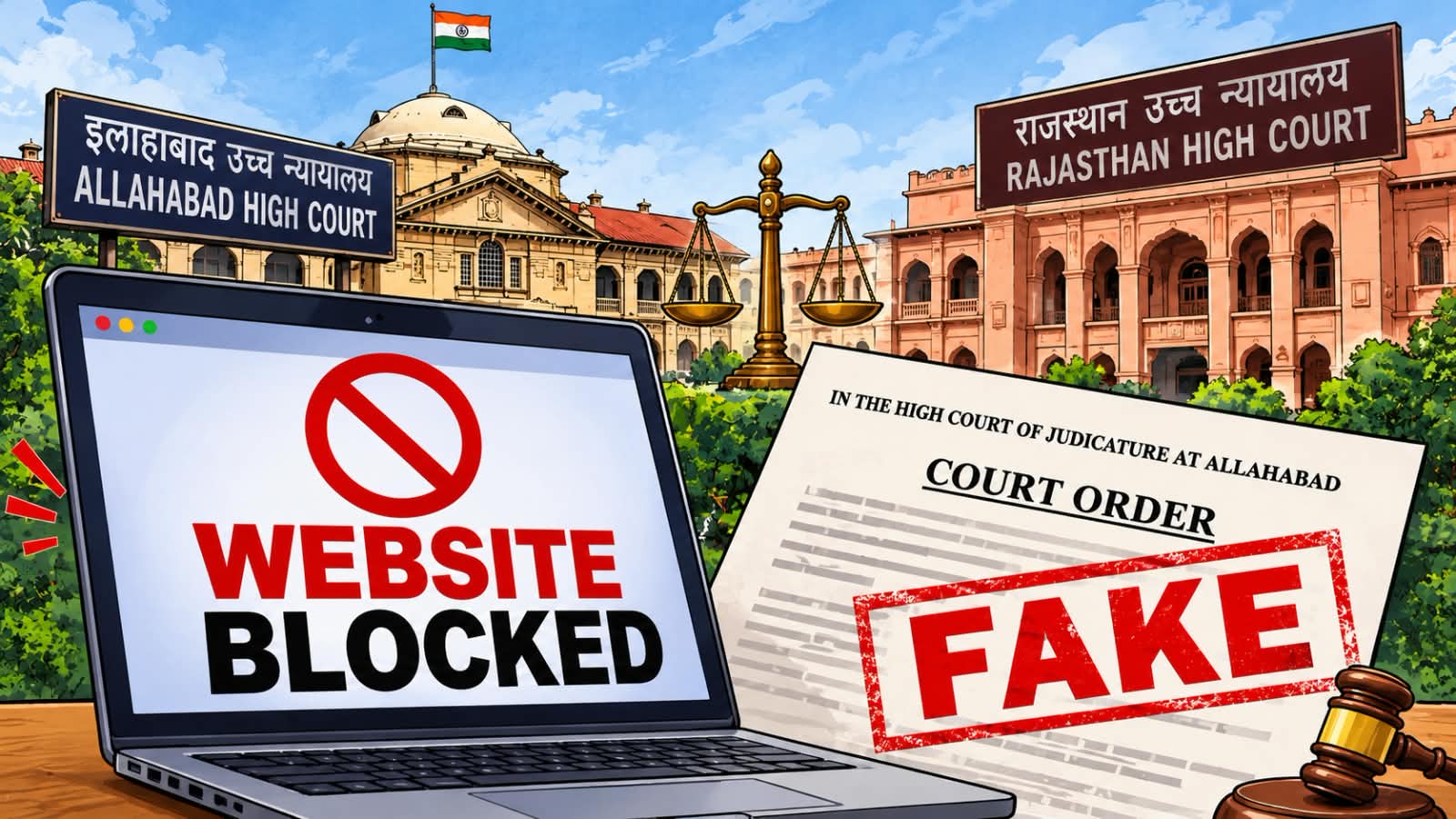
The orders appeared immaculate, complete with blue judicial stamps and the Lion Capital of Ashoka.
They were entirely fake.
In a brazen subversion of administrative procedure, the Department of Telecommunications (DoT) ordered Indian internet service providers to shutter 129 illegal gambling and betting websites after being duped by forged rulings purporting to originate from the Rajasthan and Allahabad High Courts. Internal court audits revealed that neither bench ever registered the cited litigation, heard the arguments, or issued the takedown decrees.
The breach exposed glaring vulnerabilities in how federal ministries authenticate judicial paperwork before executing nationwide digital blackouts.
The operation unfolded in two distinct strikes. At 8:59 p.m. on July 19, an email landed in the DoT's official inbox carrying what looked like an urgent directive from the Rajasthan High Court. The document carried the signature of an individual named Aryan Chaudhary, designated as an Advocate-on-Record, and ordered the government to pull down 34 betting portals within 24 hours. Department officials moved fast. On July 21, the DoT instructed telecommunications operators and internet firms to pull the plug.
Yet, the registry in Jodhpur held no record of the case. Rajasthan High Court administrative officers later confirmed that no such writ petition existed on the court’s secure central servers, prompting the bench to initiate formal legal deliberations into the breach.
Two months later, the perpetrators targeted the Allahabad High Court. A second forged ruling, dated August 14, was emailed to federal regulators demanding the blacklisting of 95 gambling domains.
The DoT issued a second round of blocking directives on September 2. Once again, nobody verified the docket numbers with the registry.
The deception unraveled when the Allahabad High Court registry checked its internal document archives. Alarmed by queries regarding the August 14 ruling, the Chief Justice of the Allahabad High Court ordered the Registrar General and the high court's computer division to conduct an immediate forensic audit.
System Manager Arindam Lahiri examined the court’s digital repository, scrutinizing internal servers and filing databases. His November 3, 2026 audit report delivered an unambiguous verdict: the cited matter—Writ Petition No. 30480/2026—had never been registered, argued, or assigned to a roster. Furthermore, the court portal showed zero judgments uploaded on August 14 matching the text.
The private secretary to the presiding judge submitted a formal written memo confirming that the bench had never authored or pronounced any such order.
The digital server records prove that the petition cited in the directive never existed on our filing ledger, and the court never passed any such decree.
Internal Forensic Inquiry Report, Allahabad High Court
Faced with undeniable evidence of judicial forgery, the Registrar General directed the High Court's Joint Registrar (Civil) to approach law enforcement on November 5. The following day, police registered a criminal case against unidentified suspects at the Cantt Police Station in Prayagraj.
Investigators booked the perpetrators under Sections 318(2), 336(2), 336(3), 337, 338, and 340(2) of the Bharatiya Nyaya Sanhita (BNS)—statutes covering cheating, aggravated forgery, and using forged instruments as genuine—alongside corresponding provisions of the Information Technology Act.
| Case Parameter | Official Record Status |
|---|---|
| Targeted Entities | 129 Gambling and Betting Websites |
| DoT Takedown Orders | Issued July 21 (34 domains) & September 2 (95 domains) |
| Fictitious Docket | Allahabad HC Writ Petition No. 30480/2026 |
| Investigating Agency | Cantt Police Station, Prayagraj Police Commissionerate |
| Statutory Charges | Sections 318(2), 336(2), 336(3), 337, 338, 340(2) BNS & IT Act |
Technical investigators are now tracking the digital paper trail. DCP (City) Sagar Jain confirmed that dedicated cybercrime teams are working to isolate the original IP addresses, mail servers, and terminal hardware used to dispatch the forged files to the central government.
Prayagraj cyber units are now coordinating with the DoT to analyze originating electronic headers, while the Rajasthan High Court prepares its own parallel legal response.