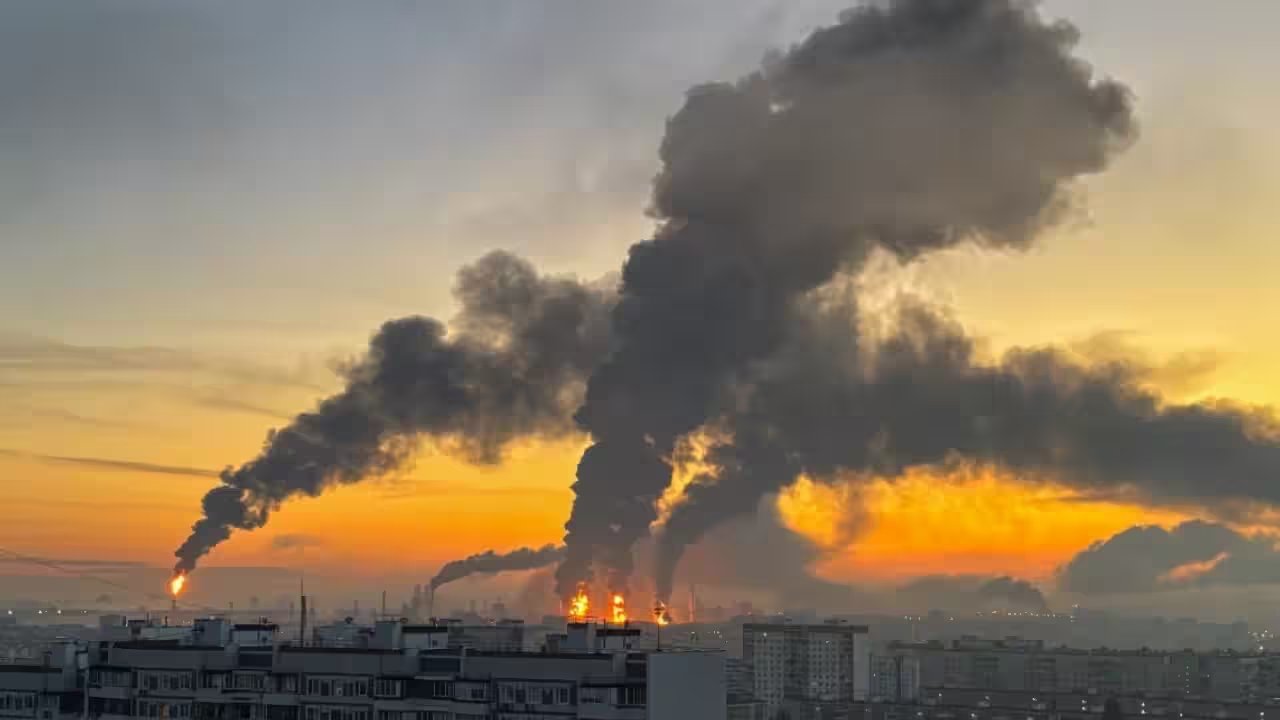
A sweeping wave of Ukrainian drone strikes has disabled operations across nine of Russia's 35 major refineries over the past week, slicing roughly 30% off the country's operational refining capacity since late October.
The strikes hit hard.
Industrial assessments indicate that the targeted installations represent a combined daily nameplate capacity of approximately 300,000 metric tonnes—or 2.2 million barrels of crude. The destruction stretches from industrial hubs in central Russia to key processing assets in Ryazan, Yaroslavl, and the Volga river basin. Most recently, on Monday night, a Ukrainian drone crashed into the Kirishi refinery in the Leningrad region, Russia's second-largest processing plant. The impact ignited an immediate blaze and killed a woman, confirmed the governor of the Leningrad region.
Russia commands an aggregate primary refining capacity of roughly 930,000 tonnes per day. By late October, domestic operators were running approximately 700,000 tonnes—equivalent to five million barrels—through distillation columns every twenty-four hours.
That throughput has stalled. Energy analysts calculate that the direct hit to crude processing will strip up to 200,000 tonnes a day from Russia's refining runs.
The timing could not be worse for the Kremlin. Moscow is already scrambling to contain domestic fuel deficits while struggling to keep diesel shipments flowing to international buyers under an export arrangement struck with US President Donald Trump. Slashed runs at secondary and primary distillation units threaten to choke both domestic distribution pipelines and seaborne tanker dispatches.
| Russian Refining & Strike Metrics | Operational Impact |
|---|---|
| Overall Refining Capacity Loss | ~30% since late October |
| Major Refineries Struck Past Week | 9 of 35 industrial plants |
| Combined Nameplate Capacity Affected | ~300,000 tonnes/day (2.2M barrels/day) |
| Projected Daily Processing Reduction | Up to 200,000 tonnes/day |
| Baseline Daily Crude Processing (Late Oct) | ~700,000 tonnes/day (5M barrels/day) |
| Total Primary National Capacity | ~930,000 tonnes/day |
| Latest Target Confirmed | Kirishi Refinery (Leningrad region) |
Kyiv sharply accelerated deep drone incursions after a mutual halt on energy attacks—announced by US President Donald Trump between Moscow and Kyiv in late October—collapsed before taking hold.
Diplomatic finger-pointing followed immediately. Russian Foreign Minister Sergei Lavrov, writing in the daily newspaper Kommersant on Tuesday, claimed Ukraine deliberately bypassed Trump's framework to press strikes against Russian petroleum complexes.
Yet Kyiv offered no apologies.
Ukrainian President Volodymyr Zelenskyy declared that Ukraine will relentlessly target the infrastructure bankrolling and powering Russia's military machine as long as Moscow pounds Ukrainian civilian life-support systems. He pointed to unrelenting Russian barrages hammering thermal plants, electric distribution networks, district heating hubs, and municipal water pumping stations across Ukraine.
Moscow has refused the de-escalation steps that our partners talked about.
Volodymyr Zelenskyy, President of Ukraine
Moscow answered the refinery strikes with heavy strikes of its own. Prime Minister Sergii Koretskyi reported on Wednesday that Russian barrages struck six major electricity substations situated across four central Ukrainian regions within hours.
Russian strikes also battered railway hubs in eastern and central Ukraine, disrupting transit corridors critical for freight and passenger transport.
With diplomatic mediation effectively dead, both militaries are expanding targeting envelopes, guaranteeing that the air assault on oil terminals, generation substations, and rail yards will intensify over the coming weeks.