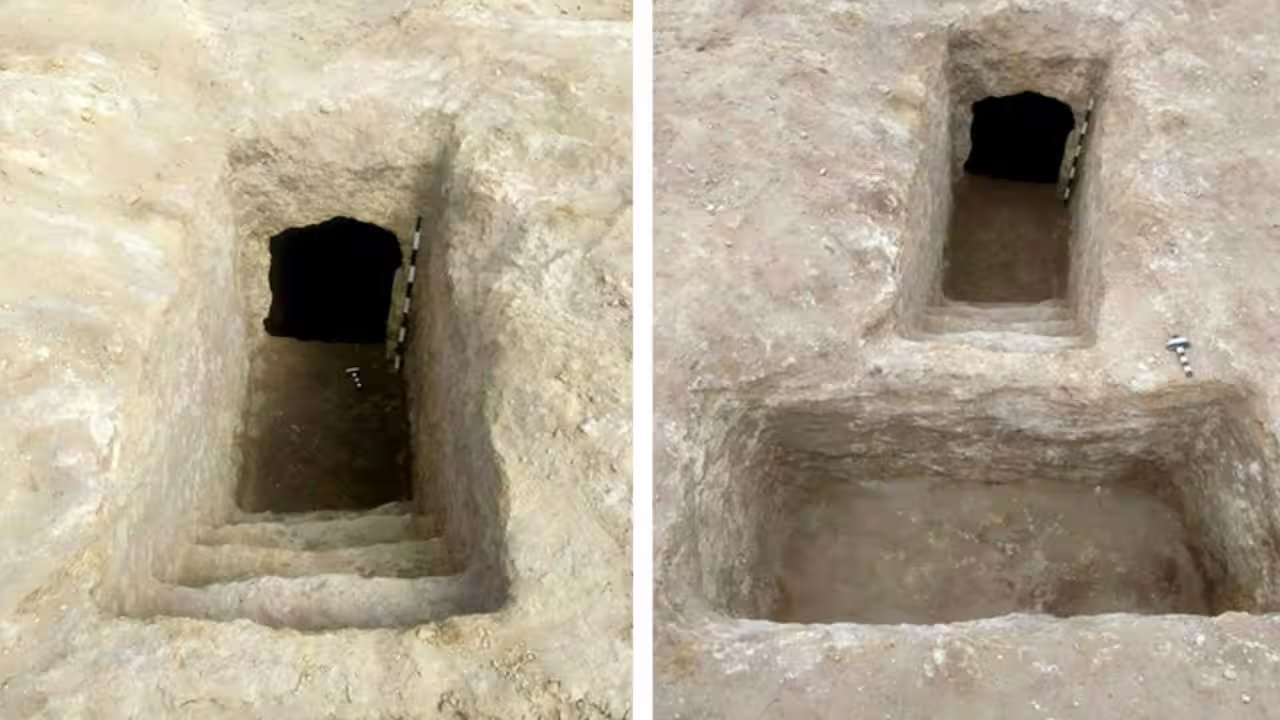
Tell el‑Yahudiya, a low‑lying site in Egypt’s Qalyubia governorate, has long been known for its Hyksos‑era military camp. The latest digs, led by the Egyptian Ministry of Tourism and Antiquities, have revealed a series of rock‑cut tombs—an unexpected find in the clay‑rich soils of the Nile Delta.
Archaeologists identified two distinct tomb designs. One features a staircase leading to a hall lined with burial openings, while the other comprises a rectangular shaft opening into twin chambers.
Portable artifacts—pottery shards, funerary figurines and bronze objects—were recovered from the tombs, allowing researchers to date the burials to the late New Kingdom and the Late Period. The continuity of use across centuries underscores the site’s long‑standing significance.
Above the tombs, the excavation exposed the foundations of a Roman military camp, confirming that the area remained an active military installation into the Greek and Roman eras. The stratigraphic sequence shows the camp layers directly over the burials, indicating successive occupation.
The Ministry of Tourism and Antiquities said the dual discovery will reshape understandings of funerary practices in the Delta. It also announced plans to dig deeper into the Roman layers in the coming months.