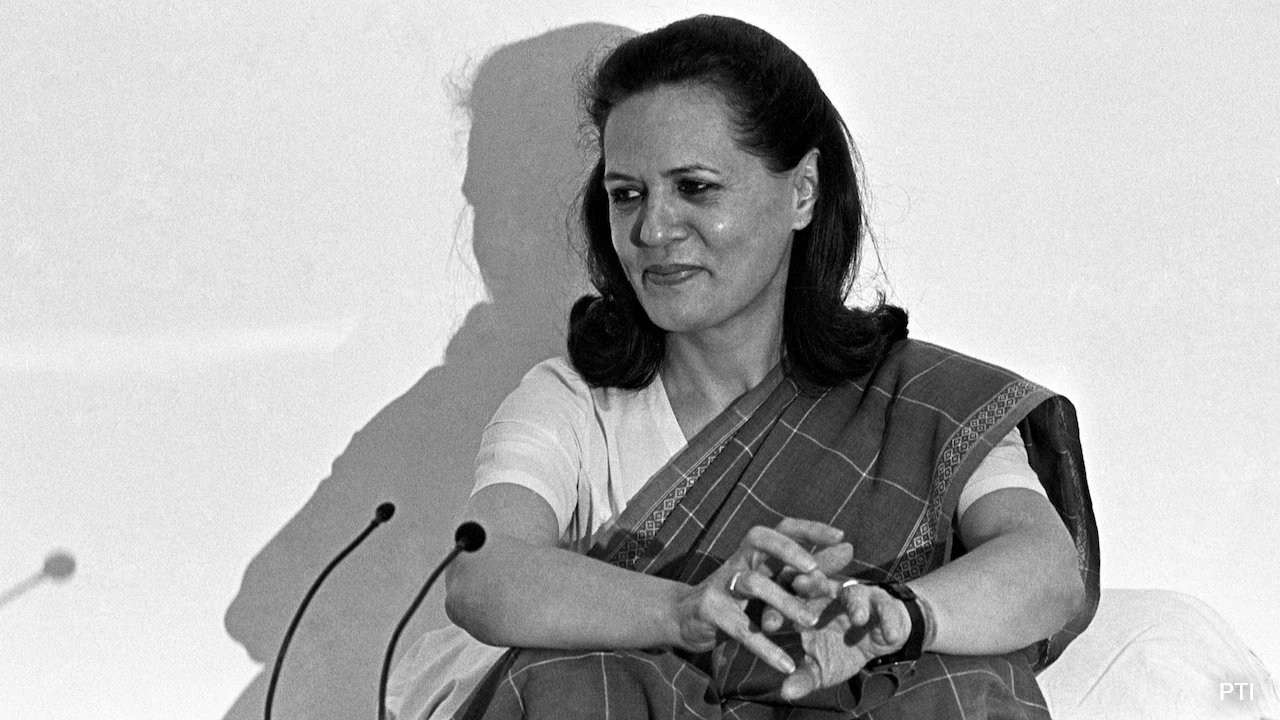
NEW DELHI — Former Congress president Sonia Gandhi released her 544-page memoir on Tuesday, November 10, breaking a twelve-year silence to address the internal party drama that blocked her from taking the prime minister's office in 2004.
Political circles had waited twelve years and three months for this volume. Titled Belonging: A Journey of Love, the book answers back to the bitter allegations that battered the Congress leadership in 2014, when Narendra Modi and the Bharatiya Janata Party swept to power and pushed the Gandhi-led organisation to an unprecedented electoral low. On July 31 of that bruising election year, Gandhi declared she would publish her own account so the public would know the truth.
She kept that promise. Yet the book sidesteps naming the very text that triggered her vow.
Gandhi's memoir directly counters claims first floated by former External Affairs Minister Natwar Singh in his 2014 book, One Life Is Not Enough. Singh, an old family confidant who left Prime Minister Manmohan Singh’s cabinet in 2005 amid corruption inquiries, maintained that Gandhi abandoned the top executive post because her son Rahul delivered an ultimatum, fearful she would be murdered like Indira Gandhi and Rajiv Gandhi.
Gandhi confirms the raw domestic terror, but reclaims the decision as her own.
Long before the 2004 general election, Gandhi writes, one of her children asked whether she would take the oath if the party triumphed at the polls. Her response was immediate: "'Absolutely not!' I'd said, almost indignantly."
Both Rahul and Priyanka opposed the move outright. They had endured the assassinations of their grandmother in 1984 and their father in 1991. To them, the prime minister’s residence carried a mortal sentence. When United Progressive Alliance partners packed into 10 Janpath and spent over an hour pleading with her to reconsider, Gandhi weakened and murmured, "Theek hai."
Her son exploded.
'You said yes?' thundered Rahul. 'Pressurised? You are being pressurised?' he demanded.
Sonia Gandhi, in *Belonging: A Journey of Love*
Beyond the family's visceral opposition, practical electoral calculation governed her final refusal. Gandhi notes she feared the BJP and allied parties would relentlessly exploit her foreign origin to destabilise governance.
In her prologue, Gandhi insists the text was never conceived as a political manifesto. She describes it instead as a private story framed by national events, tracing the journey of a young woman who left a provincial Italian town to settle in India and witness historic upheavals.
"It took me a long time, writing and rewriting, with many breaks in between," Gandhi writes. "And here it is — my own story."
Hers was a reluctant pen. In the acknowledgements, she credits close friend Manjulika Dubey with forcing her to finish the text, admitting that across the years she repeatedly protested, "I can't write another word!" and asked, "Why on earth did I get into this?!" She also singled out veteran journalist Suman Dubey — Manjulika’s husband and a figure who featured prominently in Singh's earlier version of the 2004 transition.
| Publication Milestone | Official Detail |
|---|---|
| Title | Belonging: A Journey of Love |
| Author | Sonia Gandhi |
| Length | 544 Pages |
| Release Date | Tuesday, November 10 |
| Primary Theme | Personal memoir of Italian migration, family tragedies, and 2004 premiership choice |
| Disputed Subject | Rebuttal of Natwar Singh's 2014 assertions regarding 2004 government formation |
Reactions split immediately down party lines. Rahul Gandhi publicly praised the release, remarking that he was delighted readers could finally examine his mother's life in her own words, while businessman Robert Vadra challenged BJP leaders to read the memoir without bias. Across the political aisle, opposition leaders launched fierce attacks, with Shiromani Akali Dal leader Harsimrat Kaur Badal slamming the publication and alleging the Congress leadership treated mass historical tragedies as mere footnotes.
With copies now circulating in bookstores nationwide, parliamentary opponents are reviewing the 544 pages, searching for fresh political ammunition as the national political season intensifies.