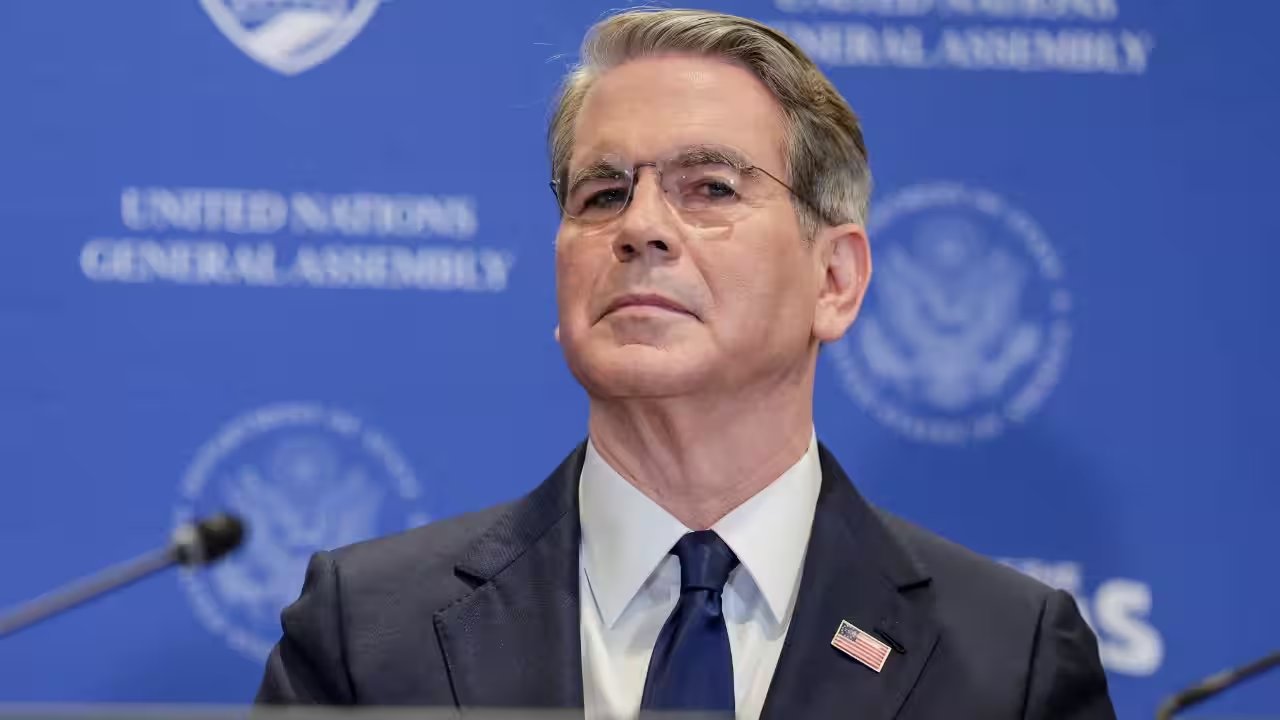
Washington will establish a bilateral emergency dialogue with Beijing to contain the catastrophic risks of advanced artificial intelligence while preserving fierce technological rivalry, US Treasury Secretary Scott Bessent announced in New York.
Speaking before the National Committee on US-China Relations, Bessent outlined the White House's economic and strategic agenda ahead of a pivotal face-to-face summit between US President Donald Trump and Chinese President Xi Jinping next week in Shenzhen. The meeting, scheduled on the sidelines of the November 18-19 Asia-Pacific Economic Cooperation (APEC) leaders' summit, marks the third sit-down between the two leaders this year. Bessent confirmed he will travel directly to China for the high-stakes negotiations.
The policy posture is deliberate. Washington seeks parity without isolation.
"As SI advances, so will the need to engage in new areas of risk management — and to demonstrate how two nations can reconcile the demands of competition with the responsibilities of leadership," Bessent said, insisting that the two powers must "harbour no illusions about the differences between the United States and China."
The planned dialogue zeroes in on superintelligence — computational systems exceeding human cognitive benchmarks. Washington and Beijing plan to establish joint protocols for evaluating and testing frontier AI models before commercial deployment, while drafting mandatory guardrails to keep human command intact over autonomous decisions.
Both capitals have also committed to operationalize a direct crisis hotline to issue instant alerts during systemic software failures or runaway AI incidents, a mechanism initially hammered out during Trump and Xi's White House meeting in September. While Trump had previously balked at imposing sweeping technological curbs that might dull the American private sector's competitive edge, the Treasury chief argued that catastrophic risk management requires baseline coordination.
We also expect to exchange best practices for evaluating and testing advanced models before their release, and for keeping human judgment firmly in command of this technology.
Scott Bessent, US Treasury Secretary
Beyond algorithm governance, Bessent presented a revised economic framework built to withstand friction over the persistent US trade deficit. The blueprint rejects total commercial severance in favor of targeted risk reduction, reviving bilateral mechanisms negotiated across the previous two presidential summits.
"The US objective is to 'de-risk, not to decouple' from trade with China," Bessent stressed. He pointed back to 1784, when the first American merchant vessel docked in Canton to barter Appalachian ginseng for Chinese porcelain, silk, and tea, to demonstrate that trade persists through geopolitical antagonism.
| Bilateral Economic & Tech Initiatives | Agreed Policy Framework | Operational Scope |
|---|---|---|
| Superintelligence (SI) Protocol | Joint Model Evaluation & Pre-Release Testing | Mandating human operational command over frontier systems |
| Emergency Alert Hotline | Bilateral Incident Notification Channel | Established during September White House summit |
| Proposed Board of Trade | Reciprocal Tariff Relief | $30 Billion non-sensitive cargo in each direction |
| Proposed Board of Investment | Bilateral Corporate Market Access | Structured dispute forum for US & Chinese firms |
Under the trade terms, a newly minted "Board of Trade" will arbitrate reciprocal tariff reductions covering $30 billion worth of non-sensitive merchandise flowing in both directions, matched by formal Chinese procurement targets for American agricultural exports. A companion body, the "Board of Investment," will handle market-access disputes and establish operating predictability for US enterprises inside China.
Yet the diplomacy arrives against an explosive corporate intelligence scandal in Silicon Valley that Bessent omitted from his prepared remarks.
Nvidia chief executive Jensen Huang faces an escalating internal investigation launched by his own board of directors following disclosures regarding an undisclosed personal relationship with Alice Huang, a businesswoman flagged by US intelligence services for suspected ties to Chinese state intelligence operations. While China's Foreign Ministry denounced the espionage claims as "groundless" and an orchestrated "smear," Nvidia confirmed its independent directors hired elite New York law firm Wachtell, Lipton, Rosen & Katz to steer the corporate probe. The chipmaker maintains that company trade secrets and US national security remain uncompromised.
Legal fallout has already breached the courtroom. In a class-action complaint filed Monday in California federal court, retail investor Mark Kistenmacher sued Nvidia and Huang, alleging securities fraud. The lawsuit charges the executive and company leadership with concealing the relationship and misrepresenting dealings with her Singapore-based entity, Megaspeed International.
Nvidia previously asserted that its internal compliance reviews cleared Megaspeed of irregular conduct. Kistenmacher's lawsuit, demanding a jury trial and unspecified monetary damages on behalf of investors who acquired Nvidia stock between October 9, 2025, and November 8, 2026, alleges shareholders were kept blind to profound regulatory and national security vulnerabilities.
Bessent and the American diplomatic delegation land in Shenzhen ahead of the November 18 APEC curtain-raiser, where Trump and Xi are scheduled to formally review the superintelligence framework and sign the reciprocal tariff schedules.
| Agricultural Pledges | Targeted Commodity Procurement | Direct Chinese purchases of US farm exports |