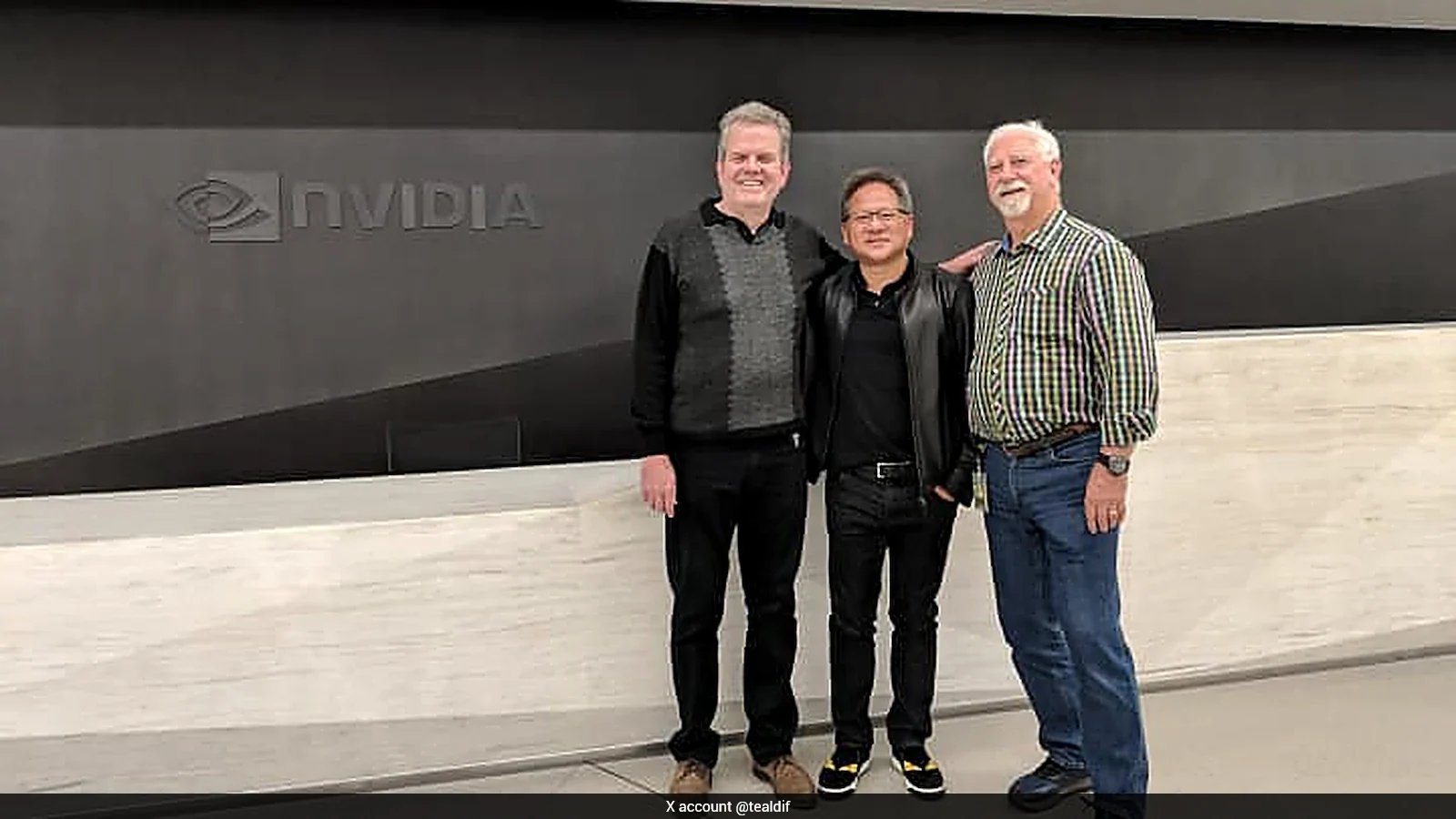
Silicon Valley empires rarely start in spotless corporate boardrooms. Thirty-three years ago, Nvidia began over bottomless cups of diner drip.
Co-founders Jensen Huang, Chris Malachowsky, and Curtis Priem spent hours huddled in a booth at a local Denny's restaurant across 1992 and 1993, arguing over silicon architectures. They were moonlighting engineers looking for neutral ground. Priem and Malachowsky designed microprocessors at Sun Microsystems; Huang handled core engineering at LSI Logic. They needed a hideout away from their corporate employers where they could draw blueprints without raising suspicion. Denny's served as their clandestine command center.
"We were not good customers," Malachowsky recalled of their marathon diner sessions. "We were going to show up for four hours and drink 10 cups of coffee."
Waitstaff eventually banished the trio to an annex at the rear of the restaurant. There, surrounded by San Jose police officers filling out incident paperwork, the engineers drafted plans for specialized chips aimed at processing complex 3-D visuals. Malachowsky took charge of hardware design, while Priem mapped out the software architecture. Huang assumed operational and commercial control, calculating manufacturing expenses, silicon wafer yields, and profit margins between breakfast orders.
He set uncompromising conditions before signing on.
"Jensen refused to join the startup unless it could make $50 million in sales in a year," Priem said.
Danger cut their booth sessions short. After spotting bullet holes punched through the front window of the diner, the founders abandoned the restaurant.
"Maybe this isn't the safest place to hang out for hours and hours," Malachowsky observed.
The team moved their planning sessions to Priem's townhouse. Yet securing a roof proved simpler than finding an identity. Priem favored the shorthand "NV"—an industry abbreviation for next version—and wanted a moniker that evoked the word "envy." Their first selection was Nvision. Priem even recorded a greeting on his answering machine welcoming callers to Nvision global headquarters. The name stalled immediately after a trademark sweep revealed several existing companies already owned it.
Priem flipped through a Latin dictionary until he landed on invidia, meaning envy. He struck the first letter. Nvidia was born.
Skepticism trailed the fledgling enterprise from its inception. When Huang informed his family that he was walking away from his corporate post at LSI Logic to launch a chip business with two friends, his mother pushed back with blunt advice: "Why don't you go get a job?"
The bet was gaming silicon. The outcome was total control over the computing engine of the 21st century.
The founders wagered that personal computers would demand dedicated microprocessors capable of rendering realistic 3-D computer graphics. Decades later, that exact graphics processing unit architecture proved uniquely suited for training neural networks and running heavy machine-learning workloads. Nvidia poured capital into parallel computing and artificial intelligence hardware years before the arrival of chatbots like ChatGPT transformed enterprise computing.
| Corporate Benchmark | Operational Metric | Historical Detail |
|---|---|---|
| Current Market Capitalization | $3.98 Trillion | Surpassed major global technology peers |
| Founding Timeline | 1992–1993 | Launched by Huang, Malachowsky, and Priem |
| Foundational Revenue Target | $50 Million annually | Minimum entry condition set by Jensen Huang |
| Original Product Scope | 3-D Graphics Silicon | Specialized video game graphics accelerators |
Market Context: The hardware choices hammered out at that roadside booth created a corporate powerhouse now sitting at the apex of global capital markets. The company's specialized GPUs remain the benchmark silicon powering the planetary artificial intelligence buildout, anchoring multibillion-dollar data center investments worldwide.
| Current Primary Engine |
| Data Center GPUs |
| Powering enterprise AI clusters and LLM training |