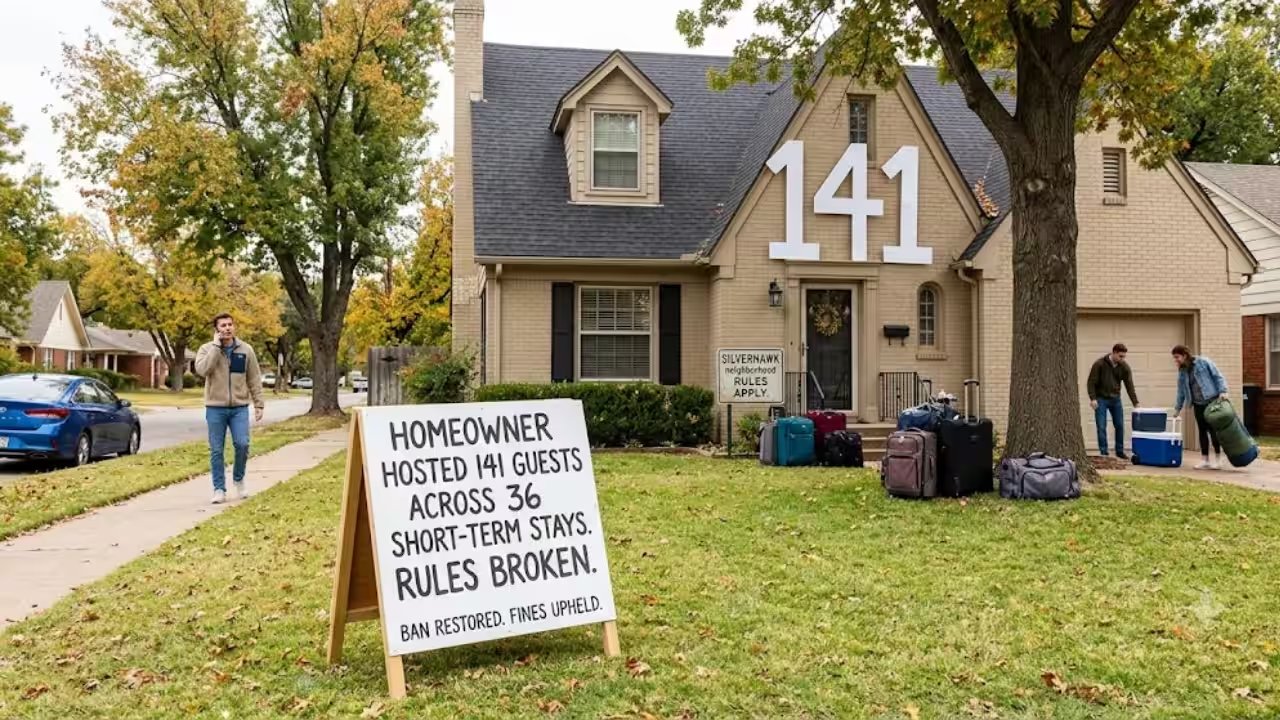
The Oklahoma Supreme Court ordered homeowner Adewale Eniola Tawose to pay $8,528 in accumulated fines on November 10, 2026, after ruling his short-term rental business breached neighborhood residential covenants.
By reinstating the restrictions, the state's highest judicial bench crushed an appellate ruling that had briefly shielded short-term property rentals from community prohibitions. The dispute in case 122129, Silverhawk Homeowners Association, Inc. v. Tawose, drew a hard line between private property rights and neighborhood covenants that bar commercial ventures in residential subdivisions.
He fought the board. He lost.
Between late 2021 and late 2023, Tawose hosted 141 guests across 36 separate bookings at his house within the Silverhawk subdivision. When the Silverhawk Homeowners Association Board flagged the short-stay activity and demanded compliance with community covenants, two other homeowners ceased operations and shifted their properties to long-term leases. Tawose refused, insisting he held the legal entitlement to deploy his residential property as he chose.
Following an exhaustive five-day trial, the District Court of Oklahoma County barred Tawose from running the short-term operation and levied $8,528 in fines and assessments. Tawose appealed, securing a temporary victory when the Oklahoma Court of Civil Appeals overturned segments of the judgment, deciding that transient guest rentals did not automatically strip a home of its residential status or constitute commercial exploitation.
The state Supreme Court erased that rationale entirely.
Writing for the majority, the justices determined that Tawose's enterprise mimicked a commercial hotel rather than an ordinary home. The property operated with strict check-in and check-out windows, stocked guest amenities, deployed turnover cleaning services between stays, and utilized an on-site cleaner who handled property management and resolved guest inquiries.
Tawose disputed several operational claims, yet the high court highlighted that he retained explicit rights to enter the premises throughout customer stays—a standard practice for hoteliers and innkeepers that differs sharply from standard long-term residential leasing. Stacking 141 paying occupants across 36 visits over two years severed the property from residential domestic use.
| Legal and Operational Parameter | Official Finding and Case Status |
|---|---|
| Case Number & Style | Case 122129; Silverhawk HOA v. Tawose |
| Court of Jurisdiction | Oklahoma Supreme Court |
| Defendant | Adewale Eniola Tawose |
| Guest and Booking Volume | 141 guests across 36 distinct stays (2021–2023) |
| Financial Penalty Upheld | $8,528 in association fines and assessments |
| Operational Hallmarks Cited | Fixed check-in times, cleaning crew, host right-of-entry |
HOC covenants establish binding private contracts designed to preserve suburban tranquility and protect neighborhood asset values. The Supreme Court established that when an owner routinely opens suburban doors to rotating waves of paying customers for profit, the enterprise breaches neighborhood covenants dedicated to single-family residential living.
Under the restored District Court order, Tawose must immediately liquidate the $8,528 liability owed to the Silverhawk Homeowners Association and permanently halt all short-term guest operations at the property.
| Final Judgment | District Court order reinstated; commercial ban enforced |