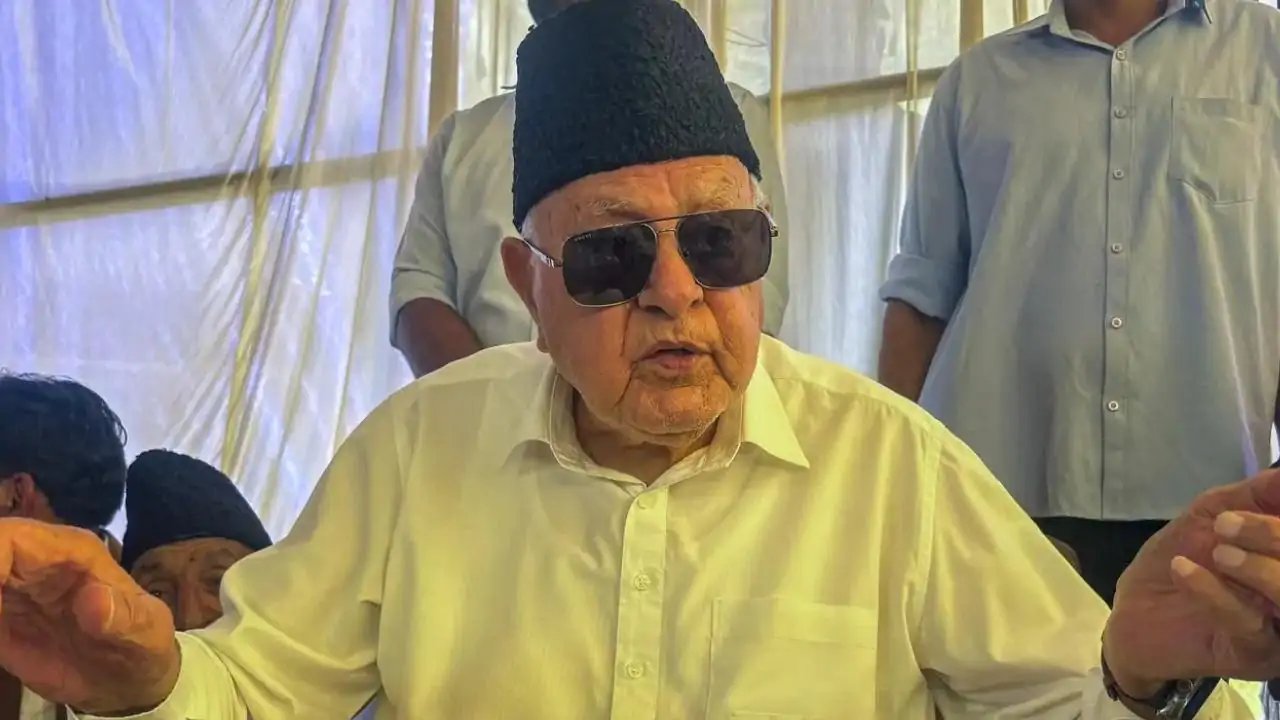
SRINAGAR — National Conference president Farooq Abdullah on Thursday challenged the Centre's diplomatic doctrine on Pakistan, urging immediate bilateral negotiations rather than waiting for cross-border firing to cease.
Military confrontations solve nothing. The former Jammu and Kashmir chief minister mounted his argument directly against New Delhi’s longstanding position that talks and terror cannot coexist, asserting that prolonged diplomatic freezes guarantee endless bloodshed across the subcontinent.
Ab aap intezaar karenge, jab tak aap sabki goliyan band ho jayengi, tab tak raat ho jayegi.
Farooq Abdullah, National Conference President
Abdullah spoke to reporters after offering condolences to the family of retired information officer Madan Mantoo, who died recently following a cardiac arrest. The veteran leader pressed Islamabad to immediately halt its support for terrorism, stressing that cross-border violence would never yield political concessions or alter Kashmir's constitutional reality.
Kashmir remains an indivisible part of India. Abdullah underscored that reality firmly. But he pointed to escalating war zones across Iran and Ukraine as immediate proof that armed conflicts generate devastation rather than durable settlements. Mutual engagement remains the sole viable exit route.
The dialogue pitch arrived on the heels of back-to-back terrorist assaults across Jammu and Kashmir that shattered official claims of complete regional pacification. Armed militants launched separate strikes in Kulgam and Kishtwar districts within a 48-hour span, inflicting sharp casualties on security personnel.
| Security Metric | Official Assessment Details |
|---|---|
| Fatalities | 2 Special Police Officers (SPOs) |
| Injuries | 3 Central Reserve Police Force (CRPF) personnel |
| Attack Window | 48 hours across Kulgam and Kishtwar |
| Political Stance | Kashmir confirmed as integral part of India |
The violence pierced administrative declarations that terrorism had ceased following the abrogation of Article 370. Abdullah directly contested assertions from New Delhi regarding total regional normalcy, cautioning that security risks remain active and erratic. One never knows where the next strike might erupt.
Abdullah pushed for the immediate revival of the South Asian Association for Regional Cooperation (SAARC), arguing that regional neighbors must assemble at the conference table to settle disputes and unlock shared economic growth. He pointed to the European Union, where nations put aside historic wars to build collective prosperity.
Past prime ministers mapped that road. Abdullah cited Indira Gandhi’s doctrine of fostering steady ties with surrounding states, noting that India must step forward as South Asia's largest power to assemble regional leaders under the SAARC framework.
Abdullah also moved to clarify past remarks regarding Pakistan that drew political blowback, emphasizing that his references addressed the atrocities committed during the 1947 tribal invasion. Those raids included the killing of a Christian doctor and his family, alongside the rape of nuns at a hospital in Baramulla.
Security forces across Kishtwar and Kulgam have expanded cordon-and-search operations to hunt down the modules responsible for the fatal shootings, while administrative officials review local deployment grids ahead of upcoming regional security assessments.