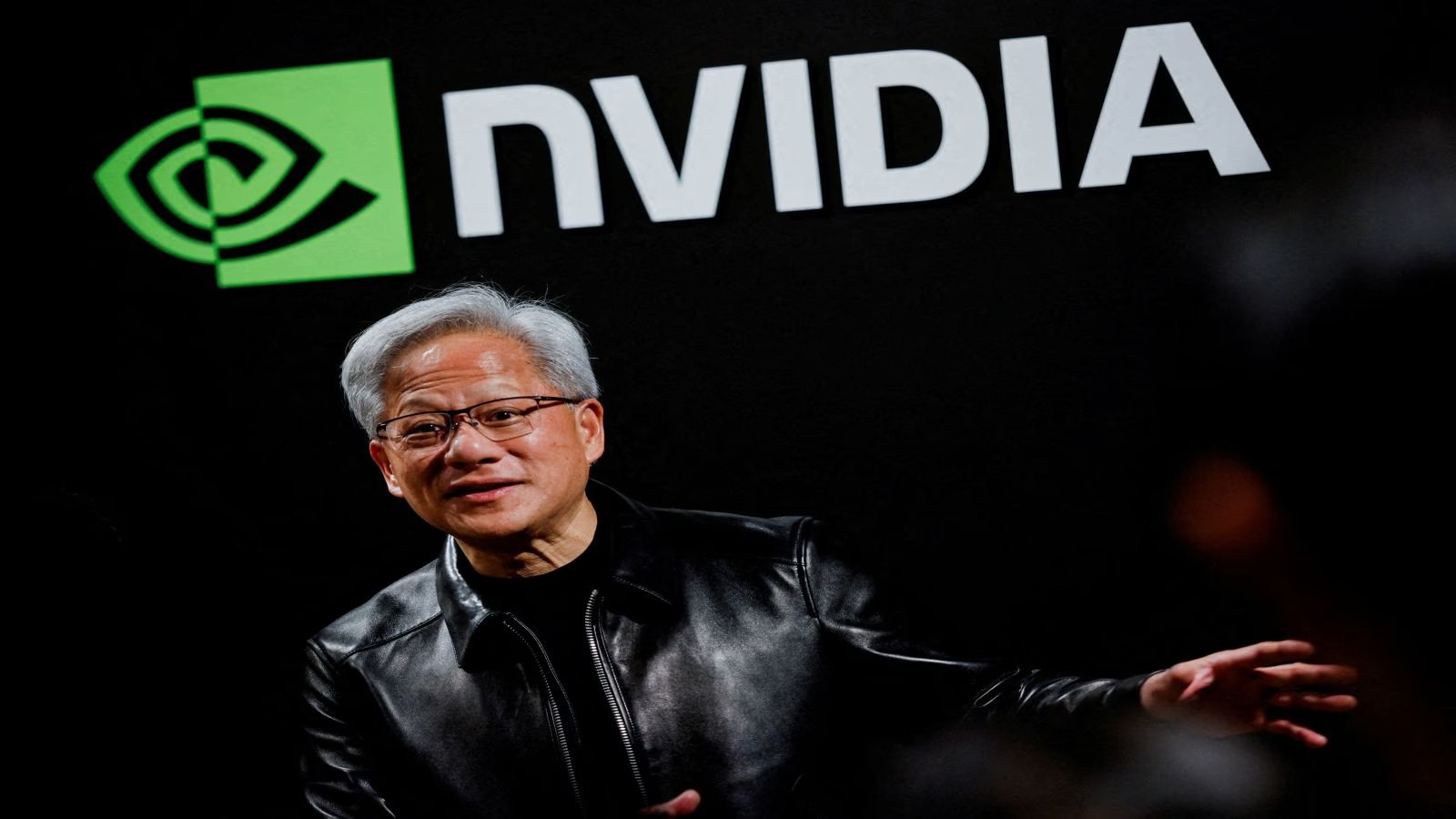
Nvidia crossed the $5 trillion threshold in October 2025. No corporation had ever touched that number.
The Santa Clara chipmaker vaulted into financial history on the back of its H100 and next-generation Blackwell graphics processors—silicon engines that anchor modern enterprise artificial intelligence data centres. Capital rushed into the stock from sovereign wealth funds, pension desks, and retail brokerage accounts alike.
At the center stands Jen-Hsun Huang. Known universally across the technology sector for his signature black leather jacket, the 62-year-old co-founder and chief executive officer controls roughly 3.5% of Nvidia’s equity. A family trust overseen with his wife, Lori Huang, commands an estimated $103 billion in company stock.
Yet the road to corporate supremacy began far from Silicon Valley balance sheets.
Huang was born in Taipei on February 17, 1963. His family relocated to Thailand, where his father worked at an oil refinery, before regional political instability prompted his parents to send nine-year-old Huang and his older brother to relatives in Washington state. Those relatives dispatched the boys to Oneida Baptist Institute, a boarding school in rural Kentucky. Huang spoke little English. He washed campus toilets and handled menial cleaning chores as the youngest pupil in his class.
His mother countered the isolation with discipline, selecting ten random words from an English dictionary each morning for her sons to memorize.
"I cleaned more toilets than all of you combined," Huang told Stanford University students in a 2024 address, pointing to the manual labor that grounded his operational endurance. The family eventually reunited in Oregon, where the teenage Huang worked as a dishwasher, table busser, and server at a local Denny's diner.
At Oregon State University, while studying electrical engineering at age 17, Huang met fellow engineering student Lori Mills. He offered a blunt bargain: study together every Sunday to lock in straight As. He also issued an audacious wager, promising he would become a chief executive by age 30. They married five years later.
Huang kept the timeline to the minute.
On his 30th birthday in 1993, following engineering stints at AMD and LSI Logic alongside a master's degree from Stanford, Huang founded Nvidia with Chris Malachowsky and Curtis Priem. Their original boardroom was a booth inside a San Jose Denny's—a corner the diner chain has since memorialized with a brass plaque.
Public markets embraced the venture in 1999. Nvidia completed its initial public offering that year and launched the GeForce 256, marketed as the world's first GPU, primarily targeting 3D PC gaming.
Then Huang made the high-stakes capital allocation decision that defined his career.
In 2006, Nvidia introduced CUDA, a proprietary software architecture that unlocked graphics processors for general-purpose mathematical compute. Wall Street punished the stock for years over soaring research expenditures that produced modest commercial revenue. But Huang refused to pull back. When academic researchers proved in the 2010s that CUDA-enabled GPUs trained deep neural networks exponentially faster than standard central processing units, Nvidia captured an impenetrable head start.
| Milestone / Corporate Metric | Parameter Details |
|---|---|
| Market Capitalization Peak | $5.0 Trillion (Achieved October 2025) |
| Jensen Huang Direct Equity Stake | ~3.5% of outstanding shares |
| Lori Huang Family Trust Valuation | ~$103 Billion in Nvidia equity |
| Software Moat Foundation | CUDA (Launched 2006) |
| Core Enterprise Hardware | H100 and Blackwell GPU Architectures |
| Corporate Foundation Date | February 17, 1993 (San Jose, California) |
Market Context: Nvidia's moat rests on a dual lock-in: proprietary CUDA code running exclusively on specialized hardware architectures. Competitors cannot simply design faster silicon; they must dismantle an enterprise ecosystem where millions of developers write code natively optimized for Nvidia compilers.
The financial dam broke in November 2022 when OpenAI released ChatGPT. Global demand for hyper-dense computing capacity surged beyond existing supply lines. Nvidia held the only scalable production fleet.
Every sovereign nation and cloud infrastructure giant scrambled for allocations of H100 silicon, followed immediately by orders for the Blackwell architecture. Hardware pricing power pushed gross margins to record highs.
Scale brought immediate political realpolitik. In Washington, early regulatory skepticism gave way to strategic alignment. Donald Trump acknowledged in July 2025 that he had previously weighed antitrust interventions against the chipmaker before grasping its critical leverage.
I said, 'Look, we'll break this guy up,' before I learned the facts of life.
Donald Trump, commenting on Nvidia's systemic market importance in July 2025.
The corporate chessboard also carries an extraordinary genealogical twist. AMD Chief Executive Officer Lisa Su—Huang's primary rival in high-performance datacenter compute—is his first cousin once removed. Taiwanese genealogist Jean Wu revealed that Huang's mother is the sister of Su's maternal grandfather, an ancestral lineage Nvidia officially confirmed.
The two executives never shared a childhood table, crossing paths only after climbing to the summit of Silicon Valley.
"No family dinners," Su noted in an industry discussion, terming the executive overlap an interesting coincidence.
In Taiwan, public fascination with Huang mirrors rock-star fandom, a cultural fixation dubbed "Jensanity." Crowds shadow his movements through Taipei's night markets. During a May visit to Raohe Street, Huang bypassed a massive line at a grilled corn stall by simply paying for every patron waiting ahead of him. Both of his adult children, Madison and Spencer, now work inside Nvidia, while Lori and Madison manage the wardrobe that made the leather jacket a global fixture.
Huang attributes his market dominance to deliberate adversity. Speaking to Stanford graduates, he rejected conventional corporate optimism in favor of psychological friction.
"For all of you Stanford students, I wish upon you ample doses of pain and suffering," Huang stated, arguing that low expectations breed the resilience required to survive market corrections. Within Nvidia's executive suites, he still invokes "pain and suffering" to keep engineering divisions on war footing.
With enterprise capital expenditures for compute facilities accelerating across North America, Europe, and Asia, Nvidia faces mounting foundry supply demands alongside competitive chip designs from AMD. But as the market enters the next phase of enterprise infrastructure deployment, Huang commands the computing floor from the largest valuation ever logged on a public exchange.
| Initial Public Offering | 1999 (Coinciding with GeForce 256 release) |