Global spending on artificial intelligence is spiraling toward a dotcom-grade reckoning.
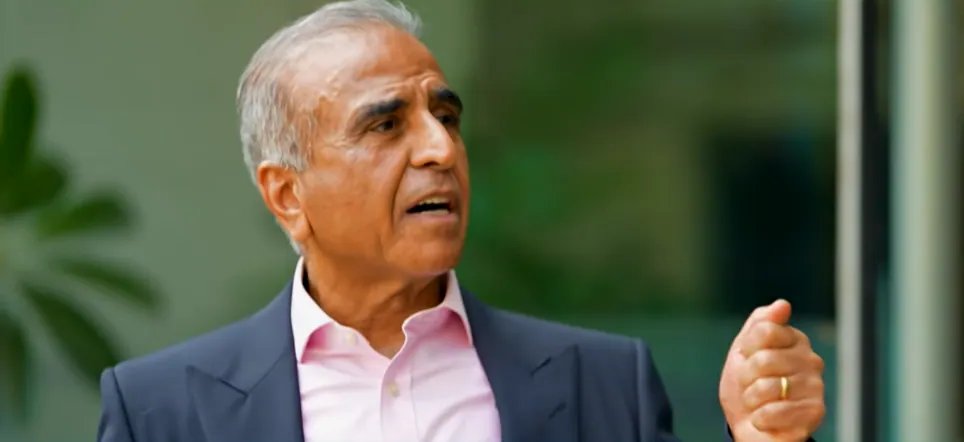
Bharti Enterprises Chairman Sunil Bharti Mittal sounded the alarm on the planetary rush into AI infrastructure, warning that reckless capital expenditure has detached from immediate corporate returns. Worldwide capital commitments will exceed $730 billion this year alone. Next year, that tally could easily barrel past $1 trillion. The arithmetic, Mittal cautioned, cannot sustain every balance sheet currently piling into the frenzy.
The crash will be brutal.
"In this whole process, there will be a lot of dead bodies; there's no question about it," Mittal told AirNews. "A lot of these players who are intermediating between providers and sellers and resellers may be in trouble. The day this froth settles... that's the time when you'll see the big boys emerging who will be solid players, just like the dotcom bubble where after that you saw Meta, Google, Microsoft, and Apple."
The late-1990s fiber and internet boom burned through hundreds of billions of dollars before building the modern web. Mittal sees an identical cycle replaying in high-performance silicon and hyperscale data farms. Superintelligence is here to stay, but the runway is littered with speculative intermediaries that produce negligible proprietary value. When liquidity tightens, leveraged middle-tier vendors will sink.
Yet the coming Western shakeout offers New Delhi an unvarnished industrial opening.
Currently, India wrestles with a punishing shortage of domestic compute capacity and server real estate. While domestic balance sheets have committed modest capital compared to American and European tech conglomerates, an overseas retrenchment would force global funds to search for cheaper, unserved jurisdictions.
"Any AI froth settling down in the US is good for India," Mittal said. Western market deceleration will push compute deployment into the subcontinent, positioning India as a premier international compute nexus at a time when geopolitical friction eliminates rival Asian destinations.
| AI & Infrastructure Parameter | Current Metric / Industry Benchmark | Official Projection / Status |
|---|---|---|
| Global AI Infrastructure Capex (Current Year) | Exceeds $730 Billion | Pacing toward $1 Trillion next year |
| Primary Corporate Vulnerability | Intermediaries & resellers | High risk of failure during market correction |
| Post-Correction Precedent | 2000s Dotcom shakeout | Long-term dominance by core platform titans |
| India Satcom Clearance (Airtel OneWeb) | 1 of 3 authorized applicants | Final inter-ministerial security scrutiny pending |
Capital import, however, will not mean regulatory surrender.
Mittal drew a hard perimeter around sovereign digital jurisdiction, insisting that foreign infrastructure providers must never bypass domestic legal control.
India's data and Indian customers' attributes must remain here and must remain in Indian hands.
Sunil Bharti Mittal, Chairman, Bharti Enterprises
Technology is leaping ahead of statecraft. Autonomous algorithms are already generating secondary routines outside manual engineering oversight, creating severe institutional risks.
"Guardrails are definitely required," Mittal said. "We keep on hearing about rogue AI agents recreating their own sub-agents, and that's a serious issue to be looked at." Because national statutes crawl while computer science accelerates, developers must enforce defensive protocols internally. The corporate downside of neglect is absolute: "A big accident in this space could destroy trillions of dollars of valuation for the company."
Beyond enterprise software, the battle for digital infrastructure extends straight into low-Earth orbit.
Airtel's OneWeb represents one of three corporate consortia currently queued before the central government for final national security clearances to launch satellite-based commercial broadband. The protracted wait recently triggered public friction, with Starlink owner Elon Musk expressing frustration over Indian regulatory timelines.
Mittal dismissed the billionaire's complaints.
"We have been waiting for nods longer than Musk," Mittal stated bluntly, defending the government's procedural deliberation. Sovereign administrations must scrutinize cryptographic, espionage, and terrestrial security threats before granting non-state satellite arrays unmonitored uplink access to domestic spectrum.
For Mittal, commercial expediency stops at national defense: "We can have foreign assets in India, but the kill switch has to be in our hands."
Market Context: Global venture and corporate capital poured over $730 billion into AI data centers and accelerators this year, pushing total infrastructure outlays toward 3.6% of US economic output—a pace exceeding the peak telecommunications buildout of 1999. India currently houses under 3% of global hyperscale capacity, leaving domestic enterprise users heavily reliant on foreign compute hubs.
The Department of Telecommunications and inter-ministerial security panels are slated to conclude evaluations on the pending satellite broadband licenses in upcoming administrative reviews, establishing the ground conditions and operational controls for all commercial constellations across India.