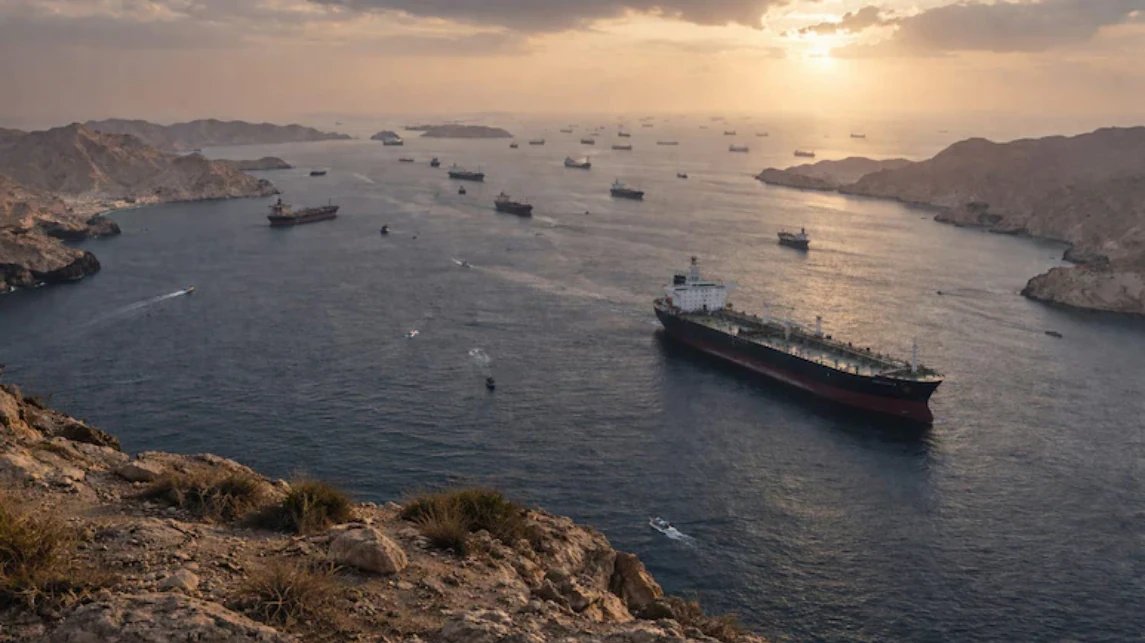
DUBAI — Explosions crippled two commercial oil tankers in the Strait of Hormuz on Tuesday, leaving both vessels ablaze after they defied Iranian navigation restrictions in the strategic waterway, the Islamic Revolutionary Guard Corps announced.
Flames engulfed both ships. The waterway carries one-fifth of global oil supplies, and the blasts immediately rattled maritime traffic along the world's most critical petroleum corridor. Guard Corps commanders did not disclose the names, flags, or operator origins of the burning tankers.
According to an official statement released by the IRGC, Iranian forces intercepted the vessels after both tankers entered navigation lanes outside Tehran's designated maritime framework.
Two violating oil tankers, travelling along an unauthorised route in the Strait of Hormuz, have been brought to a halt following massive explosions and are left burning.
Islamic Revolutionary Guard Corps
Iranian military officials detailed specific triggers behind the dual explosions. The Guard Corps stated that one vessel, identified as a supertanker, struck a naval mine that triggered a massive blast. The second tanker suffered an operational incident while attempting an unauthorized passage under armed convoy, according to the military release.
"The second tanker, which was under the escort of the aggressor American military and attempting a covert passage via an illegal route, also had an incident," the Guard Corps added.
Hours after Tehran's announcement, the Abu Dhabi National Oil Company confirmed a direct strike on its maritime fleet. ADNOC stated that one of its commercial vessels "sustained damage following an attack in the UAE's territorial waters" in the Persian Gulf during Tuesday afternoon.
Emirati officials did not confirm whether the damaged ADNOC ship was one of the two vessels referenced in the Iranian military communique.
Yet the maritime perimeter remains volatile. Regional shipping routes have faced severe disruptions since wider Middle East hostilities erupted in late February, prompting Tehran to impose tight passage controls across the waterway. The Iranian government demands that commercial ships use only routes cleared by the Islamic Republic. In response, Washington enforced a naval blockade against Iranian ports and deployed warships to guide commercial traffic through the chokepoint.
| Operational Parameter | Official Status | Details Reported |
|---|---|---|
| Vessels Targeted | 2 Commercial Tankers | Both on fire; 1 confirmed supertanker |
| Primary Mechanism | Naval Mine & Interdiction | IRGC claims 1 mine strike, 1 convoy disruption |
| Escort Profile | United States Navy | Second vessel reportedly transited under US military escort |
| UAE Territorial Incident | 1 ADNOC Vessel | Damaged in afternoon strike within UAE waters |
Conflicting security claims have deepened the confrontation between Tehran and Western coalition forces. Iranian state authorities have repeatedly declared that foreign commercial vessels caught fire in the strait throughout recent weeks, asserting that drifting naval mines remain active across primary channels.
United States military authorities rejected that assessment. United States Central Command, which directs American military operations across the Middle East, stated earlier that coalition naval sweeps had cleared all active mines from the waterway. CENTCOM also confirmed last month that coordinated naval protection operations had enabled regional energy producers to export 1.5 billion barrels of crude through the Strait of Hormuz since the summer.
Commercial maritime monitors and regional port authorities in Fujairah and Dubai are tracking salvage efforts and damage assessments as naval units review security protocols across Gulf shipping lanes.
| Strategic Freight Share |
| 20% of Global Oil |
| US CENTCOM facilitated 1.5B barrels since summer |