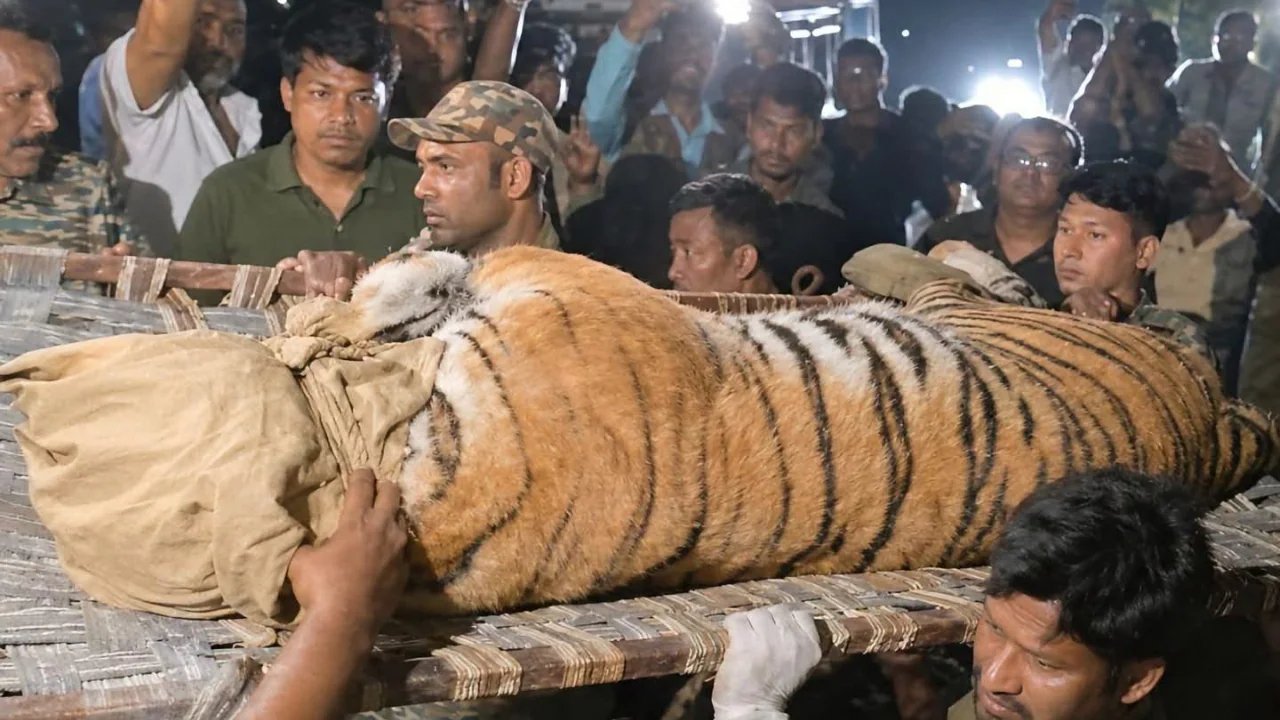
ALIPURDUAR — Three-year-old Royal Bengal tigress Dooars Rani aborted three foetuses inside northern West Bengal's Buxa Tiger Reserve on the night of November 7, throwing the state’s flagship carnivore revival project into turmoil.
The project unraveled fast.
The animal, officially catalogued as T-138, arrived from Bihar’s Valmiki Tiger Reserve in early October to establish a resident breeding population in an expanse that has lacked one for decades. Instead, repeated sedations, an undetected pregnancy, two separate escapes, and makeshift holding pens culminated in the loss of the two-month-old foetuses. Forest department staff have preserved the specimens for pathological examination, while both a central inquiry team and a state-level panel scrutinise whether regulatory and veterinary protocols were broken.
West Bengal wildlife authorities have remained tight-lipped, issuing no formal explanation for the sequence of breakdowns.
Veterinary teams missed the pregnancy entirely during pre-capture screenings in Bihar. Six veterinary doctors and wildlife specialists examined T-138 before clearing her for crate transit, yet none detected that she was carrying three cubs. Wildlife veterinarians involved in the operation acknowledged that early-stage pregnancy in wild carnivores can defy visual detection, but field biologists have questioned whether mandatory ultrasound diagnostics were executed prior to chemical immobilisation.
Speed superseded caution.
Planning for the inter-state transfer had dragged along for months before suddenly accelerating in late September to meet an arbitrary October 2 arrival deadline. Forest teams darted and captured the tigress in Valmiki, subjecting her to two separate rounds of chemical sedation across a grueling 17-hour highway journey covering hundreds of kilometres between September 29 and October 2.
Sedation carries acute physiological risks for pregnant felids. The chemical cocktails disrupt blood pressure, induce hypothermia, and trigger severe muscular distress—stresses compounded when an animal is boxed in a transport crate on potholed arterial roads.
| Translocation Parameter | Recorded Status at Buxa Tiger Reserve |
|---|---|
| Animal Identifier | Royal Bengal Tigress T-138 ('Dooars Rani') |
| Age & Source | 3 years; Valmiki Tiger Reserve, Bihar |
| Transit Timeline | Captured Sept 29; arrived Buxa Oct 2 (17-hour transit) |
| Sedation Events | 2 highway transit sedations, followed by recapture immobilisation |
| Gestation Status | 3 foetuses aborted on Nov 7 (estimated 2 months old) |
| Holding Infrastructure | Repurposed herbivore (deer) enclosure |
Things deteriorated the moment handlers opened the transport crate. Rather than settling into the Buxa core, T-138 bolted eastward, trekking more than 100 kilometres across administrative boundaries into Assam's Raimona National Park.
Tracking teams pursued her across state lines. They cornered the tigress, darted her with immobilising drugs a third time, and hauled her back to West Bengal.
Upon return, officials did not place her in a fortified carnivore acclimatisation facility. They locked her inside an enclosure built for spotted deer. State wildlife officers confirmed that capital allocations for a purpose-built tiger soft-release facility had stalled in administrative pipelines, leaving field rangers no choice but to repurpose herbivore pens. Predictably, the enclosure failed to hold an apex predator. T-138 burrowed beneath the perimeter fence and broke out a second time into the surrounding sal forests.
Days after that second escape, her body expelled the three foetuses.
Sixty forest personnel and three trained departmental elephants now comb the dense tracts of the Buxa foothills, following faint telemetry pings from T-138's radio collar. Meanwhile, investigators from the Ministry of Environment, Forest and Climate Change and the state panel are scheduled to cross-examine the six-member veterinary panel later this month to fix institutional accountability for the failed operation.
| Tracking Deployment | 60 forest personnel, 3 trained patrol elephants |