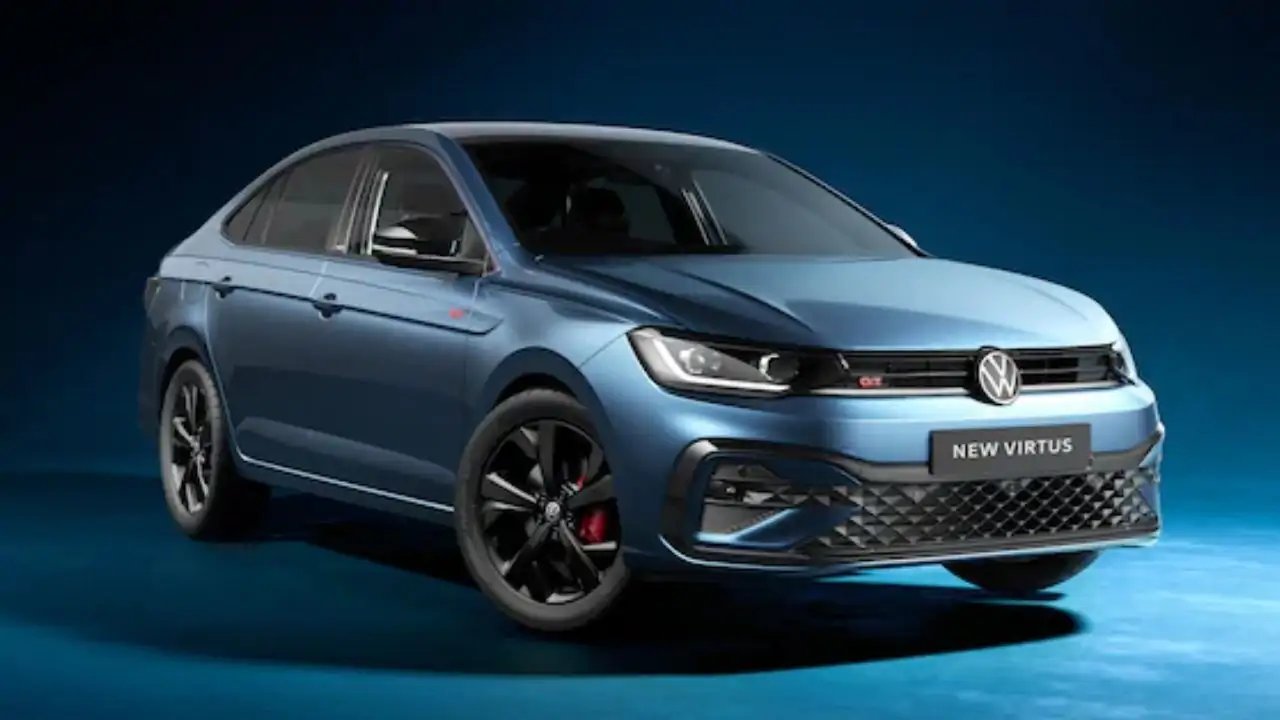
Midsize sedan buyers hunting for German engineering just received fresh ammunition. Volkswagen has taken the wraps off the Virtus facelift in India, updating its flagship volume four-door with sharpened visual accents, revised safety hardware, and an overdue transmission overhaul. The update marks the sedan's first major styling and equipment refresh since its domestic launch in June 2022.
Curb appeal matters. The updated front end swaps out the old lower apron for a sharper mesh-style air dam, paired with downsized fog lamp housings and revised internal lighting signatures. While the primary headlamp shells keep their signature contour, the internal elements look noticeably tighter. Around the back, Volkswagen reshaped the rear bumper and updated the LED elements embedded within the taillamp clusters. The car retains its standard 16-inch wheel sizing on fresh alloy patterns. For drivers wanting track-side swagger, the GT trim layers on gloss-black alloy wheels, bright red front brake callipers, black door mirrors, a roof finished in deep black, and a discreet lip spoiler fixed to the boot lid.
Congested city parking demands better visibility. Volkswagen answers that gripe by slotting a 360-degree surround-view camera system into the Virtus, with lenses mounted visibly beneath the wing mirrors. And that addition alone will save countless alloy rims from brutal curb rash in tight basements.
Official cabin photographs remain under wraps. The horizontal dashboard architecture will carry over unchanged, though showroom floors will see updated digital displays. Buyers can expect the continuation of the 10.25-inch configurable digital instrument cluster, backed by a revised 10.1-inch infotainment screen that integrates updated interface software alongside AI-assisted capabilities. Front seat ventilation, electric seat adjustment, wireless smartphone charging, and the single-pane electric sunroof will continue on top-tier variants.
Under the bonnet, the mechanical blueprint holds steady with two proven turbocharged petrol engines. The entry-level 1.0-litre, three-cylinder TSI motor pushes out 115hp, while the performance-focused 1.5-litre, four-cylinder TSI mill delivers 150hp. The major shift lies in the transmission tunnel. Volkswagen is dropping the venerable six-speed torque converter on the 1.0-litre engine in favour of a modern eight-speed automatic unit, providing closer gear ratios for smoother crawling in stop-and-go metro traffic. A six-speed manual gearbox stays standard on the 1.0-litre, while the punchy 1.5-litre variant retains its rapid-shifting seven-speed dual-clutch DSG.
| Engine Option | Power Output | Transmission Choices | Key Drivetrain Highlight |
|---|---|---|---|
| 1.0-litre TSI Turbo-Petrol | 115hp | 6-speed Manual / 8-speed Torque Converter Automatic | New 8-speed gearbox replaces 6-speed automatic |
| 1.5-litre TSI Turbo-Petrol | 150hp | 7-speed Dual-Clutch DSG Automatic | Performance GT specification with cylinder deactivation |
The midsize sedan territory remains a battle of endurance. While compact SUVs continue gobbling market share, the Virtus facelift gives highway drivers a grounded alternative to high-riding crossovers. Volkswagen will line the updated sedan up directly against its mechanical sibling, the Skoda Slavia, alongside established segment rivals like the Hyundai Verna and the Honda City. Official pricing and variant walk-throughs will arrive closer to the retail rollout next month.