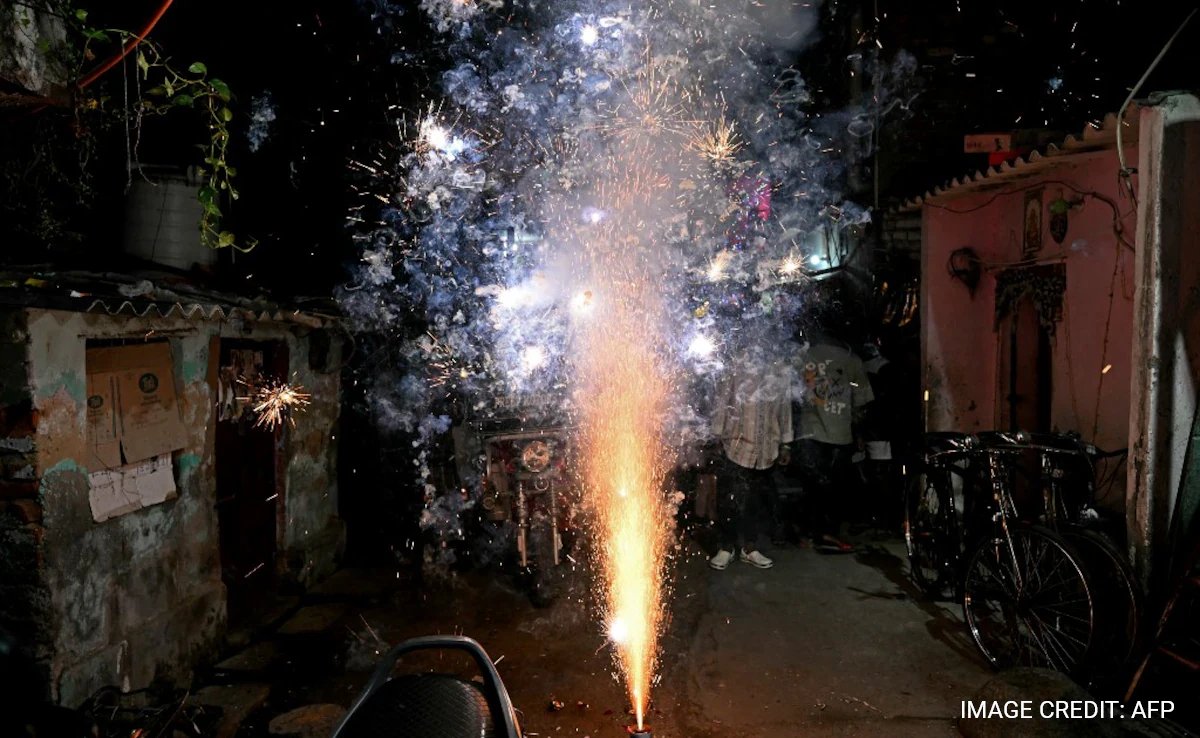
Delhi choked under a thick toxic haze during Diwali 2026 as daily average PM2.5 concentrations spiked to 257 micrograms per cubic metre, cementing the festival as the fourth most polluted day of the entire year.
Conditions worsened rapidly across the National Capital Region as stagnant winter air trapped festive smoke alongside vehicular exhaust and regional biomass emissions. Findings compiled by Dr Manoj Kumar at the Centre for Research on Energy and Clean Air (CREA) established that the festival also ranked as the fourth most polluted Diwali recorded since 2016. The days framing the celebrations offered zero respite. November 5, 6, and 7 locked in the sixth, seventh, and eighth worst air quality readings across the capital for 2026.
Yet regulatory promises of low-emission pyrotechnics collapsed on the ground.
Under guidelines established by the Council of Scientific and Industrial Research - National Environmental Engineering Research Institute (CSIR-NEERI), certified green crackers must demonstrate at least a 30 per cent reduction in particulate matter emissions compared to conventional formulations. They must also restrict specific gaseous pollutants.
But environmental researchers argue that laboratory benchmarks have decoupled from retail reality. Retail shelves across wholesale hubs routinely stock standard, toxic fireworks disguised with counterfeit packaging, illegitimate manufacturer approvals, and bogus QR codes.
Green crackers are nothing more than greenwashing. Documented evidence shows that so-called 'green crackers' rarely meet the prescribed emission thresholds. If a bureaucrat like Tukaram Mundhe were overseeing manufacturing and supervision with strict, uncompromised enforcement, maybe we could talk, but right now? It's just another term invented to throw dust in our eyes — literally.
Abhiir Bhalla, Environmentalist
The technological benchmark cannot offset runaway volume. Environmentalist Siddhant Sarang pointed out that reducing individual chemical emissions per unit fails to mitigate atmospheric hazards when consumption surges unchecked across high-density urban clusters.
"The CSIR-NEERI framework requires green crackers to demonstrate a minimum 30% reduction in particulate matter emissions compared with conventional crackers or meet prescribed combinations of particulate and gaseous emission reductions," Sarang said. "This is a meaningful technological intervention, but a reduction in emissions per cracker does not automatically translate into a proportionate reduction in overall pollution. The total number of crackers used, duration of bursting, concentration of use in particular areas, and prevailing weather conditions all matter."
| Air Quality Parameter | Recorded Metric (Delhi 2026) | Baseline / Standard Significance |
|---|---|---|
| Diwali 2026 Daily Average PM2.5 | 257 µg/m³ | 4th most polluted day of 2026 |
| Historical Diwali Rank (Since 2016) | 4th Worst Recorded | Reflects persistent festive peak shocks |
| Pre-Diwali Air Quality Index Ranks | Nov 5 (6th), Nov 6 (7th), Nov 7 (8th) | Multi-day build-up prior to main festival |
| CSIR-NEERI Target Particulate Cut | 30% Minimum PM Reduction | Rarely met due to retail counterfeiting |
The immediate health threat unleashed by firecracker emissions remains indisputable. An IIT-Delhi study conducted in 2022 revealed that pyrotechnic displays account for roughly 95 per cent of elemental PM2.5 in Delhi's atmosphere during peak celebratory windows. The concentrated pulse pushes the city's air quality indices beyond measurable scales overnight.
But researchers caution against using festival smoke to obscure structural policy failures that poison northern India throughout the calendar year. Stubble burning across adjoining agrarian belts generates seasonal outrage, yet scientific data demonstrates that vehicular exhaust, unpaved road dust, and uncurbed industrial zones across the regional airshed form the steady, lethal baseline.
"We need to stop treating firecrackers as the sole alpha and omega of our air pollution crisis, but we also shouldn't downplay their immediate devastation," Bhalla stated. "Firecrackers cause massive, concentrated toxic spikes right after festivals like Diwali, shooting PM2.5 levels off the charts overnight. However, science and data tell us that Delhi's crisis is a year-round, regional fossil-fuel and governance problem."
The Supreme Court of India previously declined to impose a total national blanket ban on pyrotechnics, opting instead to permit certified green crackers during restricted windows while delegating enforcement powers to municipal bodies and state police. On the streets, that enforcement fractured entirely. Midnight bursting went largely unpenalised in densely populated sectors across Delhi, exposing an institutional vacuum between top-level judicial mandates and local beats.
Public health advocates and regional authorities now face an immediate deadline to overhaul compliance protocols before winter temperature inversions lock particulate matter against the ground through the remainder of the seasonal cycle.
| Peak Firework Share of Elemental PM2.5 | ~95% (IIT-Delhi 2022 Benchmark) | Dominant driver of short-term toxic spikes |