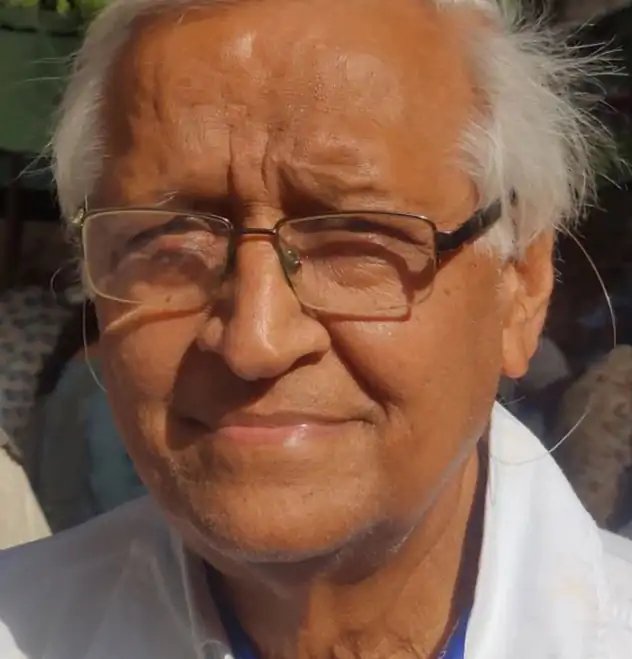
Sanjit Bunker Roy, the pioneering social activist who turned an arid Rajasthan village into a global model for rural self-reliance, died on Tuesday morning at his home in Tilonia. He was 81.
Roy breathed his last at 6:15 am. His wife, renowned social activist Aruna Roy, sat at his bedside alongside close colleagues and village workers who lived alongside him for decades. The Social Work and Research Centre, known worldwide as Barefoot College, formally announced his passing from Tilonia in Ajmer district.
"He went peacefully as he wanted to in his own home in Tilonia, surrounded by Aruna and some of the countless people who loved and cared for him deeply," the institution said in a public statement.
His funeral takes place in Tilonia at 4 pm on Tuesday.
Roy spent over 50 years proving that formal degrees hold no monopoly on practical human intelligence. He rejected conventional elite circles to anchor his life in rural Rajasthan, building an enterprise that equipped non-literate grandmothers with technical mastery.
Roy's detour from privilege began early. An alumnus of St. Stephen's College and an accomplished squash player, he abandoned a comfortable career track after witnessing the horrors of the 1966–67 Bihar famine. The starvation he saw shook him.
In 1967, he packed his bags and headed into rural north India to work with farming communities. He reached Tilonia, a parched tract in Ajmer, and teamed up with a local farmer named Meghraj. Together, the two men dug open wells across the drought-prone terrain to recharge plunging groundwater tables. Manual labor replaced academic theory.
Five years later, in 1972, Roy formalized that ground-level experience by establishing the Social Work and Research Centre. The institution quickly shed bureaucratic labels, adopting the moniker Barefoot College. The governing premise was simple: rural men and women possessed the indigenous knowledge required to solve their own crises without urban intermediaries.
In the mid-1970s, his wife Aruna Roy resigned from the Indian Administrative Service to join him permanently in Tilonia, forming one of India's most influential civil society partnerships.
Roy anchored Barefoot College strictly in Mahatma Gandhi’s doctrines of local self-governance and manual labor. He bypassed traditional diplomas entirely, hiring teachers, engineers, architects, and medics from the local community based solely on practical ability.
His flagship endeavor trained illiterate and semi-literate rural women—affectionately known as "Solar Mamas"—to fabricate, install, and service solar-powered lighting systems. Women who had never stepped foot inside a classroom mastered circuitry, soldering tools, and charge controllers through color-coded schematics. They carried electricity to thousands of remote, un-electrified settlements.
The solar initiative quickly broke beyond Indian borders. Barefoot College flew in grandmothers from developing nations across Africa, Latin America, and Southeast Asia, training them in Tilonia before sending them home to electrify their own villages.
Roy also started night schools across rural pockets so children from grazing families could study after daytime cattle herding duties ended. Rainwater harvesting setups spread across schools, while localized health and craft initiatives insulated villagers from predatory commercial middlemen.
| Milestone | Historical Detail |
|---|---|
| Academic Background | St. Stephen's College graduate, national squash champion |
| Defining Catalyst | Relief volunteer work during the 1966–67 Bihar famine |
|---|---|
| Groundwork in Tilonia | Digging recharge wells with local farmer Meghraj in 1967 |
| Institution Founded | Social Work and Research Centre (Barefoot College) in 1972 |
| Landmark Programs | 'Solar Mamas' engineers, village night schools, rainwater collection |
| National Policy Input | Tech missions on water, literacy, and immunisation under Rajiv Gandhi |
Condolences poured in across the political spectrum as news of Roy's death spread across Rajasthan and New Delhi.
Congress general secretary Jairam Ramesh framed Roy as an institutional pioneer who built an entire generation of grassroots workers. He pointed to Roy's pivotal role during the administration of former prime minister Rajiv Gandhi, where Roy helped draft voluntary organizations directly into central development programs. Roy pressed technical solutions into primary state delivery mechanisms, concentrating heavily on rural drinking water, adult literacy drives, and infant immunisation programs.
In later years, he would smilingly say that he was recognised as being the husband of the legendary Aruna Roy.
Jairam Ramesh, Congress General Secretary
Congress MP Shashi Tharoor, Roy’s junior from St. Stephen's College, hailed his ability to break intellectual elitism.
His extraordinary vision of training rural grandmothers into 'Barefoot Solar Engineers' illuminated thousands of off-grid homes across India and the developing world.
Shashi Tharoor, Member of Parliament
Former Rajasthan Chief Minister Ashok Gehlot recalled visiting Roy recently in Tilonia, noting that Roy spent his life translating Gandhian philosophy into concrete rural prosperity. Former Deputy Chief Minister Sachin Pilot echoed that sentiment, emphasizing that Roy altered the social trajectory of thousands of marginalized village households.
Following Tuesday's final rites at 4 pm, the administrative leadership of the Social Work and Research Centre in Tilonia will continue operating its rural campuses, water projects, and international training cohorts under its existing governing council.