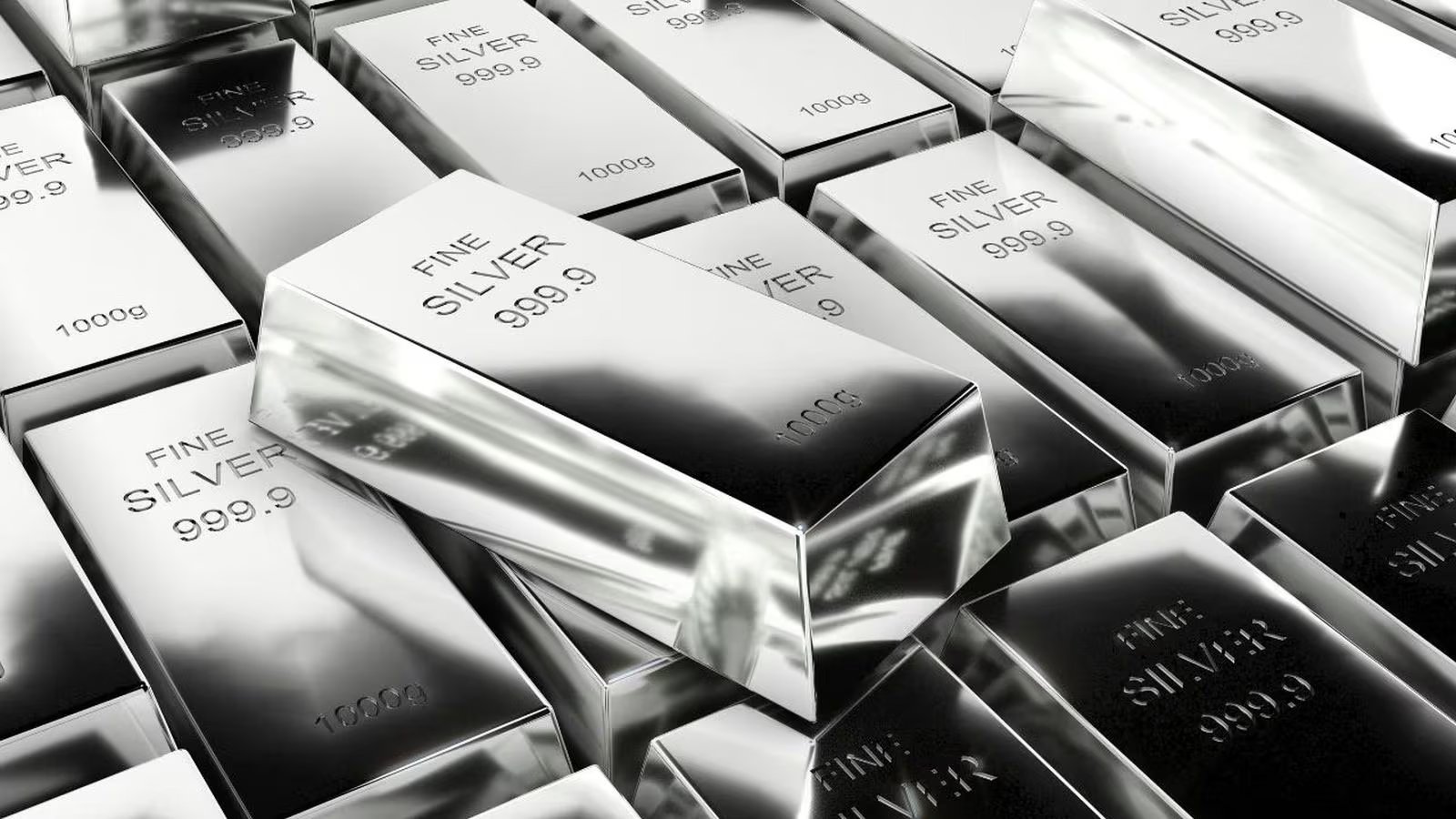
The unwind was brutal. After touching a record high of ₹4,29,000 per kilogram earlier this year, domestic silver prices have collapsed more than 57%, settling into a subdued band between ₹1,77,000 and ₹1,82,000 in November.
International spot prices tell an identical story of speculative exhaustion. Silver peaked at an unprecedented $122 an ounce in January, riding an aggressive retail and institutional wave that began when the metal traded at $71 at the start of the year and $30 on January 1, 2025. Yet the triple-digit valuation cracked within weeks. Prices tumbled to $57 an ounce by June, slipped to $54 by October, and briefly breached $48 before steadying near $50 to $51.
Resistance at $50 remains fierce.
The sell-off stems from a structural realignment in physical and financial demand rather than routine profit-taking. Technological shifts across photovoltaic manufacturing delivered a severe blow, cutting silver consumption in the solar panel sector by 19% as manufacturers thrusted lower-cost substitutes into cell designs.
Industrial headwinds did not stop at green energy. A sharp pullback across artificial intelligence and technology equities spilled into industrial metals, cooling order books for high-grade silver components. Simultaneously, moderating factory output in China weakened baseline physical intake across Asian supply chains.
Then came the leverage trap. Escalating margin hikes across major commodity bourses forced automated liquidations and margin calls on leveraged longs. As speculative positioning unraveled, exchange-traded fund redemptions accelerated, feeding secondary market liquidity back into a market that lacked sovereign or physical support.
Market Context: A surging US dollar index and stubbornly high sovereign bond yields raised the carry cost of holding non-yielding hard assets, transforming dollar-denominated bullion from a haven into an expensive balance-sheet burden.
Institutional desks across Wall Street and Europe are now recalibrating terminal valuations. Consensus has formed around one firm boundary: the brief era of triple-digit silver is over for the foreseeable future.
Commerzbank staked out the most aggressive projection on the street, modeling an upper ceiling of $95 an ounce. Metals Focus penciled in an average target of $84.50, while Goldman Sachs set an operational trading corridor between $63 and $84. Citi strategists outlined an average target of $75 within a broad $65-to-$95 channel, tracking ongoing industrial re-stocking cycles.
UBS expects the metal to trade near $80. European majors HSBC and Deutsche Bank took a more restrained stance, anchoring their price expectations in a tight range of $68 to $70. JPMorgan anchored the conservative end of the institutional spectrum, projecting silver to average just $63 to $64 an ounce.
| Institution / Research Desk | 2026 Price Target ($/oz) | Desk Outlook |
|---|---|---|
| Commerzbank | $95.00 | Peak Bull Case |
| Metals Focus | $84.50 | Sector Average |
| Goldman Sachs | $63.00 – $84.00 | Wide Trading Band |
| UBS | $80.00 | Range Projection |
| Citi | $75.00 ($65.00 – $95.00) |
Indian trade mirrored the offshore collapse point-for-point. The contract opened the calendar year at ₹2,00,000 per kg—itself double the ₹1,00,000 level logged on January 1, 2025—before parabolic buying thrust quotes to the historic ₹4,29,000 crest.
The reversal proved merciless. Sustained liquidation took hold by May, and by June, contracts violated the ₹2,00,000 floor to hit ₹1,94,000.
Now trading less than half its peak, silver faces a lengthy consolidation phase as commercial fabricators, bullion dealers, and industrial consumers recalibrate procurement strategies against elevated borrowing costs and realigned factory demand.
| Mid-Cycle Target |
| Deutsche Bank | $68.00 – $70.00 | Baseline Projection |
| HSBC | $68.00 – $70.00 | Baseline Projection |
| JPMorgan | $63.00 – $64.00 | Conservative Band |