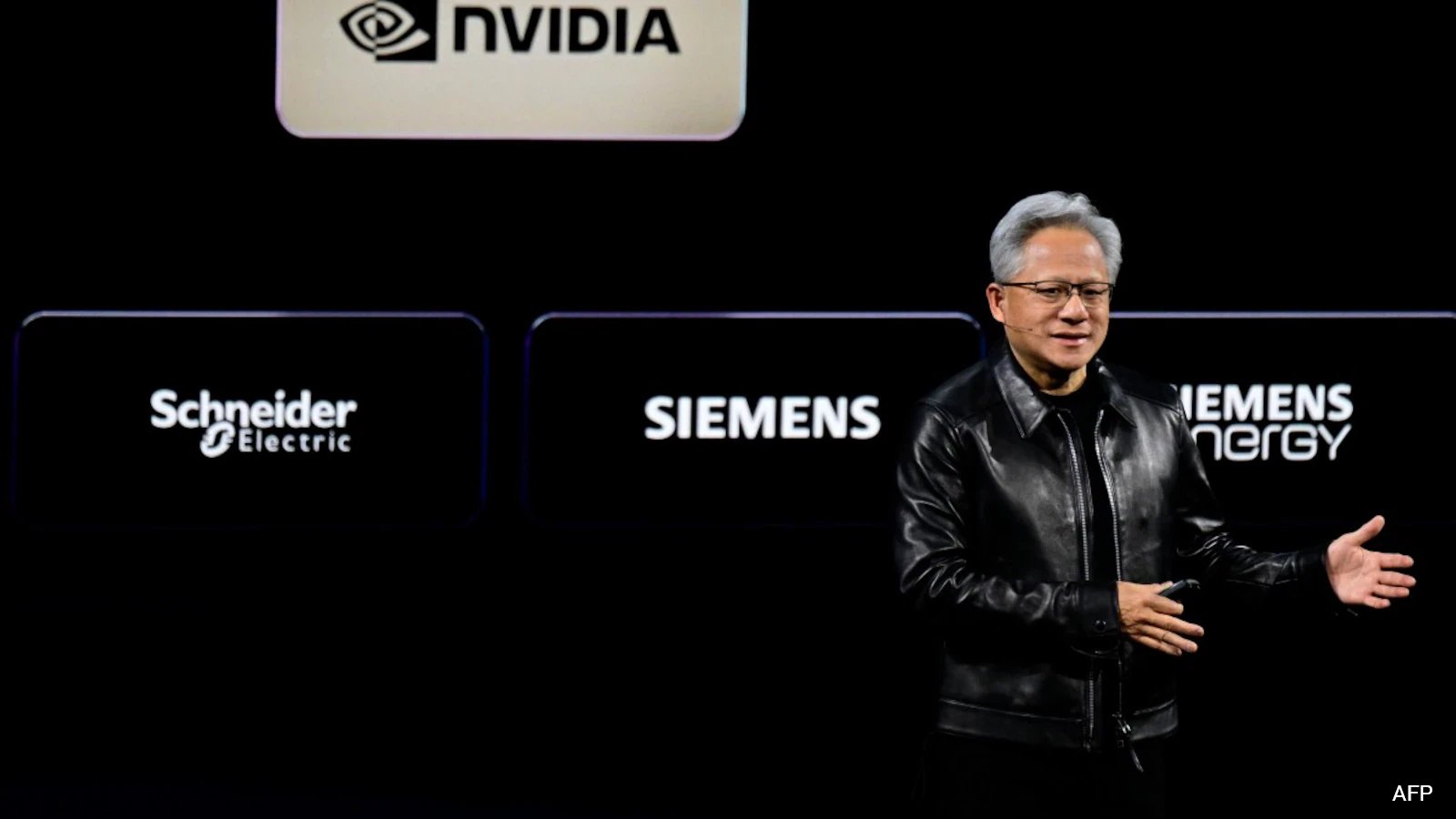
Jensen Huang resigned Thursday as chief executive and board member of Nvidia, ending a 33-year reign over the $4.5 trillion silicon colossus he co-founded in a Silicon Valley diner.
Nvidia offered no official explanation for the sudden departure. The exit followed 14 days of furious public controversy and months of quiet pressure in Washington, where an alleged personal relationship crossed into federal counterintelligence scrutiny. US officials believe the woman involved operated on behalf of Chinese intelligence—an allegation China's foreign ministry swiftly rejected as "purely unsubstantiated and directed at smearing China." Huang surrendered control of the world's most valuable company virtually overnight. Finance Chief Colette Kress stepped in as interim leadership to steady operations.
The shock departure rattled global semiconductor markets.
Huang, 63, built Nvidia into the undisputed bedrock of generative artificial intelligence from absolute scratch. Born in Taipei in 1963 as Jen-Hsun, he spent his early childhood in Thailand before his parents dispatched him and his brother to the United States. An uncle had recommended a boarding school in rural Kentucky, believing it to be a prestigious academy. It was an institution for troubled youth.
Too young for official enrollment, Huang boarded on campus while attending a local public school alongside the children of tobacco farmers. Bullies targeted him. He spoke little English and spent his afternoons scrubbing dormitory toilets.
But he endured. "We worked really hard, we studied really hard, and the kids were really tough," Huang recalled of that era. "The ending of the story is I loved the time I was there."
Hungry for stability, his family regrouped in Oregon. Huang bussed tables and washed dishes at a local Denny's, joined his high school computer club outside Portland, and completed an electrical engineering degree at Oregon State University at age 20. There, he met his wife, Lori. Technical stints designing microprocessors at AMD and LSI Logic followed.
In 1993, Huang gathered two engineer friends at a Silicon Valley Denny's booth. Armed with just $40,000, they wagered that personal computers needed specialized chips capable of rendering complex 3D graphics.
Nvidia invented the Graphics Processing Unit, or GPU, in 1999. First deployed to power hyper-realistic video games, those massive parallel calculation engines proved decades later to be the irreplaceable engines behind generative AI platforms like ChatGPT and Claude. Tech giants queued up for allocation. Nvidia commanded profit margins north of 70 percent, locking in a virtual monopoly over cutting-edge machine-learning hardware.
By financing its own enterprise clients and backing startups that purchased its hardware, Nvidia forged an intricate commercial web that accelerated the global AI boom while consolidating its market dominance.
| Financial & Corporate Metric | Official Status / Valuation |
|---|---|
| Company Enterprise Value | $4.5 Trillion |
| Co-Founder Initial Capital (1993) | $40,000 |
| Huang Estimated Personal Wealth | ~$160 Billion |
| Huang Nvidia Equity Stake | 3.6% to 4.0% |
| Hardware Gross Margin Baseline | Exceeding 70% |
| Interim Corporate Stand-In | Colette Kress (Finance Chief) |
Huang transformed himself alongside the business. Once an obscure engineering executive, he spent the last four years packing stadiums worldwide, clad invariably in a trademark black leather jacket over a black T-shirt, sporting an Nvidia logo tattooed on his arm. His personal fortune swelled to approximately $160 billion, anchored by an equity stake between 3.6 and 4 percent.
Taiwan treated him like royalty. Crowds swarmed his night-market strolls and visits to TSMC founder Morris Chang, whose foundries fabricate Nvidia's flagship silicon.
Yet inside the executive suite, Huang drove his ranks with relentless intensity. Former lieutenants describe a fierce leader who protected his teams yet tore flawed presentations to shreds, hammering home a permanent corporate gospel: "The company is always 30 days away from going out of business."
The company is always 30 days away from going out of business.
Jensen Huang, Co — Founder and Former CEO, Nvidia
Huang stepped aggressively into foreign policy when the Biden administration imposed sweeping chip export bans in late 2022 to restrict Beijing's military modernization. Huang pushed back publicly, warning that locking American hardware out of China would severely damage domestic technology research. Later, he forged ties with Donald Trump ahead of his second term, frequenting the White House and Mar-a-Lago to safeguard semiconductor supply chains.
Market Context: The leadership void at Nvidia strikes at the center of the US-China technology cold war. With export rules tightening and Washington viewing supercomputing silicon as vital national defense infrastructure, any leadership disruption at the sole supplier of tier-one AI chips directly impacts hyperscale data centers, sovereign defense programs, and Wall Street capital flows.
Nvidia's board must now decide whether to appoint an internal successor or mount an external search to guide its $4.5 trillion enterprise through intensifying national security oversight.