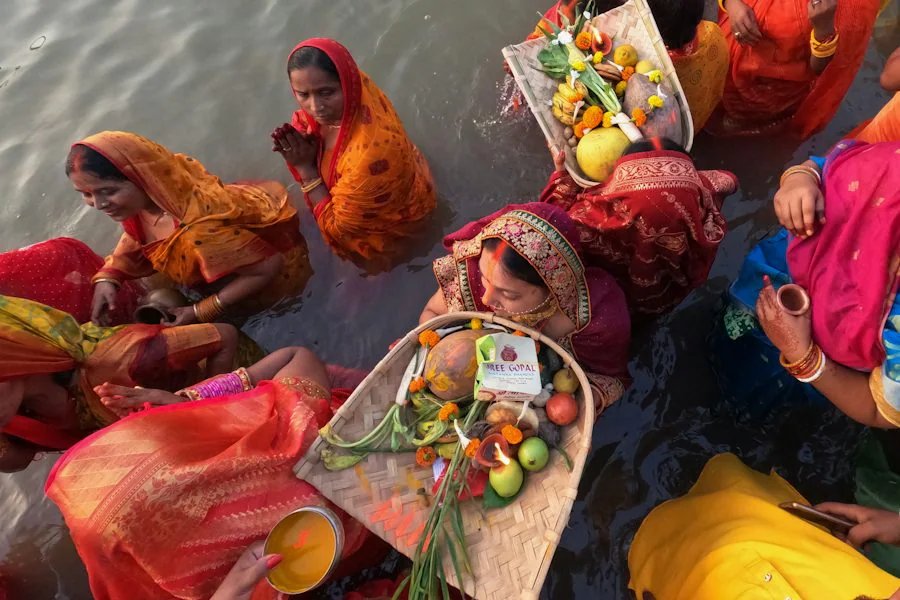
None of Delhi's Yamuna ghats meet basic bathing water standards.
Pollution monitoring records from the Delhi Pollution Control Committee (DPCC) confirm that all seven major riverside sites designated for Chhath Puja fail central environmental safety benchmarks. On November 15, tens of thousands of devotees will enter the river at dusk to offer arghya to the setting sun, returning before daybreak on November 16 for dawn prayers. Yet the chemical and bacterial reality awaiting them downstream is brutal. Untreated municipal sewage, industrial effluents, and rotting biological waste dominate the riverbed across most of the capital.
The Centre's environmental mandate sets biological oxygen demand (BOD)—the primary yardstick for organic pollution and sewage loading—at 3 milligrams per litre (mg/L) or lower for safe outdoor bathing. Faecal coliform, the bacterial footprint of human and animal waste, carries a desirable baseline below 500 units and a hard ceiling of 2,500 units. High faecal coliform counts turn sacred river dips into direct vectors for cholera, typhoid, acute diarrhoea, hepatitis A, and severe dermatological infections.
A stark geographical boundary slices the Yamuna into two entirely different rivers at Wazirabad. Above the barrage, water quality hovers near acceptable safety thresholds. Below it, the river dies.
Between Palla, where the river enters Delhi from Haryana, and Wazirabad, three upstream locations—Shyam Ghat, Sonia Vihar, and Sur Ghat—offer the least degraded water. DPCC tracking logs show BOD levels along this stretch staying between 2 and 4 mg/L, while faecal coliform remains within the 2,500-unit ceiling. But even here, clean status remains out of reach. At the Wazirabad monitoring station, BOD sits at 4 mg/L—a full 33 percent over the statutory limit—and faecal coliform touches 1,300 units, more than double the ideal health baseline.
Then comes the rupture. A massive municipal drain empties into the Yamuna immediately downstream of Wazirabad, unleashing untreated municipal sewage into the mainstream.
Past the drain, water metrics deteriorate violently. At the DPCC's ISBT Bridge monitoring station, BOD shoots up from 4 to 30 mg/L—ten times the permitted ceiling. Faecal coliform explodes from 1,300 to 35,000 units. At Vasudev Ghat and Nigambodh Ghat near Kashmere Gate, bacterial counts stand at 14 times the maximum legal limit. The water is effectively raw domestic runoff.
Further south, ITO Chhath Ghat sits 200 metres from the ITO Bridge station, while Kalindi Kunj lies 350 metres from the Okhla Barrage. Bacterial counts at both locations remain seven to eight times higher than safe limits. Kalindi Kunj presents the most severe visual hazard in the capital: massive banks of pungent, white toxic foam blanket the river's surface. Stagnant pools trapped behind the barrage gates, paired with dense weed infestations, accelerate chemical accumulation.
| Ghat / River Location | BOD Level (Limit: ≤ 3 mg/L) | Faecal Coliform (Limit: ≤ 2,500) | Compliance Status | Official Risk Profile |
|---|---|---|---|---|
| Sur Ghat (Wazirabad) | 4 mg/L | 1,300 | Non-compliant (Marginal) | Low oxygen depletion; moderate bacterial exposure |
| Shyam Ghat & Sonia Vihar | 2 to 4 mg/L | Within 2,500 limit | Non-compliant (Marginal) | Clearest upstream water; lower infection risks |
| Vasudev & Nigambodh Ghats | 30 mg/L |
Satellite telemetry from the European Space Agency's Sentinel-2 constellation recorded throughout October confirms this structural breakdown. Spectral analysis shows that the three upstream sites register clean surface water signatures and low algal density. But below Wazirabad, water murkiness surges and algal spectral intensity triples. This explosion traces directly to sewage-borne nutrients—phosphate levels jump eightfold between Wazirabad and the ISBT Bridge. As these massive algal blankets die and rot, they strip dissolved oxygen out of the water column, suffocating the aquatic ecosystem.
With the opening evening arghya set for sunset on November 15, civic authorities face an unyielding deadline to deploy water misting guns, chemical defoamers, and barricades to keep devotees safe from direct exposure to raw river froth.
| 35,000 |
| Critical Violation |
| 14x bacterial limit; severe risk of gastrointestinal illness |
| ITO Chhath Ghat | Elevated | 7x to 8x permissible cap | Severe Non-compliance | Heavy domestic waste load; elevated pathogen risks |
| Kalindi Kunj (Okhla Barrage) | Critically High | 7x to 8x permissible cap | Critical Hazard | Toxic froth layer; high weed choking and organic rot |