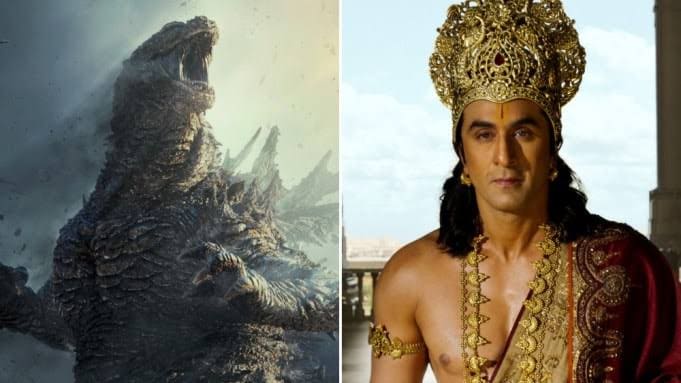
Hollywood just received an unforgiving lesson in cinematic efficiency. Takashi Yamazaki’s Godzilla Minus Zero stomped straight to the top of the North American box office, pulling in $31.6 million over its three-day opening frame. It pushed The Cat in the Hat to second place and left Nitesh Tiwari’s mythological tentpole Ramayana: Rise of a Legend eating dust down in fifth. Tiwari’s production mounted the widest North American release ever granted to an Indian film. Yet it scraped together just $8.7 million over the standard Friday-to-Sunday window, crawling to $12.2 million across an extended launch. That handed Toho’s nuclear lizard a 260% margin of victory in American multiplexes.
Numbers tell the real story here. The financial disparity makes the thrashing look absurd. Produced by Japanese legacy studio Toho and distributed across the Atlantic by GKIDS, Yamazaki crafted his kaiju spectacle on a lean $19 million budget. Meanwhile, Prime Focus Studios, DNEG, and Monster Mind Creations poured roughly $210 million into Tiwari's ancient battlefield.
| Production Metric | Godzilla Minus Zero | Ramayana: Rise of a Legend |
|---|---|---|
| Reported Budget | $19 million | $210 million |
| North America Weekend Haul | $31.6 million | $8.7 million |
| Worldwide Opening | $63 million | $55 million (approx ₹500 crore) |
| Primary Revenue Engine | International theatricals | India Domestic ($30M+ / ₹290 crore) |
Domestic loyalty spared Tiwari an outright rout. Ramayana collected approximately $55 million—roughly ₹500 crore—globally over its four-day release, powered almost entirely by Indian moviegoers who contributed more than $30 million (₹290 crore) in gross domestic collections. But overseas, Yamazaki took the crown without setting foot in South Asian cinemas. Godzilla Minus Zero posted an estimated $63 million worldwide opening. "This weekend's opening takes the Japanese production to a new level -- it's nearly three times the previous opening in Dec 2023," noted veteran box office analyst David A. Gross.
Craft explains the chasm. Set in 1949 amid the smoking ruins of post-war Tokyo, Yamazaki’s script forces a recovering nation to confront King Ghidorah, a three-headed dragon-like terror, while a radiation-regenerated Godzilla re-enters the fray. The creature combat feels tactile, grounded, and terrifyingly immediate. Sony Pictures handled international distribution for Ramayana, banking on the superstar wattage of Ranbir Kapoor as Rama, Sai Pallavi as Sita, and Yash as Ravana to pull crossover crowds. That star power set cash registers ringing in Mumbai and Bengaluru. In Chicago and Toronto, filmgoers bought tickets for the giant lizard instead.
The focus now shifts to theatrical legs and long-term recoupment. Tiwari's two-part cinematic venture will not conclude until Ramayana: Part Two arrives for Diwali 2028. But the opening salvo across the Pacific delivered a clear verdict: outsized spectacle cannot simply buy global dominance when disciplined, razor-focused genre cinema shows up to play.