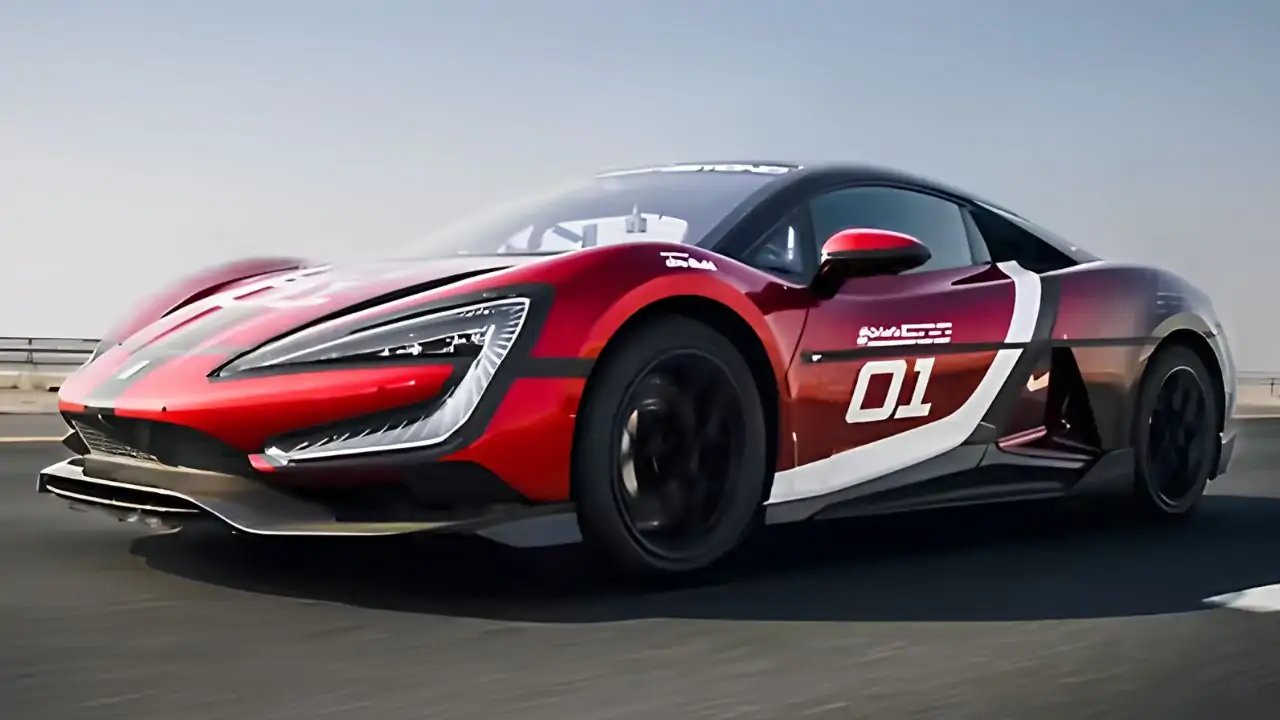
Five hundred kilometres per hour on road tyres was once fantasy. BYD just killed that debate.
During high-speed trials on a closed straight in Abu Dhabi, the Chinese automaker's Yangwang U9 Xtreme punched the speed trap at 503.17 km/h. That run earned an official Guinness World Record, breaking the car's own previous high-water mark of 496.22 km/h set in Germany in September 2025. And it makes this track special the first production automobile in history to officially crack the 500 km/h barrier.
To pull it off, the driver spent roughly sixty seconds scorching the rubber to find traction. Once the tyres bit, he pinned the throttle at half-travel until the cluster hit 380 km/h. Then came the drop of the hammer. With the pedal buried flat against the floor, the quad-motor powertrain hauled the carbon chassis to 503.17 km/h before running out of asphalt.
Make no mistake: this is not standard showroom fare. The U9 Xtreme packs four individual electric motors churning out a combined 2,977 bhp, spinning at a dizzying 30,000 rpm. That yields a power-to-weight ratio of roughly 1,200 bhp per tonne. Instead of conventional mechanical differentials, a dedicated torque-vectoring computer recalculates wheel power 100 times every single second to stop the chassis from swapping ends at runway speeds.
| Hardware Metric | Yangwang U9 Xtreme Specification |
|---|---|
| Top Speed Recorded | 503.17 km/h (Abu Dhabi, UAE) |
| Peak Power Output | 2,977 bhp (Four Electric Motors) |
| Motor Max Speed | 30,000 rpm |
| Power-to-Weight Ratio | ~1,200 bhp per tonne |
| Traction Battery | 80 kWh capacity, 30C discharge rate |
| System Voltage | 1,200V / 1,000A architecture |
| Global Production Run | Strictly limited to 30 units |
To feed that much electrical fury without melting cells, BYD fitted an 80 kWh pack engineered for a ferocious 30C discharge rate across a 1,200V, 1,000A electrical bus. Aerodynamic balance comes down to brute downforce — a carbon-fibre front splitter, deep dual-channel bonnet ducts, an aggressive swan-neck rear wing, and an underbody diffuser keep the machine suctioned to the tarmac. The platform previously logged a 6 minute 59.157 second lap around the Nürburgring Nordschleife, turning it into the first mass-produced electric supercar to dip under seven minutes.
Cool your jets if you were hoping to park one in Mumbai or Bengaluru. The Yangwang U9 Xtreme will not be sold in India. Global allocation stops at just 30 hand-built units, positioning it strictly as an engineering testbed rather than a commercial product. The clever DiSus-X active suspension seen on the standard U9 — famous for hopping over rough road imperfections — will not be landing at your neighbourhood dealership either.
Yet the technical fallout matters. BYD is using the Yangwang halo project to stress-test high-voltage thermal control and extreme pack discharge under desert ambient heat. While BYD prepares to introduce its luxury Denza sub-brand to the Indian market on November 13, that portfolio runs on distinct, passenger-focused platforms. Don't expect 30,000 rpm motors in domestic commuter crossovers, but the extreme limits being established here show how high Chinese battery engineering is currently aiming.