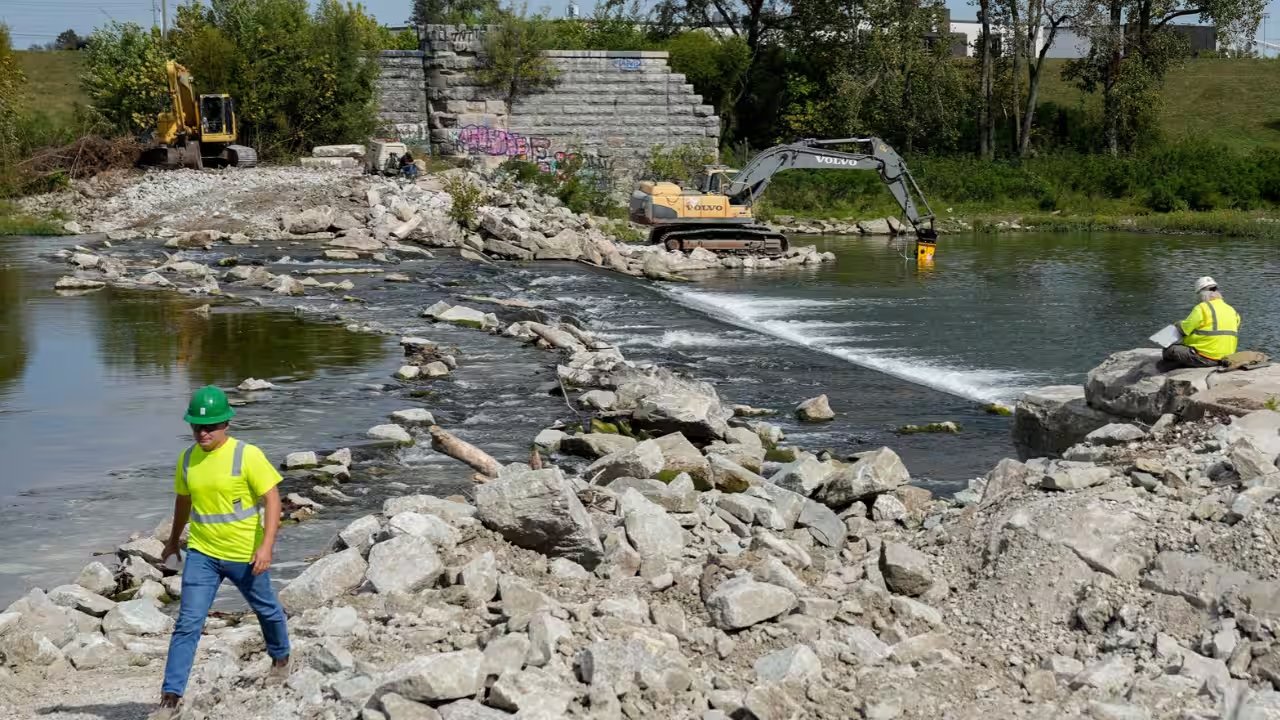
Crews have started tearing out the Emrichsville Dam, ending a 127-year blockade on the White River’s West Fork. The structure, built in 1899 to create a boating pond known as Lake Indy, sits just south of 16th Street in Indianapolis. Its removal reverses decades of artificial water conditions that trapped aquatic species downstream.
The dam never served flood control or water supply purposes. It was purely recreational. Yet its 250-foot span altered flow for 4.3 miles upstream, creating a hard barrier for fish and mussels. In October 2018, the structure partially collapsed, forcing emergency rock fills that stabilized the debris but left the ecological blockage intact.
Indiana’s freshwater mussels depend on fish to transport their larvae. Without free movement, these threatened species cannot reproduce effectively. The US Fish and Wildlife Service funded the removal with a $750,000 grant via the National Fish Passage Program, which has cleared over 3,400 barriers nationwide since 1999.
The city is keeping the two historic towers on either bank, including the locally famous Beer Tower. Preservation agencies negotiated this compromise to retain the site’s 19th-century character while eliminating the in-stream obstruction. This preserves local memory without sacrificing the river’s health.
Work wraps up on December 18, 2026. The Department of Public Works will then monitor ecosystem changes for a full year, tracking flow rates and species recovery through February 2027.