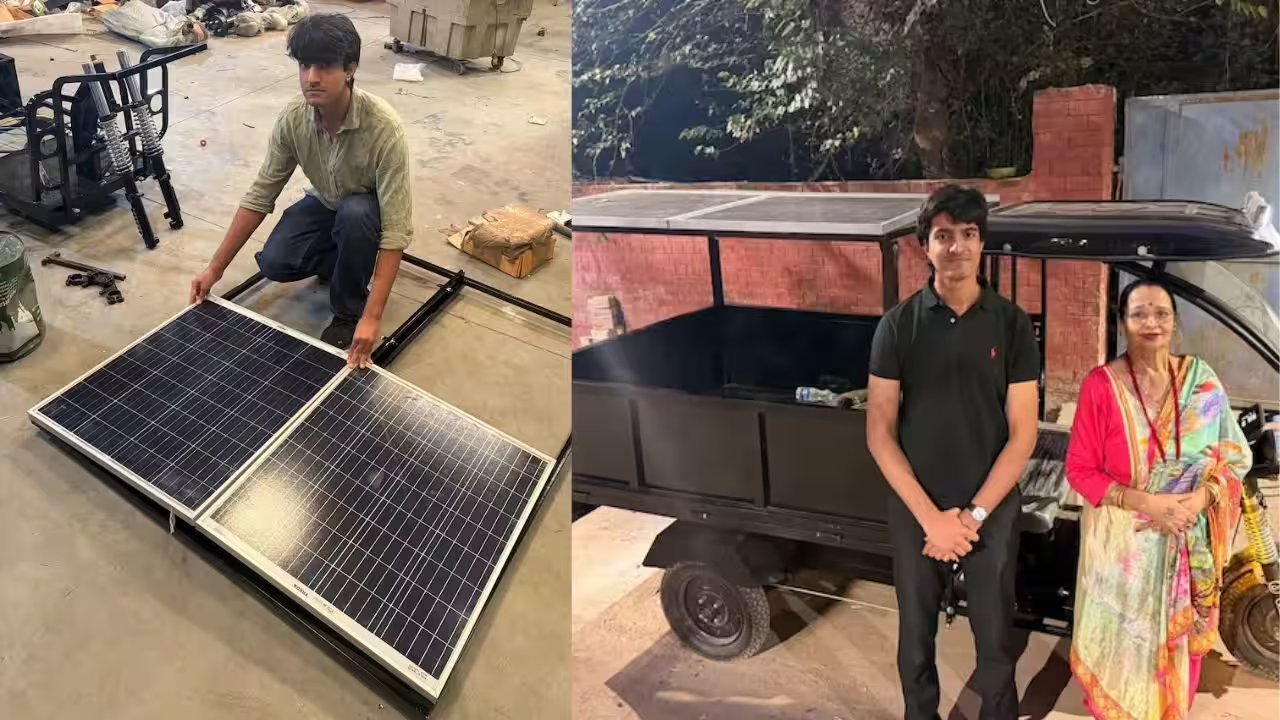
A seventeen-year-old high school student in Gurugram has engineered an electric utility three-wheeler for ₹1,02,536. The machine runs at an estimated operating expense of just 13 paise per kilometre. Built by Class 12 student Akshit Khera without an engineering garage or institutional seed funding, the prototype pairs a weatherproof two-seat cabin with a rear cargo bed and an overhead 400-watt solar panel. The design answers a basic urban survival dilemma: how blue-collar delivery drivers can afford their own wheels without sinking into debt.
The idea took shape during conversations in Khera's living room. The family of his domestic worker had relocated to Gurugram, struggling against relentless local transit fees. The husband worked as a hired cargo driver, locked out of vehicle ownership by commercial electric loaders priced between ₹1.5 lakh and ₹2 lakh. Khera spent weeks interviewing 20 transport families across the city, tracking their daily route logistics and fuel outlays. He initially sketched a fully solar-powered machine. Yet winter daylight cycles and hauling demands quickly ruled out total solar reliance—forcing him toward an efficient hybrid balance.
Khera chopped his initial ₹1.35 lakh blueprint down to ₹1,02,536 through aggressive component revisions. He hauled parts from scrap hubs in Delhi's Mayapuri automobile market, pitting quotes against each other to pocket ₹17,000 in component savings. To shed weight, he trimmed battery capacity from 5.38 kilowatt-hours down to 3.072 kilowatt-hours. Structural engineers would recognize the restraint: heavy-gauge steel tubing went strictly to critical load-bearing corners, shaving 26 kilograms off the chassis and cutting ₹2,100 from raw material costs. For the cargo bed, he abandoned plywood—which rots during monsoons—and riveted painted steel sheeting directly over the deck.
Over a dozen fabricators across Gurugram, Faridabad, and Delhi rejected the project outright. They called the design impractical. But a lone craftsman named Arun agreed to weld the frame together. When the solar panel's operating voltage mismatched Khera's initial charge controller, the teenager spent nights redesigning the electrical circuitry. As Khera observed of the setbacks, fixing miscalculations on paper cost pennies compared to junking burnt metal on the shop floor.
| Vehicle Metric | Specification / Measured Figure |
|---|---|
| Total Build Cost | ₹1,02,536 |
| Battery Pack | 3.072 kWh Lithium-Ion |
| Solar Panel Capacity | 400W (Serves as Weatherproof Roof) |
| Cargo Payload Limit | 300 Kilograms |
| Single-Charge Range | 50 Kilometres Minimum |
| Estimated Energy Draw | 2.46 kWh per 50 km |
| Projected Running Cost |
Energy calculations show the vehicle draws 2.46 kilowatt-hours to cover 50 kilometres. The 400-watt roof panel supplies an estimated 63 per cent of that electricity during a standard working day, letting grid plugs top up the balance. Solar contributions will shift with the weather: down to 41 per cent during heavy monsoon overcast, and leaping to 87 per cent under peak northern summer heat.
Khera is no stranger to vehicle mechanics. He previously handled design and fabrication for Apex Racing at the 2025 STEM Racing World Finals in Singapore, helping his crew secure the seventh-fastest average lap time against 82 international outfits. Backed by his parents, Amit and Kanchan Khera, the young builder now plans to run extended load tests across Haryana's industrial corridors to translate his working prototype into a street-legal delivery fleet.
| 13 Paise per Kilometre |