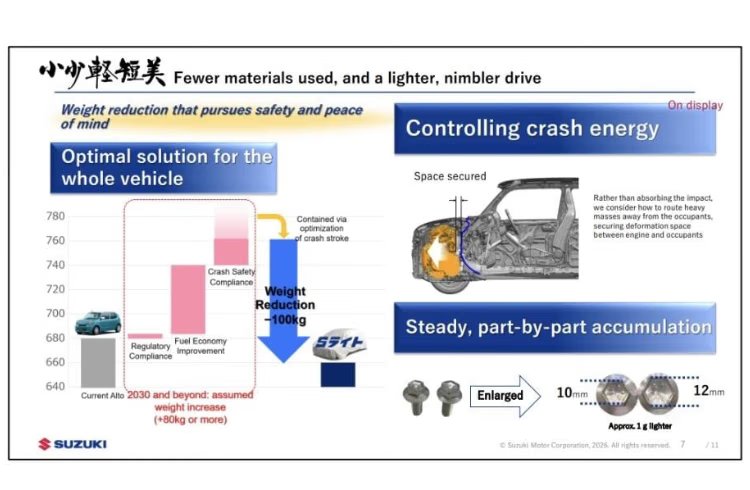
Suzuki’s latest tech briefing isn’t about a new car launch; it’s a weight‑cutting manifesto that could ripple across its future lineup. The company says it can shave 120 kg from a vehicle’s mass by 2030, with a 100 kg target already achievable. For the everyday buyer, that means lighter cars that need less energy to move, translating to lower battery costs and higher range in EVs.
The strategy hinges on rethinking crash‑deformation rather than adding steel. Engineers are moving heavy components—like the engine—forward, tweaking chassis geometry, and swapping out heavier parts for high‑strength composites. By controlling how a car crumples in a collision, the design keeps the deformation zone clear between the engine bay and occupants, satisfying safety regulators without the weight penalty of extra reinforcement.
This is a big deal because safety standards keep tightening while cars get fancier. In India, the CPCB has pushed for higher frontal‑impact crumple zones, and the Ministry of Heavy Industries has mandated stronger body‑structures for all new models. Adding steel to meet those rules typically adds 50‑100 kg, driving up cost. Suzuki’s approach keeps weight down and cuts manufacturing expenses, a win‑win for price‑sensitive buyers.
The weight‑saving trick also dovetails with Suzuki’s powertrain efficiency push. A lighter chassis means a smaller battery is needed to hit the same range, which is critical for the company’s upcoming electric Swift and Alto variants. Competitors like Hyundai and Tata are also experimenting with modular platforms and lighter alloys, but Suzuki’s holistic, cross‑departmental plan could give it a first‑mover edge.
Suzuki hasn’t tied the target to a specific model yet, but it’s clear the strategy will shape the next generation of petrol, hybrid, and electric cars. If the 100‑kg cut is realized by 2030, buyers in Delhi, Mumbai, and Bengaluru could see new Suzuki EVs that combine lower price tags with competitive 400‑plus km ranges. The company will likely roll out the first model with this weight‑reduction tech around late‑2026, with city‑wide availability following in 2027.
What to watch next: keep an eye on Suzuki’s press releases in the coming months for a model name and launch window, and check how the new weight‑cutting strategy affects battery sizing and pricing. For now, the 120‑kg promise is a headline‑making commitment that could reshape the Indian EV market.