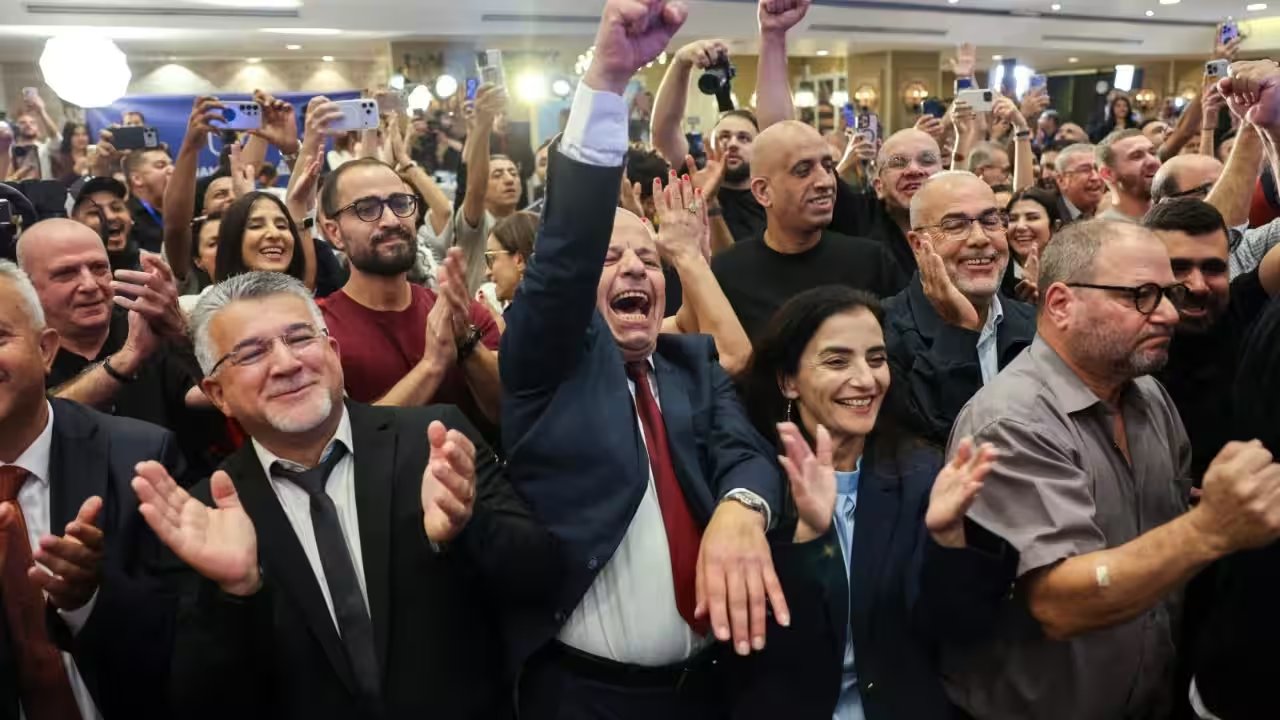
Israel’s two largest Arab parties are set to double their parliamentary presence, with the Joint List and Ra’am together expected to win 19 seats in the 120‑member Knesset—nearly twice what they hold today.
The Joint List, led by Yousef Jabareen, has projected 12 seats and is openly refusing to join an Ehud Eisenkot‑led government, citing its stance on Gaza and Lebanon. Jabareen said from his home in Umm al‑Fahm, “We will use our 12 seats to help topple Netanyahu’s government and push for a new political direction.”
Ra’am, headed by Mansour Abbas, is eyeing 7 seats and has signaled a willingness to back an Eisenkot coalition from the outside. Abbas told Israeli television that “most voters for the Eisenkot bloc want a government with Ra’am.” He also added a Jewish former police officer to the party slate to broaden appeal.
Likud, the party of former Prime Minister Benjamin Netanyahu, remains adamant that it will not negotiate with any Arab party, with spokesperson Guy Levy stating, “Not a chance.” Netanyahu’s own Likud wing repeated the stance, reinforcing a hard line against Arab coalition participation.
Historically, Arab parties have supplied outside support to governments, but Ra’am only joined a ruling coalition in 2021‑2022. The Arab citizenry—about 20% of Israel’s population—plays a major role in healthcare, with over 20% of physicians and a quarter of nurses coming from the community. A family of four from Umm al‑Fahm hopes that the new parliamentary strength will translate into better representation and services for their neighbourhood.
Coalition talks are scheduled to begin on April 3, 2026, and the outcome will hinge on whether the new Arab bloc can secure a pivotal role—either as a formal partner or as a strategic swing vote—over the next 120‑member council.