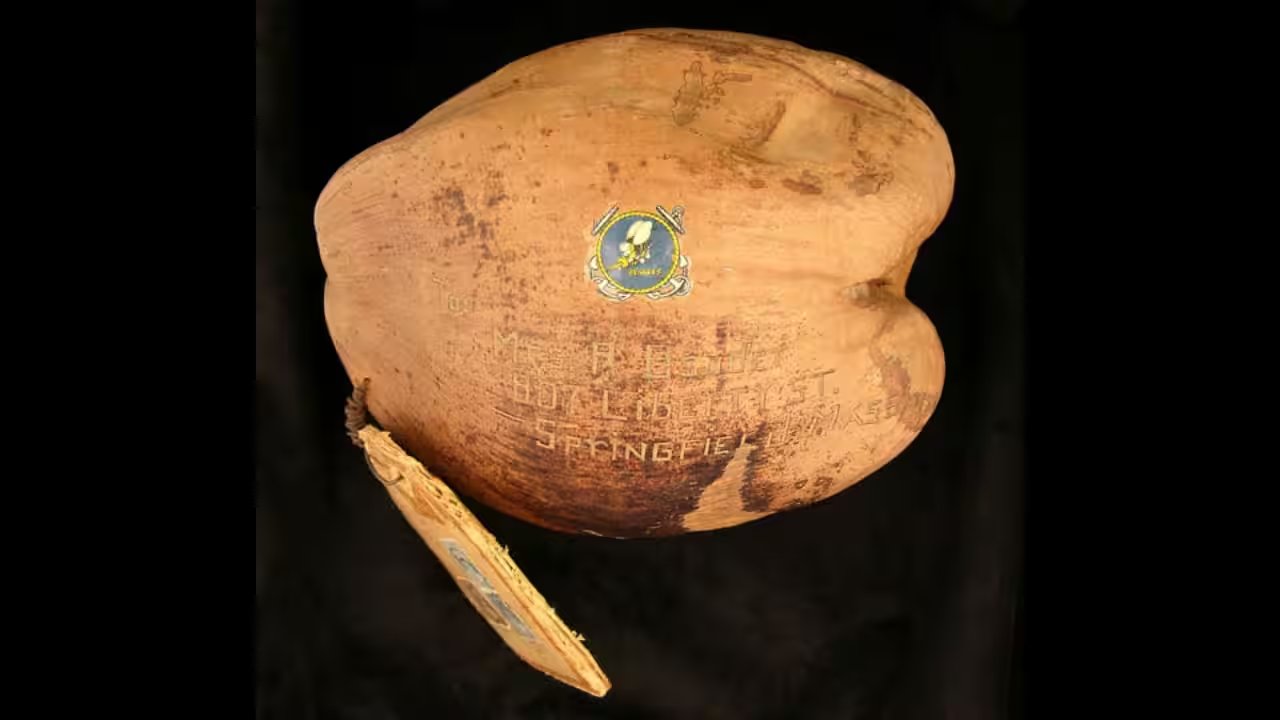
Raymond Boudet didn't write on paper. In 1944, the US Navy serviceman stationed in Hawaii carved a heart pierced by an arrow into a coconut and mailed the entire fruit to his wife, Marie, in Springfield, Massachusetts. The unconventional parcel traveled via the Fleet Post Office in San Francisco, bearing a return address that confirmed its naval lineage.
The coconut carried more than just a carved message. It featured a paper decal of a hula girl playing the ukulele and the insignia of the 99th Naval Construction Battalion, Company A. Boudet, a member of the Seabees, had spent roughly 18 months in Hawaii before deploying to Samar in the Philippines to build a hospital camp. The 37-cent postage—wired directly to the fruit—was canceled by the Navy, the Navy Censor, and the U.S. Department of Agriculture, validating a piece of mail that defied standard postal norms.
Mailing oddities wasn't unprecedented in the early 20th century. Since parcel post launched in 1913, Americans have sent everything from food to animals through the system. One notorious 1913 incident saw an Ohio couple mail their eight-month-old son to his grandmother for 15 cents, a cost lower than a train ticket. Regulators quickly banned mailing people, but coconuts remained a legal, if bulky, novelty.
Marie Boudet eventually donated the coconut to the Smithsonian's National Postal Museum. She included a note detailing the marriage that began when both were 19 in 1942. Raymond returned from the war safely, and the couple stayed together for another 53 years. The coconut outlasted the war, serving as a physical reminder of a bond that endured the distance and uncertainty of the Pacific theater.
The artifact now sits in a museum display, a stark contrast to the strawberries often associated with romance. It stands as a rare, tactile record of how ordinary people maintained personal connections while the world was at war.