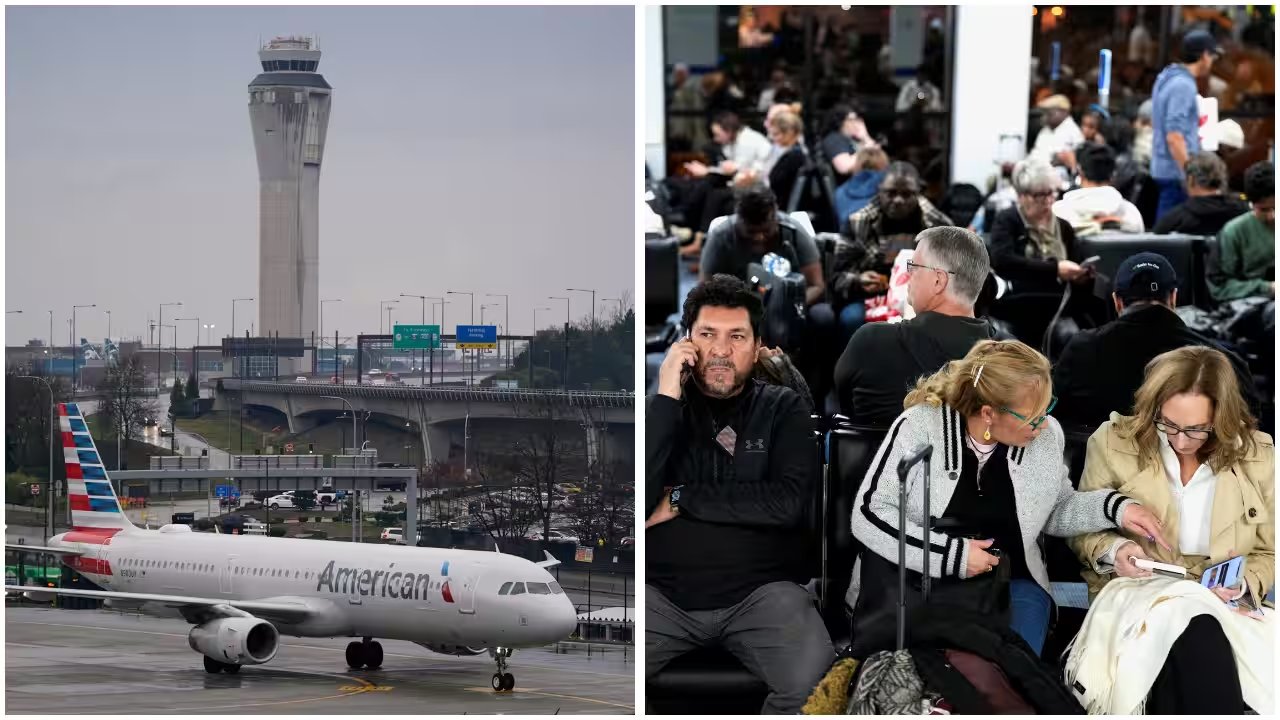
The Federal Aviation Administration grounded all commercial aircraft departures across the United States on Friday, ordering an unprecedented nationwide halt after a severe telecommunications blackout crippled 22 regional air traffic control centres. Runways froze instantly. Nearly 500 departures stalled within hours, stranding thousands of passengers aboard parked jets, gate concourses, and tarmac aprons nationwide during peak weekend travel.
The FAA justified the sweeping intervention under emergency safety protocols, confirming departures could not safely proceed while voice and data links linking regional sectors remained compromised. Aircraft already aloft when controllers issued the order were permitted to continue to their destinations, with regional controllers handling airborne traffic on a contingency basis. It marks only the second nationwide operational shutdown since the September 11, 2001 terror attacks, surpassed in recent history only by the January 2023 Notice to Air Missions system breakdown.
Preliminary assessments traced the systemwide failure to malfunctioning network routing hardware at Chicago Midway International Airport, from where corrupted data pathways cascaded outward through federal aviation telecommunications channels. Transportation Secretary Sean Duffy mobilized FAA systems engineers to dissect the network breakdown as regional control centres experienced divergent electronic disruptions. Controllers in several sectors lost essential communication channels required to transfer high-altitude flights between adjacent airspace boundaries.
Federal administrators struggled to explain the technical breach during emergency conference calls with major airline dispatchers. Facilities across different time zones reported varying degrees of failure. Yet the core directive remained absolute: wheels stayed down until technicians verified channel reliability.
| Incident Parameter | Operational Details |
|---|---|
| Regulatory Authority | Federal Aviation Administration (FAA) |
| Affected Facilities | 22 Regional Air Route Traffic Control Centres |
| Operational Impact | Immediate nationwide halt on departures; airborne flights cleared to land |
| Initial Failure Point | Network router malfunction originating at Chicago Midway International Airport |
| Historical Precedent | First nationwide ground stop since January 2023; second since September 11, 2001 |
| Investigating Agencies | Department of Transportation, FAA, DHS, FBI, National Security Agency |
Speculation of hostile interference prompted immediate reviews by national security officials at the White House. Homeland Security Secretary Markwayne Mullin moved swiftly to quell public panic, announcing that intelligence sweeps uncovered zero evidence of foreign sabotage or state-sponsored cyber operations.
There was no indication as of yet this was a nefarious attack against us. This isn't the same comparison to 9/11.
Markwayne Mullin, Homeland Security Secretary
All flights had been safely accounted for, Mullin confirmed following emergency briefings with Transportation Secretary Sean Duffy. President Donald Trump addressed the disruption directly, stating that preliminary findings pointed squarely to an internal telecommunications breakdown rather than foreign cyber intrusion or automated system failures. Specialized cyber forensics teams from the Federal Bureau of Investigation, the Department of Homeland Security, and the National Security Agency launched joint technical audits of the FAA’s network architecture to verify that public-facing connection points had not been compromised.
Aviation administrators also dismissed suggestions that the malfunction stemmed from the agency's newly deployed artificial intelligence tool, known as the System-Wide Automated Real-Time Tool (SMART). The analytical platform—engineered by technology contractor ASI near Washington, D.C., to calculate flight flows and monitor severe weather vectors—does not operate line-level hardware inside the 22 regional control centres. ASI issued an executive statement confirming the ground stop did not originate from the SMART software environment.
Technicians from the FAA and the Department of Transportation are conducting systemwide telemetry reboots across all 22 affected regional hubs to restore fail-safe redundancy. Federal officials scheduled technical milestone updates for carriers ahead of Saturday morning flight banks, while the Department of Homeland Security pledged an exhaustive post-incident architecture audit to the White House before normal operational tempo resumes.