Modern car buyers look at sprawling curved dashboards and see slick navigation graphics. Hackers see an entry gate. As digital clusters merge climate controls, steer-by-wire telematics, and over-the-air software updates onto single glass surfaces, an insecure display panel risks becoming an open door into a vehicle's core operating network. Samsung Display moved to close that threat this week, locking in two major automotive cybersecurity credentials simultaneously — an industry first.
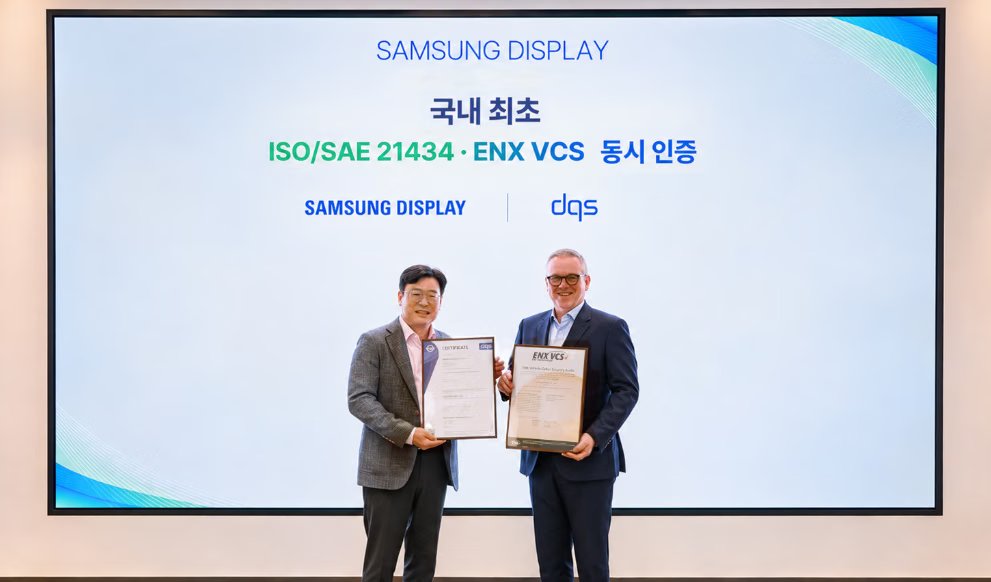
During an official handover at the Samsung Display Research facility in Yongin, South Korea, independent auditor DQS Group confirmed that the screen maker cleared both the ISO/SAE 21434 standard and the ENX Vehicle Cyber Security (VCS) label. The dual approval certifies Samsung Display’s entire automotive product lifecycle. That covers specialized engineering teams, round-the-clock threat tracking, and systematic risk assessment frameworks designed to catch vulnerabilities long before panels reach an assembly line.
The vehicle cabin has fundamentally changed. Today, the screen is an active node on the central vehicle network, not a dumb monitor wired to an analog radio. To secure it, Samsung Display ran physical teardowns and penetration tests across its automotive OLED modules, seeking out hardware vulnerabilities that remote attackers could hijack. Engineers then baked firmware safeguards and threat-mitigation protocols straight into panel blueprints. Ingo M. Rübenach, chief executive of certifying body DQS Group, noted that the industry's shift toward software-defined vehicles has transformed automaker demands, requiring suppliers to weave cyber defenses directly into design pipelines rather than bolting them on after production.
Cybersecurity now dictates who gets chosen to supply premium car cockpits. Kyung-jin Yoo, executive vice president and head of Samsung Display's mobile display development team, stated that digital resilience has become a core commercial benchmark as carmakers race toward fully connected fleets. For drivers, that means the OLED touchscreens handling driving data, instrument readings, and personal profiles carry vetted protections against data extraction and remote injection attacks.
The timing matches mounting regulatory scrutiny. The ISO/SAE 21434 benchmark establishes binding cyber risk management rules spanning every vehicle phase from initial blueprinting to final scrappage. Meanwhile, the ENX VCS label — administered by the European Network Exchange Association — audits whether suppliers actually enforce those protections on factory floors. Regulators across Europe have tightened type-approval mandates for digital vehicle architecture, forcing manufacturers to drop unverified third-tier components. By proving third-party audit compliance today, the Samsung Electronics display subsidiary guarantees uninterrupted component supply lines for premium automakers retooling their connected platforms for 2025 and beyond.