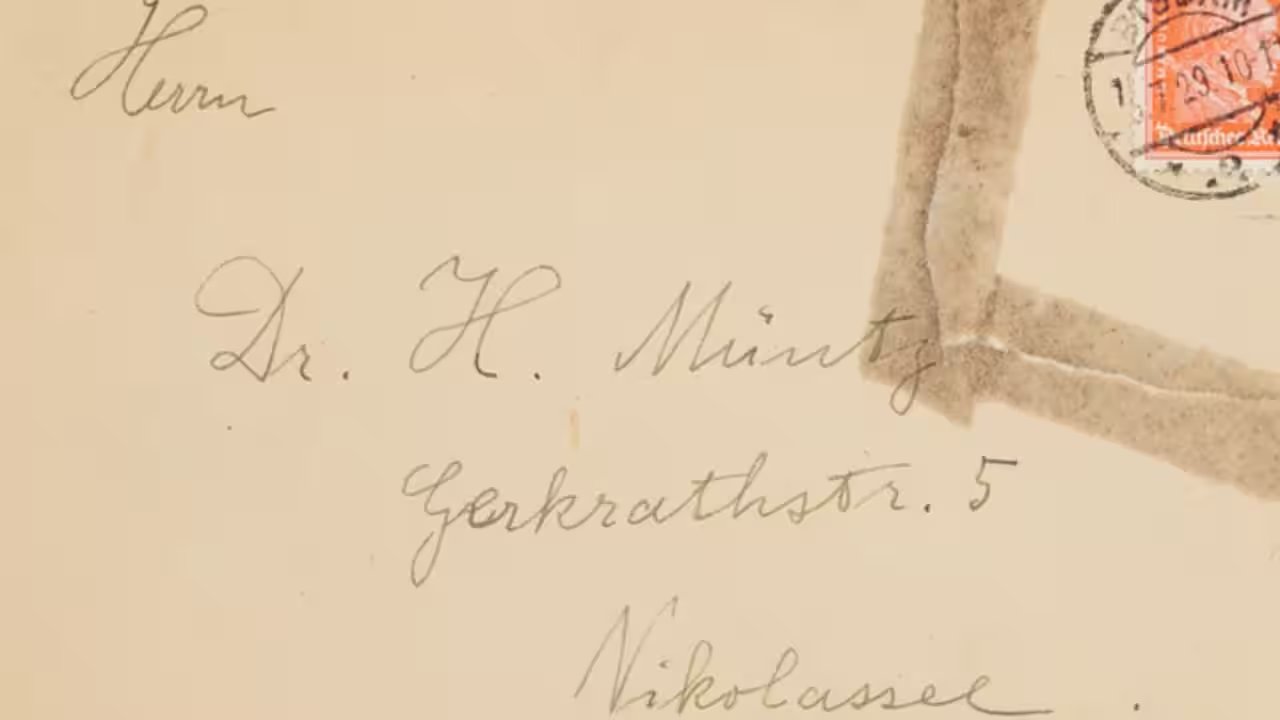
A 1929 handwritten letter from Albert Einstein explaining a complex mathematical problem to a colleague has sold for $71,811, more than tripling its pre-sale estimate. The document, which features a full page of equations and notes, was addressed to mathematician Chaim Herman Muntz and mailed from Potsdam, Germany. It went under the hammer at RR Auction, which also sold the original envelope used to send the correspondence. The final price includes the buyer's premium, significantly exceeding the house's initial estimate of $20,000 or more.
This isn't just a signed note. It's a raw, unfiltered look at Einstein's brain at work. The letter focuses on Hamiltonian mechanics, specifically examining whether certain mathematical relationships remain valid when equations are transformed. Einstein was digging into covariance and invariance—concepts that determine how physical laws hold up under different descriptions. He used Hamilton's canonical equations to map out how specific quantities in a physical system change over time, resolving a query raised by Muntz and physicist Cornelius Lanczos.
The two men had been corresponding since 1927, well before this specific letter was penned. By 1928, their discussions had shifted to "distant parallelism," a mathematical approach Einstein was testing for his unified theory of gravitation and electromagnetism. Muntz contributed key calculations on central symmetry that Einstein later acknowledged in published papers. While this particular letter doesn't directly address the unified field theory, it captures a moment where Einstein was wrestling with the foundational math that underpinned that broader ambition.
The physical document itself is 8.75 by 11 inches, written in German, and signed "A. Einstein." It contains a visible correction where Einstein crossed out the word "covariant" and replaced it with "invariant," a small but telling glimpse of his iterative process. By the end of the page, he seemed satisfied with his derivation, writing, "We probably cannot demand more than that," before suggesting Muntz apply the equation to the "problem of the rotator."
Bobby Livingston, executive vice president at RR Auction, noted that the letter’s value lies in its completeness. "What's interesting about this letter is that you can follow Einstein's calculations across the entire page," Livingston said, as quoted by Fine Books and Collection. "You can see the progression of his thinking right on the page." This item was part of RR Auction's broader Fine Autographs and Artifacts sale, which featured other historical documents, including a signature from King Edward IV.