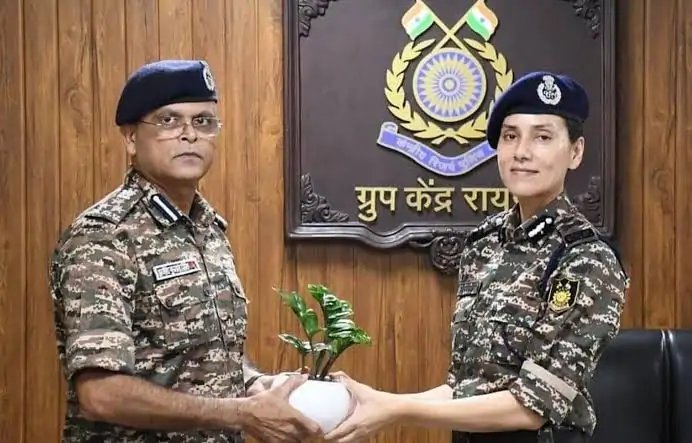
The Commando Battalion for Resolute Action, CRPF’s specialized arm for jungle warfare, now has a new boss. Sanjukta Parashar, a 2006-batch IPS officer of the Assam-Meghalaya cadre, has assumed the role of Inspector General, shattering the glass ceiling in one of the armed forces’ most demanding commands. She succeeds the 1996-batch IPS officer Danesh Rana, marking a generational handover in the unit that was raised in 2008-09 to counter Left-Wing Extremism and Northeast insurgency.
This isn't just a symbolic appointment. Parashar has earned the moniker “Iron Lady of Assam” for her aggressive, intelligence-led policing in the state’s upper regions, where she directly led operations against insurgents. Her file is thick with field experience, including a stint with the National Investigation Agency (NIA), where she handled high-stakes national security investigations. In April 2022, Union Home Minister Amit Shah personally awarded her a medal for excellence in police training while she was serving as an NIA DIG.
CoBRA is no ordinary battalions. Its personnel are drilled for guerrilla tactics in dense forests, operating in environments where standard policing fails. They conduct intelligence-based missions in areas where the state’s presence is often fragile. By placing Parashar in charge, the government is betting on a leader who has already navigated the mud, the ambushes, and the political complexities of counter-insurgency warfare in the Northeast.
Parashar’s academic background—Political Science at Indraprastha College and International Relations at JNU—complements her gritty field record. Born in October 1979, she cleared the UPSC Civil Services Examination to join the IPS in 2006. Her career trajectory, from field constable to NIA DIG to CRPF IG, mirrors the modernization of India’s internal security apparatus, which increasingly relies on specialized, combat-ready forces rather than traditional police structures.
With Parashar at the helm, CoBRA’s ongoing operations in conflict zones will likely see a sharper focus on intelligence integration and rapid response. The force faces a challenging year ahead as it continues to deploy in some of the country’s most volatile regions. The real test, however, will be whether this new leadership can maintain the unit’s operational tempo while navigating the bureaucratic corridors of New Delhi.