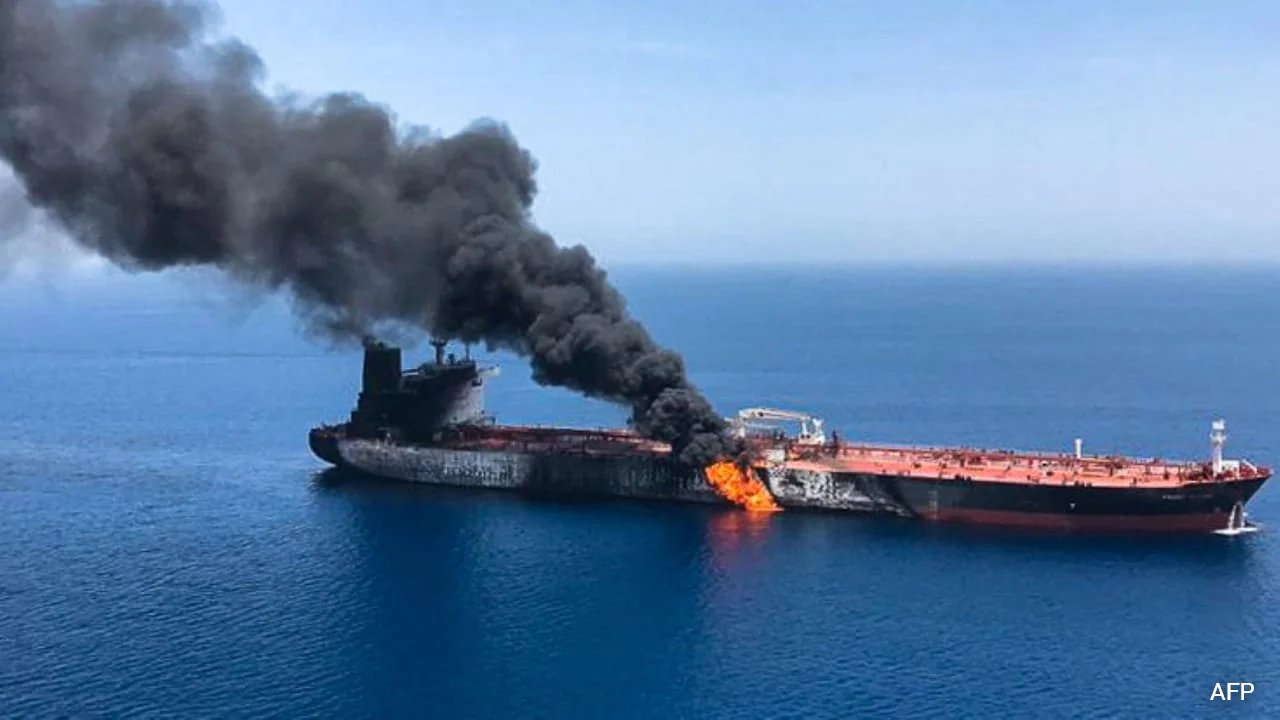
TEHRAN — Four commercial oil tankers exploded in the Strait of Hormuz after violating naval exclusion corridors, Iran's armed forces confirmed Thursday.
The chokepoint is burning again.
Iran's Islamic Revolutionary Guard Corps (IRGC) Navy confirmed that two crude supertankers were disabled by explosions on Wednesday, asserting both vessels defied repeated military warnings and steered into an "unauthorised route." State television aired maritime surveillance footage showing the hulls detonating after striking deployed naval mines. By Thursday afternoon, Iran's regular army confirmed two additional tankers struck underwater mines in the eastern stretch of the strait after disabling onboard tracking radar and entering restricted waters, triggering severe onboard blazes.
Yet the blasts expose a calculated shift in Iranian military posture.
During the initial phases of the war launched in late February, Iranian naval forces openly claimed direct missile and gunboat interceptions against commercial shipping. Tehran now frames these catastrophic strikes as passive navigation hazards, arguing foreign vessels run afoul of defensive minefields laid across the southern strait.
Allied maritime observers present a radically different account.
The United Kingdom Maritime Trade Operations (UKMTO) confirmed an inbound tanker took a direct hit from an unidentified airborne projectile approximately 14 nautical miles northwest of the United Arab Emirates port of Ras Al-Khaimah on Wednesday. The kinetic strike ignited an inferno across the ship's engine room, forcing an emergency evacuation of the entire commercial crew while salvage tugs fought back flames.
The vessel caught fire in the engine compartment following an impact from an unidentified projectile while exiting the strait. All crew members have been successfully evacuated to safety.
United Kingdom Maritime Trade Operations (UKMTO)
The naval mine strikes demolish market optimism that regional transit corridors were stabilizing. While international crude benchmarks had eased on tentative diplomatic signals between Washington and Tehran, waterborne warfare in the strait has reached its highest operational tempo of the conflict.
| Operational Parameter | Official Verification Status |
|---|---|
| Vessels Targeted (Nov 1–10) | 10 commercial tankers hit |
| October Attack Baseline | 37 documented strikes (conflict peak) |
| Primary Detonation Mechanism | Submerged naval mines & airborne projectiles |
| High-Risk Transit Zone | Southern Strait / NW of Ras Al-Khaimah |
| War Inception Date | Late February 2026 |
At least 10 commercial hulls were hit across the first 10 days of November alone, according to verified shipping data compiled by the Washington Institute for Near East Policy. That follows an unprecedented 37 maritime attacks recorded in October—the bloodiest single month for Gulf commercial shipping since combat erupted eight months ago.
Market Context: The maritime escalations unfold against an unsteady diplomatic backdrop, coming as diplomatic channels signaled potential pauses in direct US strikes if bilateral negotiations advanced. Continued disruptions across the world's most critical crude corridor threaten to reprice sovereign war risks overnight, compelling global tanker syndicates to weigh indefinite re-routing around the Cape of Good Hope.
With multiple damaged tankers adrift under tow off the Emirati coast, naval commands across the Gulf are bracing for an expanded cordon as Iranian authorities signal zero tolerance for vessels navigating without clearance.